
Buildings
Heat Pumps
The Weird Science of Heat Pumps: How Cold Air Can Heat Your Home
Can heat pumps replace fossil fuel heating? Many homes still rely on gas, oil or coal, but heat pumps offer a cleaner, more efficient alternative. They can warm homes in winter, cool them in summer, and use far less energy than boilers, furnaces or electric resistance heating. But how do heat pumps work, and what makes them so efficient? We compare air-source, ground-source and water-source heat pumps, including costs, refrigerants, installation challenges and cold-weather performance.
(Illustrated guide coming soon)
4.2overall
How this solution scores
- Impact4 / 5Replaces major emissions from oil and gas heating.
- Speed5 / 5A home can be converted in a day or two.
- Cost4 / 5Costs more to fit, then far less to run.
- Readiness5 / 5Widely installed, using the same technology as fridges and air conditioners.
- Nature3 / 5Cleaner local air, but refrigerants need careful handling.
Quiz
Question 1 of 10
Burning fuel for heating causes roughly what share of global emissions?
Score 0 / 10
Transcript
Prehistoric huts, Viking longhouses, suburban homes: humans have always loved burning things to keep them warm. Unfortunately, burning fuels for heating now accounts for around 10% of global carbon emissions [1,2], so humans will never cool the planet unless they stop playing with fire!
But what if there was another way… one that avoided burning things altogether? What if you could pull heat energy from the air, water or ground outside, warm an entire house with it, and still have enough for a hot bath?
And what if you could do it with fewer carbon emissions and lower costs than conventional heating?
Humans normally generate heat by burning things, but heat energy is everywhere: in the air, in the water, and in the ground. It might not feel like it, but even when it’s below freezing, some heat is still there. And best of all, it's free!
So how do you capture it?
Well, a clever chap called Rudolf Clausius described the basic principles of heat transfer back in the 1850s [3-8]. He showed that heat energy naturally flows from hotter spaces, like a steaming cup of coffee, to colder ones, like the winter air [9-12]. And if a glass of icy water is colder than the air, then heat will flow from the air to the glass, warming it up to melt the ice.
Like a hot cup of coffee, when you heat a home, it constantly loses warmth to the cold outside... Not ideal!
But what if you could reverse the process: pulling heat from outside into your home, even in winter. Sounds impossible, right?
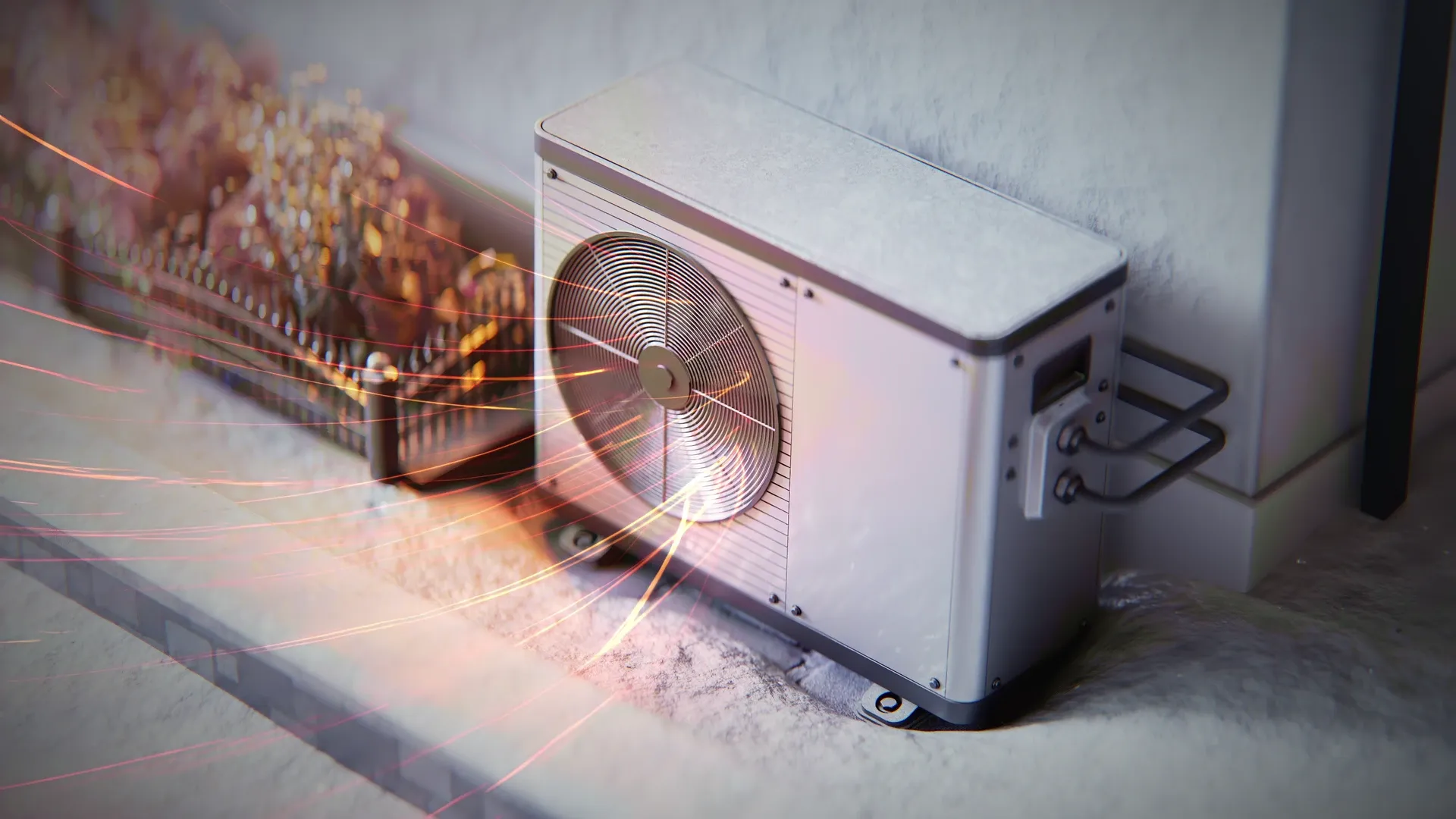
Well that's exactly what more than 180 million heat pumps are doing today [13,14]. But instead of using ice, heat pumps use an extremely cold refrigerant fluid to absorb heat from air sucked in by a fan [15-21]. Since the refrigerant fluid is even colder than the air, it easily absorbs any heat. And as it warms up, it vaporizes into a gas.
But this gas is still relatively cold, so how does it heat up a house?
Well, that’s where a compressor comes in: By squeezing the gas and its heat energy into a smaller space, it gets extremely hot [22,23,24]. And once it's hot enough, the heat flows into the house. The energy can also be transferred to a water tank to provide hot water for your radiators and steamy baths [25,26].
Finally, as it releases heat, the refrigerant condenses back into a liquid, and expands through a valve, cooling it enough to start the cycle again [15-21].
So while it seems like magic, it’s just physics.
But fans and compressors both use energy, so why not just use that energy to heat your home directly?
Well, with conventional gas or electric heating, it takes one unit of energy to generate a maximum of one unit of heat.
Heat pumps are different. Because they take heat that's already there, the same unit of energy can move 3 to 5 units of heat. This makes heat pumps 3 to 5 times more efficient than gas or electric boilers, because they move heat rather than create heat [15,18,19,20,27].
Better yet, in the summer, many heat pumps can work in reverse, providing air conditioning to keep cool! [15,16,17,20,27]
Best of all, they can cut energy costs, reduce demand for fossil fuels and reduce carbon emissions by 30% or more [28-32]. If you power them with renewable electricity, they could even eliminate the emissions from heating altogether, potentially saving billions of tons of CO2 worldwide [15,33,34].
But there are even better ways of getting heat than pulling it from the air…
Take the ground, for example: [35-37]
Not only are ground temperatures more stable throughout the year, but in winter, the ground is often warmer than the chilly air above [38-43]. So although it's costly upfront, installing pipes underground makes it easier for heat pumps to absorb heat, improving both efficiency and running costs [15,17,20,35-44].
But there's another source of heat that's even better than both the air and the ground: Water!
Since water transfers heat incredibly well, running pipes through a body of water like a large lake or pond provides a reliable source of accessible heat [45,46,47]. While installation can be just as tricky as ground source heat pumps, they can be an excellent choice, particularly for large commercial buildings [15,20,27].
Clearly, heat pumps have huge potential, but there are some drawbacks…
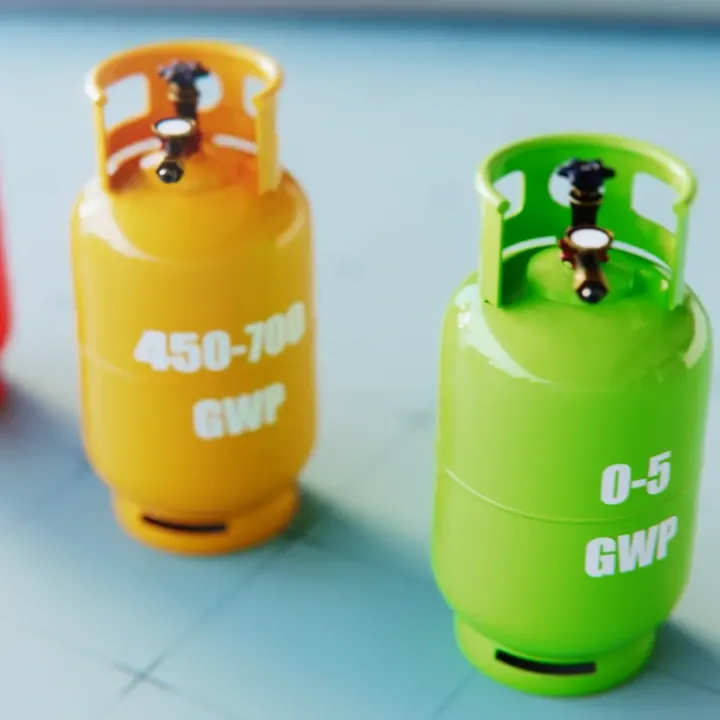
First up, refrigerant fluids: If they escape into the air, they have a powerful greenhouse effect that can be over 2,000 times worse than CO2 [27,48-52]. But with proper handling, the benefits of heat pumps far outweigh these risks [52], and new, less harmful refrigerants are already in development [27,53,54,55].
The next issue is location: not every home is heat pump-friendly. Not only do heat pumps typically need space for an outdoor unit, but to work optimally they’re best paired with modern, well-insulated homes [15,27,56,57,58].
And then there's the cost:
Installation costs can be expensive in the short term [18,59,60], but over the long term, heat pumps offer consistent savings in energy costs [15,18,61,62]. Depending on the system (and the local price of electricity), they can pay for themselves in around 5 to 15 years [63-68].
Better yet, as renewable electricity continues to get cheaper, so will the heat pumps that run on it! [69,70]
Many countries also offer grants, schemes, and subsidies that significantly reduce upfront costs, in some cases by over 90% [71-79].
Last but not least, there’s the question of extreme cold. While most heat pumps work fine in icy conditions, below -25°C they can struggle, but backup or hybrid heating systems can be used in particularly harsh winters [80,81,82].
Luckily, temperatures that low are rare, so heat pumps are suitable for most climates [83-86]. In fact, cold Scandinavian countries take the top three spots, with the most heat pumps per household in the world! [13,87,88] Thanks to clever government foresight, 60% of Norwegian homes now use heat pumps as their primary source of warmth [13,30,89].
So, with government help, a bit of planning, and the expansion of renewable electricity to power them, heat pumps could finally replace burning things for warmth, and take a huge chunk out of global emissions in the process.
Expert Advisors
3
We would like to thank
Prof. Richard Fitton
University of Salford
Professor of Building Performance School of Science, Engineering & Environment
Prof. Zhibin Yu
University of Liverpool
Chair of Energy Engineering
Prof. Rajat Gupta
Oxford Brookes University
Professor of Sustainable Architecture and Climate Change School of Architecture
Further Videos
22 links
These resources are non-affiliated.
Overview

In-Depth Look at the Role & Science of Heat Pumps
Quick Guides on Heat Pump Science, Efficiency & Installation
Real World Examples & Investigations
 I Spent 30 Days with an Octopus Heat Pump and was SHOCKED by the Running Costs!Jonathan Tracey
 Heat Pumps Explained: From Evaporation to CondensationSkill Builder (Ft. HeatGeek)
- Heat Pumps: Are They Really Worth It?UK Channel 5 (UK only)
- What They Really Mean For You - Heat PumpsBBC One (UK only)
 ITV Tonight - Saving the Planet: Saving Money?HPT Heat Pump Technologies
District Heating


Insulation


Additional Science

Further Reading
23 links
These resources are non-affiliated.
How do Heat Pumps Work?
- Heat pumps: how they work, costs and savings - Energy Saving Trust
- How are Heat Pumps Over 100% Efficient? - HeatGeek
- How Does a Heat Pump Work? UK Guide 2025 - The Renewable Energy Hub UK
- Do heat pumps work at freezing temperatures? | Heat pumps - The Guardian
- ‘You can walk around in a T-shirt’: how Norway brought heat pumps in from the cold | Energy - The Guardian
Installation Tips, Costs & Savings
- How much does an Air Source Heat Pump Cost to Install, Run and Maintain? - The Renewable Energy Hub UK
- Is A Heat Pump Cheaper Than A Boiler? Cost Comparison Guide - iHeat
- Are Heat Pumps Worth It In The UK? - The Eco Experts
- 5 Tips for positioning an air source heat pump - Heat Different
- How much can you save with a heat pump? - Octopus Energy
- Payback Periods for Energy-Saving Measures - Retrofit West
- A heat pump might be a lot cheaper than you think: here’s how - Which? News
Installation Tips, Costs & Savings — See also:
Heat Pump Types - Air, Ground, Water
- Ground source heat pumps vs air source heat pumps - Energy Saving Trust
- Geothermal Heat Pumps - US Department of Energy
- Ground Source Heat Pumps: Advantages and Disadvantages - GreenMatch
- Water Source Heat Pumps in the UK: Costs, Installation & Benefits - GreenMatch
- Water vs. Air: Understanding Heat Transfer and Its Role in HVAC Systems Design - MTS
Refrigerants
- Heat Pump Refrigerant: Types and Tips - SPRSUN Heat Pump Manufacturer
In-Depth Guides
References
93 links
- [1] Heat pumps: the core technology for sustainable heating | International Institute of Refrigeration (cites [14])
- [2] GHG emissions of all world countries | EDGAR - The Emissions Database for Global Atmospheric Research
- [3] 2nd Law of Thermodynamics | Chemistry LibreTexts
- [4] Rudolf Clausius | Thermodynamics, Heat Transfer, Entropy | Britannica
- [5] Rudolph Clausius – A pioneer of the modern theory of heat | Vacuum
- [6] On the moving force of heat, and the laws regarding the nature of heat itself which are deducible therefrom | The London, Edinburgh, and Dublin Philosophical Magazine and Journal of Science
- [7] On a modified form of the second fundamental theorem in the mechanical theory of heat | The London, Edinburgh, and Dublin Philosophical Magazine and Journal of Science
- [8] William Thomson and the creation of thermodynamics: 1840-1855 | University of Notre Dame
- [9] Thermodynamics - an advanced treatment for chemists and physicists (7th edition) | ETDEWEB | US Department of Energy Office of Scientific and Technical Information
- [10] Disorder - A Cracked Crutch for Supporting Entropy Discussions | Journal of Chemical Education
- [11] A Modern Course in Statistical Physics | Google Books
- [12] Chemical Engineering Thermodynamics | Google Books
- [13] Heating up the global heat pump market | Nature Energy
- [14] COP27: Clean heat has key role in getting a grip on climate change | European Heat Pump Association (see updates: Heat Pump Monitor 2026 – Analysis | IEA)
- [15] The Future of Heat Pumps – Analysis | IEA (see Reference Notes*)
- [16] Modern Refrigeration and Air Conditioning, 21st Edition | The Goodheart-Willcox Company, Inc.
- [17] How do heat pumps work? | National Grid Group
- [18] Heat pumps: how they work, costs and savings | Energy Saving Trust
- [19] How are Heat Pumps Over 100% Efficient? | HeatGeek
- [20] How Does a Heat Pump Work? UK Guide 2025 | The Renewable Energy Hub UK
- [21] A review of domestic heat pumps | Energy & Environmental Science
- [22] Memoirs of the Literary and Philosophical Society of Manchester | Google Books
- [23] Annales de chimie ou Recueil de mémoires concernant la chimie et les arts ... | Google Books
- [24] On the Mechanical Equivalent of Heat By James Prescott Joule | The McGraw Center for Teaching and Learning
- [25] Review of energy efficiency and system performance of residential heat pump water heaters | Energy and Buildings
- [26] A review of heat pump water heating systems | Renewable and Sustainable Energy Reviews
- [27] Decarbonizing Building Thermal Systems: A How-to Guide for Heat Pump Systems and Beyond | NLR (see Reference Notes*)
- [28] Is A Heat Pump Cheaper Than A Boiler? Cost Comparison Guide | iHeat
- [29] Heat pumps guide - Opportunities for lower carbon heating | The Carbon Trust
- [30] Executive Summary – The Future of Heat Pumps – Analysis | IEA (Executive summary of [15])
- [31] Relative CO2 emissions from the operation of air-source heat pumps compared with the most efficient condensing gas boilers by region in the Net Zero Scenario, 2010-2030 | IEA
- [32] How heat pumps and thermal energy storage can be used to manage wind power: A study of Ireland | Energy
- [33] Installation of about 600 million heat pumps covering 20% of buildings heating needs required by 2030 – Analysis | IEA (see Reference Notes*)
- [34] Net Zero by 2050 - A Roadmap for the Global Energy Sector | IEA (see Reference Notes*)
- [35] Ground source heat pumps vs air source heat pumps | Energy Saving Trust
- [36] Horizontal vs vertical ground source heat pump systems | YES Energy Solutions
- [37] Horizontal Loop vs Vertical Loop | Vitt Heating & Cooling
- [38] Ground heat exchangers—A review of systems, models and applications | Renewable Energy
- [39] Energy systems in buildings | Energy Services Fundamentals and Financing
- [40] Simulated Performance of Earthtube for Cooling of Office Buildings in the Southeast of UK | International Conference on Sustainability in Energy and Buildings
- [41] Geothermal Heat Pumps | US Department of Energy
- [42] Ground-source heat pumps systems and applications | Renewable and Sustainable Energy Reviews
- [43] General review of ground-source heat pump systems for heating and cooling of buildings | Energy and Buildings
- [44] Ground Source Heat Pumps: Advantages and Disadvantages | GreenMatch
- [45] Water vs. Air: Understanding Heat Transfer and Its Role in HVAC Systems Design | MTS
- [46] Air vs. Water: Heat Transfer Efficiency | Farr Mechanical (archived)
- [47] 2.14: Water - High Heat Capacity | General Biology (Boundless)
- [48] IPCC Global Warming Potential Values | Greenhouse Gas Protocol (see Reference Notes*)
- [49] Common Causes and Solutions for a Heat Pump Leaking Refrigerant | HVAC.com (see Reference Notes*)
- [50] Heat Pump Refrigerant: Types and Tips | SPRSUN Heat Pump Manufacturer (see Reference Notes*)
- [51] Comparison Of Selected Refrigerants Used In Domestic Heat Pumps | Greengauge (see Reference Notes*)
- [52] Heat Pump Leaks | Will Brownsberger (see Reference Notes*)
- [53] Climate-friendly alternatives to HFCs | European Commission
- [54] The next generation of refrigerants – Historical review, considerations, and outlook | International Journal of Refrigeration
- [55] Next Gen Refrigerant | Daikin America
- [56] Air Source Heat Pumps field studies: A systematic literature review | Renewable and Sustainable Energy Reviews
- [57] 5 Tips for positioning an air source heat pump | Heat Different
- [58] Heat pump retrofit in London | Carbon Trust (see Reference Notes*)
- [59] Reducing heat pump installed costs: Reviewing historic trends and assessing future prospects | Applied Energy
- [60] How much does an Air Source Heat Pump Cost to Install, Run and Maintain? | The Renewable Energy Hub UK
- [61] How much can you save with a heat pump? | Octopus Energy
- [62] Are Heat Pumps Worth It In The UK? | The Eco Experts (see Reference Notes*)
- [63] Payback Periods for Energy-Saving Measures | Retrofit West (see Reference Notes*)
- [64] Heat Pumps | Confused About Energy (archived) (see Reference Notes*)
- [65] Heat Pumps and Energy Efficiency – Making the Right Choice | Star Refrigeration (see Reference Notes*)
- [66] Water Source Heat Pumps in the UK: A Complete 2025 Guide | GreenMatch (see Reference Notes*)
- [67] How long is the payback on an Air Source Heat Pump? | Saltire (see Reference Notes*)
- [68] Igniting opportunities in the EU’s built environment | McKinsey
- [69] Lazard LCOE+ | June 2025 (In: Why did renewables become so cheap so fast? | Our World in Data) (see Reference Notes*)
- [70] What is the electricity-to-gas price ratio and why is it important? | Nesta
- [71] Boiler Upgrade Scheme | GOV.UK Find a grant
- [72] Get A Heat Pump | Heat Pumps Explained | Octopus Energy
- [73] A heat pump might be a lot cheaper than you think: here’s how | Which? News
- [74] Greece to Offer Grants for Heat Pumps in 2025 | tovima.com
- [75] ΕΞΟΙΚΟΝΟΜΩ 2025 | Greek Government
- [76] Get financial aid for energy saving intervention to your house (Exoikonomo 2025) | Greek Government
- [77] Oil to Heat Pump Affordability program | Natural Resources Canada
- [78] The Average Cost of a Heat Pump in BC | Green Building
- [79] Heat Pump Installation Cost: Average Price in Canada 2023 | The HVAC Service Solutions
- [80] Coming in from the cold: Heat pump efficiency at low temperatures | Joule
- [81] Do heat pumps work at freezing temperatures? | Heat pumps | The Guardian
- [82] Hybrid heat pumps | IRENA
- [83] Figure S2. Global terrestrial annual mean temperature for 1950-2000 (WorldClim) averaged within 0.1 degree latitudinal bands (Figure from Range-Wide Latitudinal and Elevational Temperature Gradients for the World's Terrestrial Birds: Implications under Global Climate Change | PLoS One)
- [84] FIG 5 - On the Origin of the Surface Air Temperature Difference between the Hemispheres in Earth's Present-Day Climate (Figure from On the Origin of the Surface Air Temperature Difference between the Hemispheres in Earth's Present-Day Climate | Journal of Climate)
- [85] Global Temperature - The Natural Environment | University of Hawai'i
- [86] Surface Air Temperature (Average Annual) | National Geographic MapMaker
- [87] Heat Pump Market and Statistics Report 2024 | EHPA
- [88] Which Countries Are Winning the Heat Pump Race? | Eco Experts
- [89] ‘You can walk around in a T-shirt’: how Norway brought heat pumps in from the cold | Energy | The Guardian
Reference Notes
5
Eliminating Heating Emissions
Heat pumps do not burn fuel onsite at the building. If the electricity used to run them comes entirely from renewable sources, their direct operational heating emissions can be eliminated. However, this alone does not make the complete heating system lifecycle emission-free: emissions can remain from manufacturing the heat pump and supporting energy infrastructure, as well as from refrigerant production and potential leakage [27,48-52].
The timing of renewable generation also matters. Solar panels, for example, usually generate the most electricity in summer, while heating demand is highest in winter. A building can therefore export surplus clean electricity to the grid in sunny months but still need to import electricity from the grid in winter when solar output is low and heating demand is high. Annual energy exports may be enough to balance/offset imports in overall accounting terms, but they do not directly supply that winter demand unless that energy can be stored and shifted between seasons. Without sufficient long-duration or interseasonal storage, or enough low-carbon winter generation to make up the shortfall, winter peaks may still require some fossil-fuel generation. The electricity imported to run heat pumps would therefore carry associated emissions, meaning heating emissions would be reduced but not eliminated entirely A,B; [32].
Notes on the greenhouse effect (GWP - Global Warming Potential) of refrigerants
Heat pumps globally use many types of refrigerants encompassing a range of GWP. This refers to the Global Warming Potential - the warming effect of a gas compared to CO2, usually over 100 years, where CO2 has a GWP of 1. For example, one common refrigerant used in heat pumps is R-410A which has a GWP of 2,088. This fluid is a blend of CH2F2, also called R-32, and CHF2CF3, called R-125. Another common refrigerant is R-134A, also known as 1,1,1,2-Tetrafluoroethane, or HFC-134a (HFC meaning hydrofluorocarbon). This has a GWP of 1,430 (- these GWPs are the established 100-year values from the IPCC’s Fourth Assessment Report; values from newer reports may differ).
However, as regulations and policies change globally, different refrigerants are being selected based on lower GWP. In Great Britain, for example, rules applying from 2025 dictate that the refrigerants used in new single-split heat pump and air conditioning systems must not exceed a GWP of 750 (this applies to systems containing less than 3kg of refrigerant; larger systems and specified categories, including air-to-water single split systems are currently exempt) C. The most common refrigerant that does not exceed this limit is R-32 (or HFC-32), which has a GWP of 675. New blends such as R-454B are also being considered (GWP of 466). R-290 and R-744 (also known as simply propane and CO2) have also been utilized, bringing the GWP down to 3 and 1 respectively.
However, as these policies are enacted on a country-by-country basis, and often only apply to new systems, many heat pumps globally still use refrigerants that have a GWP up to and over 2,000. If these systems are installed improperly, damaged, develop a leak, or are not handled correctly at end-of-life, these refrigerants can escape to the atmosphere as gases and have a huge impact on global warming and its associated effects, compared to if a similar volume of CO2 had been emitted instead.
Home Requirements for Heat Pump Installation
Heat pumps can be retrofitted across a wide range of existing building types. Modern, well-insulated homes may be easier to equip for efficient heat-pump operation, but age alone does not determine suitability, and older homes can also be successfully retrofitted. Their suitability and performance depend on factors including building heat loss, available space, heat-emitter and system design, and installation quality; energy-efficiency improvements can often improve their performance [58].
Payback times of heat pump systems
The payback time (or ROI - Return on Investment) of a heat pump refers to the time it takes for the cost savings from reduced energy bills to equal the initial cost of purchasing and installing the heat pump. This can vary massively depending on a range of factors: the type of heat pump system installed, the initial cost, the energy efficiency of the home, the type and cost of energy used previously including the relative prices of electricity and the fuel being replaced, and any incentives, rebates, or financing used to purchase the system. Ground source heat pumps generally have longer payback times than water and air source, with air having the shortest. Sources provided show payback times generally between 5-15 years, with [63,64] presenting scenarios where the payback period may be shorter or longer.
It is important to note that payback periods can change as equipment and installation costs, energy prices, incentives and system performance change. As cheap renewable energy expands, electricity prices are expected to decrease (as oil/gas prices continue to increase), and as more heat pumps are adopted (potentially supported by policy and/or regulation), upfront costs could reduce. Therefore, switching from a gas boiler to a renewable-powered air source heat pump could result in a far lower payback time. That being said, it is unclear how effectively renewable expansion will translate into electricity prices. Wholesale generation costs may fall, but consumer electricity prices still depend on networks, taxes, levies, overall carbon policy, marginal rates and market design D,E; [69,70].
Levelized Cost of Energy (LCOE) graph
The featured graph constitutes a summation of that published in Lazard’s LCOE+ report June 2025, and reflects the average unsubsidized LCOE values for yearly LCOE studies. It primarily relates to the North American energy landscape but reflects broader/global cost developments. Globally averaged utility-scale LCOE trajectories can be found for other renewable technologies at source F.
Bonus Material
5
The Thermodynamics: Energy, Temperature and Pressure
Temperature can be understood as the concentration of heat energy in any given substance or space. If there’s a lot of energy crammed in a particular space or object, it’s hot. If the energy is relatively spread out, it’s cold.
Greater temperature means the molecules of a substance have more kinetic energy - i.e. the faster they vibrate in a solid, or the faster they move around and more frequently they collide in a liquid or gas. When they vibrate or collide, we experience this kinetic energy as thermal energy (i.e. heat). So temperature can be raised by actively adding more energy from an external source or concentrating that energy by squeezing (more) molecules into a smaller space.
Following fundamental universal laws of thermodynamics, energy always tends to spread out or move from areas of high concentration of energy to low concentration of energy, until all things are balanced and equal (this is called Entropy - see Further Videos). This is why, on cold days, heat energy dissipates from a warm house to the cold outdoors. This heat transfer can be slowed down with insulation, but heat pumps reverse the transfer altogether through some clever use of the same principles and a special, pressurized fluid called a refrigerant.
What makes refrigerants particularly useful here is that we can easily change their boiling point.
Boiling Points
Let’s dig into the science of boiling points. Boiling refers to the evaporation of a liquid into a gas, as molecules gain enough kinetic energy to break free from the intermolecular forces holding the liquid together. In a liquid, these forces continually break and reform, allowing molecules to move past one another. Turning the liquid into a gas requires enough energy for its molecules to break away completely. This doesn’t necessarily have to happen at exactly 100°C (212°F) as it typically does for water, nor does it even have to happen when it’s hot…
For example, if you heat a kettle up a mountain, you’ll find it actually boils at a lower temperature. This is because the atmospheric pressure at high altitudes is lower than at sea level, which allows molecules to spread out and escape more easily, so less energy is needed for the water to boil. Conversely, under higher pressure, the water molecules are squeezed together and require more energy - and thus higher temperatures - to boil and break free. Therefore, the pressure can change the water’s boiling point.
Sensible vs Latent Heat
Now, usually when you heat (or cool) something like water, adding (or removing) energy first changes its temperature, by increasing (or decreasing) the kinetic energy of its molecules and making them move or vibrate faster (or slower). This energy is called sensible heat and is what we feel when something feels hot or cold to the touch.
But here’s another trick - once the water reaches its boiling point, its temperature stops climbing. Instead, all that heat energy is suddenly used to break the bonds holding molecules together and separate them from one another, turning water into steam. The temperature of the water (or rather, the water vapor produced) won’t start rising again until all water has been evaporated. The same goes for melting ice from a solid to a liquid. This is called latent heat and is a huge amount of energy. In fact, it takes 7x as much energy to evaporate water as it took to raise the temperature of the water to its boiling point in the first place.
It’s for this reason that the air feels warmer on humid days even when it’s the same temperature outside (or why weather reports will say it’s one temperature, but ‘feels like’ another) - the additional water vapor in the air contains more heat energy than in dry air (i.e. it contains all this additional latent heat).
It’s also how sweating cools you down: When sweat evaporates, it absorbs a huge amount of body heat as latent energy and carries that heat away from your skin. In humid conditions, where there is already a lot of evaporated water in the air, this process is slowed down, making the conditions feel much hotter.
The reverse occurs when water condenses from vapor back into a liquid. Just like when you added heat to boil water, it gives back out a huge amount of energy when it condenses. In this way, when anything changes phase - i.e. boils, melts, condenses or freezes - it needs to absorb or release ‘latent’ heat energy as it does so as those bonds are broken or created.
Temperature vs Pressure
So adding or removing heat changes the temperature, but a similar thing happens when you change the pressure.
Pressure can be applied to solids, liquids and gases, but gases can be readily compressed because there is space between their molecules, which are relatively spread out. Liquids and solids on the other hand cannot be compressed in the same way, because you can’t squeeze their molecules together closer than they already are. For a liquid, applying pressure instead makes it harder for molecules to separate into a gas. A vapor is a type of gas that, below a critical temperature, can be compressed directly into a liquid without actively cooling it. This is not possible for all gases i.e. all vapors are gases, but not all gases are vapors.
We know that water vapor condenses more easily when it’s under pressure, which helps to squeeze the molecules closer together. But with enough pressure, you can compress water vapor straight back into a liquid without needing to cool it. Then, when the vapor condenses into a liquid, it releases all its latent energy. Conversely, at low-enough pressure, liquid molecules will spread out without actually needing any heat. Then when they break apart and evaporate, they absorb latent energy from their surroundings.
However, this creates a bit of a tug-of-war. When compressing gases and vapors, applying pressure will also increase their temperature. Squeezing the molecules into a smaller space (or more molecules into the same space) will increase the concentration of molecules - molecules are closer together, collisions occur more frequently, and more kinetic energy is concentrated within that space.
So here’s where it gets complicated - by raising the pressure, you end up with contrasting effects: the vapor molecules are squeezed in together and so are more likely to condense, but this also raises the temperature, making them less likely to condense.
The boiling (or condensing) point of the vapor has now been raised by the pressure, i.e. it would require more energy input and a higher temperature to maintain the vapor as a gas under these new high-pressure conditions.
So, if its own temperature was unchanged, with the added pressure, it’d be a lot closer to falling below the new boiling point and condensing.
But of course, its own temperature has changed, also increasing as a result of the pressure. So while the pressure increases the boiling point, it also increases the vapor’s temperature, and this concurrent rise in temperature resists the process of condensation and maintains the vapor in its gaseous state above the ever-increasing boiling point.
To get the vapor to actually condense, you either need to raise the pressure even further - until the rising boiling point outpaces the simultaneous rise in temperature - or cool it, actively siphoning off heat, allowing all that additional kinetic energy to dissipate and the temperature to drop below its new boiling point.
This shows how temperature, boiling points and pressure are tightly linked. You can force something to change temperature (or phase) either by 1) actively adding or removing sensible (or latent) heat energy or 2) by changing the pressure, which in turn can force latent heat to be absorbed or released. And pressurizing a liquid or gas raises its boiling point (i.e. the temperature at which it either evaporates or condenses).
Of course, this all applies to other compounds besides water: It’s why spraying a can of pressurized deodorant feels cold on the skin - the rapid depressurization as it’s released allows the liquid aerosol molecules (and their energy) to spread out into a gas and causes its temperature to plummet.
The Heat Pump Cycle
A heat pump doesn’t generate heat the way traditional boilers, furnaces or electric heaters do. Rather, it uses these thermodynamic principles to move heat that’s already present against its natural flow i.e. capturing low-grade (i.e. spread-out) heat energy from outside and concentrating it indoors. This is achieved using a refrigerant in a closed-loop system, driven by four key components: a compressor, an expansion valve, and two heat exchangers, known as the evaporator and the condenser. In fact, this is the exact same as the systems used in refrigerators and air conditioners, just working in the opposite direction (i.e. concentrating heat inside a house rather than expelling it). We’ll start by looking at an air-to-air heat pump, which is essentially an air conditioner in reverse:
- Step 1: Under normal atmospheric pressure, the refrigerant has an extremely low boiling point, around -50°C (-58°F). It starts off the cycle as a very cold liquid-vapor mixture at very low pressure close to its boiling point.
It passes through a coil of pipe known as an evaporator and starts to absorb heat from the air outside (blown across the coil by a fan). Because the refrigerant is so cold, it absorbs heat even when it's relatively cold outside - even in sub-zero (°C) air temperatures† - so long as the air is still warmer than the refrigerant itself. As it absorbs heat, it warms up, and soon passing above its low boiling point, evaporates into a gas. As it does so, it absorbs even more energy i.e. its latent heat. - Step 2: Now the refrigerant is a fully gaseous vapor under low pressure. It’s still relatively cool (at most the temperature of the air outside), but thanks to the additional latent heat it’s absorbed, holds a considerable amount of energy.
The refrigerant gas then passes through a compressor. This pressurizes and compresses the gas, squeezing molecules closer together and all their energy into a smaller space (i.e. the molecules collide more often, so their kinetic energy is increased), and the temperature is increased.
It’s this act of compression that heats the vapor. Now the refrigerant is fairly hot, usually around 50-70°C (120-160°F) - hot enough that it's still a gas, despite the fact it now also has a raised boiling point. - Step 3: The refrigerant then passes into the indoor unit and through another coil known as a condenser. The refrigerant is now considerably hotter (its energy is more concentrated) than the air inside, so heat is naturally released and flows out into the room. As it does so, it cools. It doesn’t have to cool much before it falls below its new boiling point, raised by the increased pressure in the condenser coil. It then readily condenses back into a liquid and releases that huge amount of latent energy – enough to heat up an entire room or home.
- Step 4: The refrigerant is now a cool (near room temperature) liquid under high pressure, spent of most of its heat energy, and passes through a depressurizing expansion valve. This reduces the pressure in the pipe and allows the refrigerant to expand – thus its molecules can spread out and allow the remaining energy to dissipate outwards. This returns the refrigerant to a liquid-vapor mixture and suddenly makes it very cold, ready to start the cycle again and pass back through the evaporator to collect more heat.
This shows how manipulation of pressure, phase changes and latent heat can move large amounts of energy, much more than that which could be moved via basic temperature gradients using sensible heat alone. In contrast, hot water in your radiator quickly dissipates its sensible heat that you can feel (which compared to latent heat we know is relatively little), so to heat up an entire room needs to be constantly replenished with more hot water through your radiators. The flow rate of the refrigerant in a heat pump can be much lower to deliver the same amount of heat. Thankfully, heat pumps can also be partnered up with boilers and water-based heating systems to transfer heat to the water circulating through your radiators, underfloor heating and domestic water supply (see Types of Heat Pumps).
† Note: Heat or thermal energy is still present even when the temperature is below 0°C - just very dispersed. 0°C itself is an arbitrary marker on a continuous temperature scale (the Celsius scale), based around the melting/freezing point of water under normal atmospheric pressure. Hence, the Celsius scale can drop below zero to negative numbers.
True ‘Absolute Zero’ is based on an absolute scale of energy (the Kelvin Scale), which specifies the lowest temperature theoretically possible for any compound, where energy is at an absolute minimum. The Kelvin scale does not drop below 0K, which equates to -273°C, because you cannot have negative energy. Anything above this temperature, and a heat pump can theoretically work. In practice, modern heat pumps can extract energy from air as cold as -20°C (i.e. 253K). If performance is poor above these conditions, it’s usually due to design or installation rather than the technology itself.
Efficiency (vs Traditional Heating)
Heat pumps use electricity to move heat from one place to another, rather than to generate it. In contrast, traditional heating systems generate heat, either through electrical resistance (‘resistive heating’, used in electric heaters) or by burning fossil fuels like coal or gas in a furnace or boiler.
This makes heat pumps much more efficient. At most, a typical gas furnace or boiler may reach about 90% efficiency - some energy from combustion inevitably escapes with the hot smoke as water vapor is released (in the form of uncaptured latent energy). For electric heaters, powering with electricity from the grid - generated by burning fossil fuels and carried via transformers and miles of transmission lines from power stations - only amounts to about 40% of the original chemical energy contained within those off-site fossil fuels.
Heat pumps, meanwhile, consume a relatively small amount of electricity to run the fans in the indoor and outdoor units and to power the compressor. The refrigerant within the loop changes phase in a natural, spontaneous process - the heat pump just creates the right conditions for this to occur. Therefore, a well-designed and -installed heat pump can move more than 3x the amount of energy as it consumes in electricity (i.e. 300%). Under ideal conditions (see Heating Systems), this can climb to over 5 or as much as 8x more efficiently (500-800%).
Efficiency = The energy output (the heat you get) ÷ The energy or fuel input (what you pay for)
Depending on where you live, electricity prices are typically significantly higher than gas prices. For example, in the UK, electricity costs around 3x the price of gas. But because heat pumps can operate at efficiencies above 300%, they can be cheaper to run than gas boilers - especially as the electricity-gas price gap narrows with the shift to greener grids and policies, and the price of electricity comes down.
The cheapest, most efficient option is to run heat pumps on renewable electricity. But even if a heat pump is powered by fossil-fuel electricity, it can still be more efficient and cheaper than traditional heating systems. A heat pump running with an efficiency measure of only 2.5 may only be able to use 40% of the original energy in the natural gas burned in the power station, but by using that power to move 2.5x the energy as is consumed, it boosts that 40% up to 100% - and thereby surpasses even the 90% efficiency achieved by burning the gas onsite.
How heat pump efficiency translates to actual effectiveness and running costs depends on:
- House size: larger homes need more energy to heat.
- Insulation: well-insulated homes retain heat and allow pumps to run at lower, more efficient temperatures.
- System design and installation: poor installation or older units can perform badly and cost more than a boiler, but modern units installed well can save significant money.
Types of Heat Pump
There are several different types of heat pump, but they all use the same basic principles. The most common types extract heat from the air:
- Air-to-air heat pumps are essentially air-conditioning systems in reverse. They both use two fan-coil heat exchangers, where a fan blows air over each coil containing the refrigerant to either absorb or release heat. There is very little difference from air conditioners, except the refrigerant moves heat in the opposite direction – in air conditioners, the evaporator is located inside to absorb heat, and the condenser is located outside to release it.
Air-to-air heat pumps can heat rooms faster and sometimes be reversible to provide cooling. Here, the evaporator and condenser are interchangeable, and an additional valve reverses the flow of refrigerant without needing to reverse the compressor. This can also provide air conditioning and dehumidifying benefits: The evaporator coil absorbs heat from its surroundings and thus makes everything around it very cold - water vapor condenses out of the air on contact with the coil, which thereby reduces humidity in the room.
They’re cheaper and flexible to locate around furniture; however, they’re generally less comfortable for living spaces (they can be noisy, blowy and create turbulent air movements, as well as repeatedly overshoot and undershoot the temperature), and harder to balance heat throughout a home, often requiring a system of multiple indoor units across different rooms, or a duct system to deliver warm air throughout the building. Plus, you would still require some form of additional heating for your domestic hot water. - Air-to-water heat pumps use a coil or a metal plate heat exchanger to transfer heat from the refrigerant to the water circulating through your radiators and underfloor heating, or the water inside your domestic hot water tank (these are separate systems; you don’t want to be bathing in radiator water!). These systems are slower to heat up but also to cool down. Therefore, they suit a more comfortable, stable environment. This also allows your hot water tank to be used as a form of energy storage too. However, they’re much more expensive and can require significant upgrades to pipework and radiators (which take up wall space and may be blocked by furniture). Plus some places, like the US, may not already have wet systems installed.
- Combined systems can make use of both radiators and fan-coils, depending on the room e.g. radiators placed in bathrooms, and fan units in other rooms. Meanwhile, heat recovery systems can use heat extracted by air conditioning systems that would normally be expelled outside in the summer and use it to heat domestic hot water instead.
Air source heat pump units also come in different arrangements:
- Split block units are historically most common, with one heat exchanger unit located inside and one outside. The compressor and expansion valve are typically located in the outside unit to limit noise disruption and take up less indoor space. Refrigerant piping then circulates from outdoors to indoors, where units can be sited away from each other to optimize use of space.
- Monoblock units are now increasingly popular. Usually air-to-water heat pumps, both heat exchangers and the entire refrigerant loop are located in a single outside unit, with pipework feeding hot water to radiators inside. This avoids the need for custom-built refrigerant piping going in and out of the house, saving time, cost and risk.
Air source heat pumps work effectively in most conditions, although below -20°C, they can struggle. Similar to how air conditioners can dehumidify the air, in winter, water can condense and freeze on the outdoor coil or unit, causing a build-up of frost. This can be easy to fix (e.g. systems automatically and temporarily reverse the refrigeration cycle to allow frost to melt) but this can reduce average efficiency over time (although new, active defrosting or frost-prevention technologies exist).
Ground source heat pumps are typically more efficient and effective at lower temperatures, as ground temperatures are more stable and consistent than in the air, especially during winter when heating is most needed. They use another closed loop of a circulating fluid (typically a mixture of water and antifreeze) called a collector that absorbs heat from the ground (or deposits heat if working in reverse for cooling) and transfers heat to the refrigerant via the evaporator. There are two main types of collectors:
- Horizontal arrays involve pipework laid through shallow trenches. The more spread out (less clustered) the piping, the more heat it can extract, thus the more efficient they are. This also lowers the risk of sucking out so much heat that it freezes the ground (which can be very damaging). The most efficient collectors cover as much ground as possible in a single continuous loop.
- Vertical arrays require much less space and penetrate deep into the ground (so far as any existing underground infrastructure allows – ground surveys are needed!). They come in two different arrangements:
- Closed loop - a deep borehole dug with a single, long loop of pipe that is then backfilled. Several boreholes may be needed for a typical house, depending on how deep each is.
- Open loops make use of aquifers, i.e. they use underground water directly as the heat-transfer fluid passing round the collector loop. They’re more efficient (have one fewer point/barrier of heat transfer) but require more specialism and maintenance (dirty water requires regular cleaning of system filters).
Ground source heat pumps often depend on water in the ground to conduct and replenish heat, which depends on soil porosity and permeability. An easier option is to extract heat straight from a body of water instead.
Water source heat pumps can be even more efficient and stable than ground source heat pumps and involve closed or open loops in the same way: using a separate closed loop of collector fluid passing through the water, or water from the source directly (which again improves efficiency but requires regular cleaning). The rate at which water (and thus the available heat) replenishes is important - running water can be more effective than still water with no active currents replenishing the adjacent waters. It’s also better to source heat upstream and output the used, heat-depleted water downstream, to maximize efficiency and avoid recirculating cooler water that’s already been used.
Ground and water source heat pumps involve far greater upfront installation costs and require access to sufficient space or water, but, with greater efficiency, have the potential to bring greater savings in running costs over time. However, air source heat pumps have massively improved and leveled the playing field - there’s now less emphasis on the temperature and stability of the heat source and more on optimizing hydronic design and the heating system itself.
Optimizing Heating Systems
System sensors and control:
- Smart Thermostats – can help to maintain steady heating by carefully modulating the temperature through small adjustments, rather than repeatedly switching the heating off and on again.
- Weather Compensation – heating is moderated proactively using sensors that detect the outdoor temperature, before it’s affected the temperature inside your home.
Wet system water temperatures:
- Larger radiators and larger water tanks can contain more water and thus more thermal energy at a given temperature. This means they can keep water at lower temperatures to store the same amount of heat as smaller tanks or radiators (i.e. at a lower thermal density). This reduces temperature differences between the water and its surroundings, which slows heat transfer. While this slows the rate at which the system heats your home, larger radiators also provide more surface area over which they release heat, which compensates for the slower rate of transfer. This also increases stability by delivering heat more steadily and slowing unwanted and wasteful heat loss from tanks and connecting pipework.
Moreover, this allows the heating system to operate with lower flow temperatures overall. Because the refrigerant must be hotter than the water for heat to pass into it, cooler water allows the refrigerant’s target temperature to remain lower. The source of heat always has to be hotter to drive heat transfer, so a hotter flow or tank temperature forces a heat pump to run hotter, whereas cooler flow or tank temperatures mean the refrigerant temperature can run lower too.
A lower refrigerant target temperature also means a smaller temperature difference from the outdoor heat source that the heat pump has to overcome. The compressor therefore has less work to do raising the refrigerant’s pressure and temperature, reducing electricity consumption and improving efficiency. - Stratification (i.e. the natural formation of a temperature gradient – or ‘thermocline’ – inside your water tank) can help lower the temperature of the water receiving heat from the refrigerant, thereby increasing the rate of heat transfer or reducing the need for hotter refrigerant. Therefore, it’s better to place the heat exchanger coil at the bottom of the tank, where heavier cooler water sits underneath warmer water.
For this reason, it’s better to have taller, thinner cylinders that accentuate this thermocline, and direct cold water returning from radiators around the house to the bottom of the tank with the rest of the cold water (at low pressure and velocity to avoid stirring up the water already in the tank).
Pipework and heat exchangers:
- More powerful heat exchangers can heat water faster or with smaller temperature differences throughout the system. For example, longer or ribbed coils have greater surface area and so can enhance heat transfer. However:
- Make the flow path too long or narrow and it’ll restrict the rate of refrigerant flow and thus heat delivery. The pump will then have to work harder, raising the necessary input temperature from the refrigerant in the heat pump.
- Make the coil bore too wide and the pressure will drop and the fluid will travel too slowly, which will allow an insulating layer to form around the edge of the pipe which will restrict heat transfer.
This also applies to water pipes and coils running to and through your radiators. Pipes must be fine-tuned and balanced to help maximize heat transfer at the radiator but minimize heat loss from any connecting pipework.
(Bonus Material based on information from Technology Connections & Heat Geek)