
Transport
Future Shipping
Could This Power the Ships of Tomorrow?
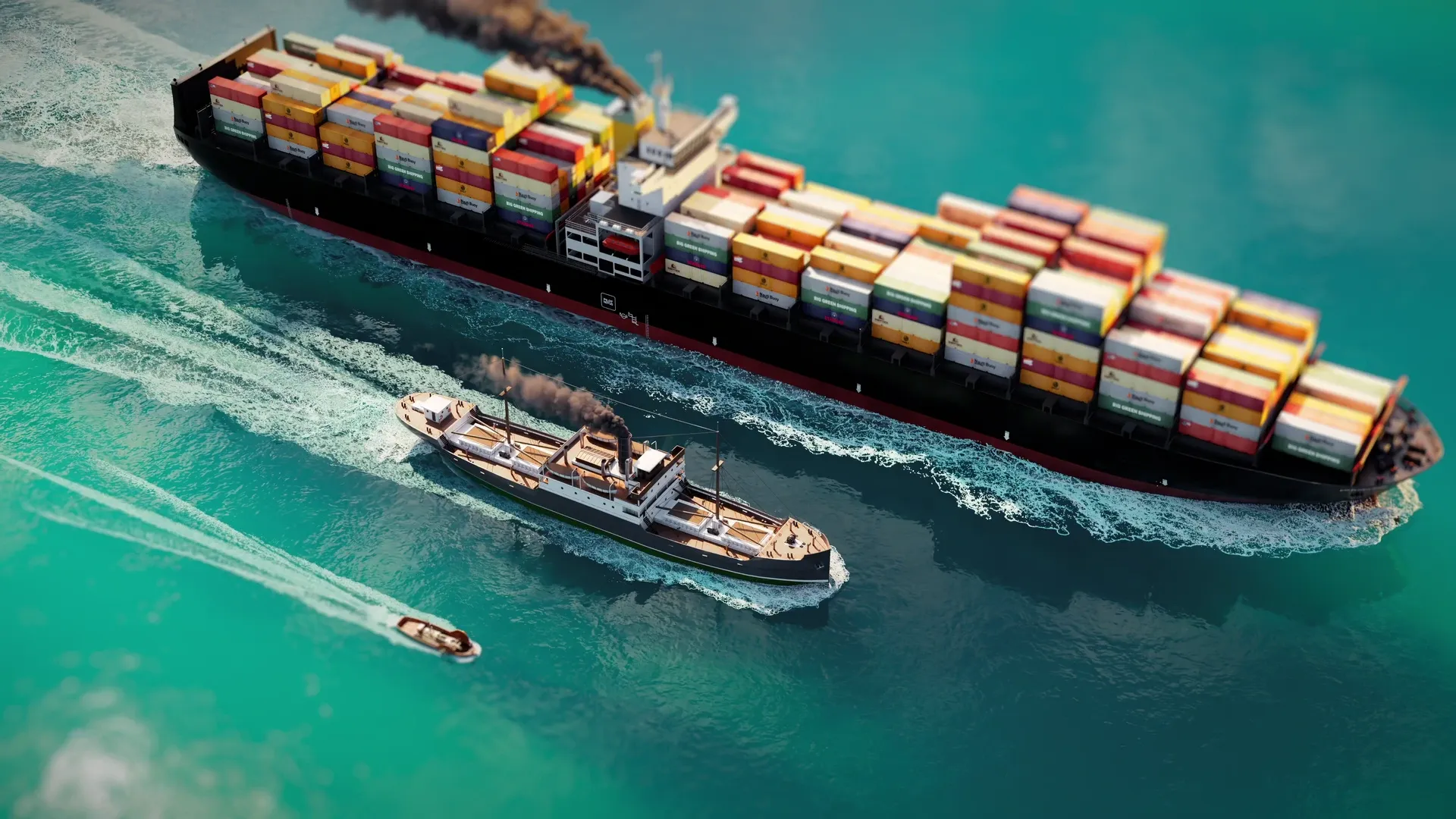
Shipping keeps the global economy moving, but most cargo ships run on bunker fuel, one of the dirtiest fuels in transport. So can humanity clean up shipping emissions without disrupting global trade? The main options include using ammonia and green hydrogen as fuels, electric and nuclear-powered vessels, more efficient ship designs, and even a return to wind-assisted cargo ships. Each could revolutionize maritime transport.
(Illustrated guide coming soon)
2.6overall
How this solution scores
- Impact3 / 5Shipping carries almost all world trade on some of the dirtiest fuel there is.
- Speed2 / 5Ships last decades, so fleets change slowly.
- Cost2 / 5Efficiency saves fuel, but green fuels cost far more than oil.
- Readiness3 / 5Ammonia and methanol vessels are commercially operating, electric ships are still in testing.
- Nature3 / 5Cuts sulphur and soot, but ammonia brings its own toxicity risks
Quiz
Question 1 of 10
Roughly what share of global carbon emissions comes from shipping?
Score 0 / 10
Transcript
Oceans cover 71% of the planet [1]. Beautifully blue though they may seem, throughout most of history humans have found them rather tricky to explore, which might explain how they ended up naming a planet that is quite obviously covered in water, the ‘Earth’.
But despite these early difficulties, millions of tons of raw materials, food, goods, and people now traverse this blue expanse every day [2,3,4]. Without the roughly 100,000 ships that carry this cargo [5,6,7], the modern human world would grind to a halt.
But moving all that stuff requires a lot of energy, and at the moment almost all of that energy comes from polluting fossil fuels [8,9,10]. Today, shipping accounts for around 2% of global carbon emissions [11] and without action, that could rise to 17% by 2050 [11,12].
So how can humans reduce the environmental impact of this essential ocean trade? What is the future of shipping?
For thousands of years, ocean shipping has carried the lifeblood of civilization. From the sleek galleys of the Ancient Phoenicians to the gold-laden galleons of the Spanish Empire, nations have risen and fallen in the wake of maritime trade.
But the real game-changer arose in France in 1783, when Frenchman Claude de Jouffroy whacked a steam engine on a boat to create the first steam-powered ship [13,14,15]. Traveling faster and farther than ever before, steam ships soon revolutionized global trade and cleared the decks for the massive container ships of the present.
Today, a vast network of shipping lanes connects the world and forms the backbone of the global economy. It allows aluminum from Australia and copper from the Congo to be shipped to Shanghai to assemble solar panels that are sent to San Francisco.
Unfortunately, unlike Claude’s little steamboat, the modern behemoths that carry these goods rely on enormous engines that guzzle up vast volumes of fossil fuels.
Every year the shipping industry consumes a whopping 2 billion barrels of oil [7,9,16,17], enough to stretch to the moon 4 times! [18-22] And pumps out more CO2 per year than Germany [23,24].
In fact, shipping fuel, known as bunker fuel, is some of the dirtiest in existence [25,26]. It’s notorious for producing toxic pollution like sulfur oxides, nitrogen oxides and particulates, [27-30] as well as copious quantities of carbon dioxide.
So how can humans wash away the emissions of ocean trade? Well, there are six ports of call on the route to sustainable shipping.
The first method is called slow steaming. This simple strategy is widely used around the world [31-34]. Due to the density of water, fuel consumption rises exponentially with speed, so slowing down by just 10% can reduce fuel use and emissions by nearly 30% [35,36,141].
Unfortunately slowing down isn’t always practical due to delivery schedules and profit margins [37-40].
So the next solution is to improve the design of the ships themselves. Marine organisms like barnacles and seaweed increase drag on a ship’s hull, so by cleaning regularly and applying anti-fouling coatings, ship crews prevent them from attaching.
When sailing through the open seas, the smooth, barnacle-free hulls lower both drag and fuel consumption by up to 10% [41,42,43].
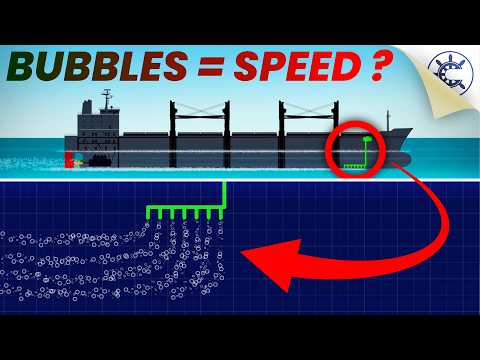
Hull shapes are getting smarter and more streamlined [44,45,46], and some ships use air lubrication systems [44-48] that pump a layer of air bubbles beneath the hull to minimize friction and reduce drag even further [44,46,49-52].
Where port sizes allow, replacing smaller ships with larger ships is another tactical approach. With economies of scale, larger ships can cut fuel consumption and emissions per container unit by up to 30% [53-56].
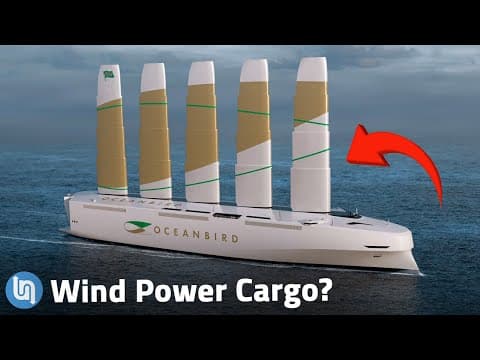
Another ingenious strategy is inspired by the sailing ships of old. Shipping companies are fitting enormous wing-like sails on cargo ships to reduce the need for engine power [57,58].
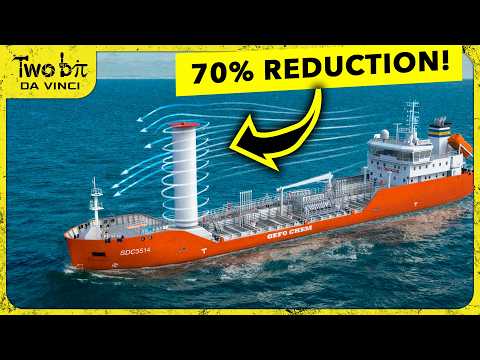
Special spinning rotors, called Flettner rotors, are being used to harness something called the ‘Magnus effect’, which uses the airflow of the wind to create a pressure difference that generates extra thrust [59,60,61].
Some ships even use kites to harness high-altitude winds! [62] All reduce the need for engine power and can cut fuel consumption by up to 30% [63,64,65].
But there's an obvious solution staring humanity in the face...
A little-known fact is that around 40% of all the cargo that’s shipped around the world is actually fossil fuels! [66,67]
This means that using less coal, oil, and fossil gas and more renewable energy on land can significantly reduce the number of cargo ships needed at sea.
Fewer oil tankers also lowers the risk of oil spills. It’s a win-win-win!
But even if humans sail their ships more slowly, engineer more efficiently, and ship less coal, oil and gas, powering ships with fossil fuels will always create CO2…
Perhaps the obvious answer is electrification. After all, it works for cars so why not ships? Fully electric cargo ships are already in use for short distances in places like Norway [68], and a recent study has shown that up to 40% of all container shipping could be electrified [69]. But while this would work for short to medium distances, batteries are not practical for long distances.
They can be used with conventional engines in a hybrid setup [70], but using batteries alone would take up too much of the cargo storage capacity [71,72,73]. This is impractical and expensive, so other solutions are needed.
Alternatively, humans could replace bunker fuel with a different type of fuel. Some shipping companies have changed to a form of fossil gas called Liquefied Natural Gas (LNG) which can virtually eliminate toxic sulfur emissions and reduce nitrogen oxides by up to 80% [74,75,76].
But because it’s still a fossil fuel, it only reduces CO2 emissions by about 20 to 30% [77,78,79].
To make things worse, LNG experiences ‘methane slip’ where unburned methane gas leaks from ship engines directly into the atmosphere [80-83]. Over 20 years, methane has a global warming impact over 80 times greater than CO2, so over the crucial next two decades, LNG will be just as bad for the atmosphere as bunker fuel! [84-87]
Clearly, a better solution is needed.
Enter Biofuels [88-91]. In theory, these can be carbon neutral and are replacing fossil fuels in some ship engines without the need for significant modifications [92,93,94].
Problem solved, right? Well, not exactly. Obtaining biofuels can lead to deforestation and carbon emissions as land is cleared to grow the crops needed to make them [95-99].
But biofuels can be made from sustainable sources like microalgae or seaweed [100,101], which humans are carefully cultivating to ensure carbon neutrality. This way, biofuels could become a powerful tool for decarbonizing industries like shipping and aviation [8,102-106].
A better long-term option could be to power ships with green hydrogen fuel [107-110] which is produced by splitting water into hydrogen and oxygen with electricity from wind and solar power.
This can either be used as liquid hydrogen, which has to be stored in super cold cryogenic containers, or it can be converted to liquid ammonia or methanol fuels, which are much easier to store [111-117]. This change in fuel could cut shipping emissions to almost zero!
But green hydrogen production would need to be ramped up quickly, which is easier said than done [118-121].
A final long-term option could also be on the horizon: nuclear-powered shipping! [122,123] Recent breakthroughs like small modular reactors and molten salt reactors have renewed interest in nuclear powered container ships [124-127].
In fact, the nuclear ships of the future are already being designed! [124,125,128-130]
So, can humanity clean up the shipping industry once and for all? The United Nations and the International Maritime Organization seem to think so, with a goal of reaching net-zero emissions by 2050 [131-134].
To keep tabs, they are using the Carbon Intensity Indicator to rate how efficiently ships limit CO2 emissions [135,136,137].
But just measuring progress won’t cut it: the long-term shift requires scaling up renewable energy like wind and solar to produce green hydrogen, ammonia, and methanol. Along with biofuels, these are key to replacing the fossil fuels powering ships today [8,23,138].
In the short term, reducing fuel consumption through slow steaming, improving ship design, wind power, and electrification is essential.
It won’t be easy, and it won’t happen overnight, but with the inevitable progress of humanity, the future of shipping will be green!
Expert Advisors
3
We would like to thank
Dr. Faïg Abbasov
European Federation for Transport and Environment
Shipping Programme Director
Dr. James Mason
University of Manchester
Tyndall Centre for Climate Change Research
Dr. Conor Walsh
University of Greenwich
Natural Resources Institute
Further Videos
25 links
These resources are non-affiliated.
Overview
 Climate change: Can global shipping go green?Sky News
 The true cost of shipping basically everythingDW Planet A
 Are Renewable Powered Ships Possible?real Engineering
 Why Rivals Are Working Together to Transform ShippingTED
 Can Shipping go Green?ClimateAdam
 How containerization shaped the modern worldTED-Ed
 How Ocean Shipping Works (And Why It's Broken)Wendover Productions
Specific Solutions — Slow Steaming
Specific Solutions — Ship Design
Specific Solutions — Wind Power
 Windship Technology | The Future of ShippingUK Chamber of Shipping
 Is wind power the future of freight shipping?Just Have A Think
 Is Wind Power The Future of Shipping?Ziroth
 Why Wind Power Ships May Be The Future of TransportationUndecided with Matt Ferrell
 Surprise Breakthrough Solves Shipping's BIGGEST ProblemTwo Bit Da Vinci
Specific Solutions — Electric Power
Specific Solutions — Alternative Fuels
 Is this vessel the future of shipping? Shipping giant Maersk is banking on itCNBC
 The First-Ever Cargo Ship Powered By Green FuelTED
 Can this magic fuel clean up the shipping industry?DW Planet A
 The Carbonless Fuel That Could Change How We Ship GoodsTED
 Green Pioneer: The World's First Dual-Fuel Ammonia ShipRE:TV
 Methanol in focus: Barriers and pathways explainedDNV Maritime
Specific Solutions — Nuclear Power
Carbon Intensity Rating
Further Reading
36 links
These resources are non-affiliated.
Overview
- Sea Transport - MIT Climate Portal
- Climate impact of shipping - Transport & Environment
- International shipping - IEA
- Maritime transport - Australian Government Department of Climate Change, Energy, the Environment and Water
- Addressing climate change – a decade of action to cut GHG emissions from shipping - International Maritime Organization
- A History Timeline About Shipping - History Timelines
- What Is Bunker Fuel and Why Do Ships Use It? - ScienceInsights
In-depth Insights & Reports
- Maritime Decarbonization Strategy 2022 - Zero Carbon Shipping
- Review of Maritime Transport 2023 - UN Conference on Trade and Development
- A pathway to decarbonise the shipping sector by 2050 - IRENA
- Fossil fuel carrying ship and the risk of stranded assets in the transition to a low-carbon economy |Journal of Marine Science and Engineering - Kühne Foundation
Solutions — Slow Steaming
- Speed management | GreenVoyage2050 - International Maritime Organization
- Slow steaming – a viable long-term option? - Wärtsilä Technical Journal
Solutions — Ship Design
- Hull performance coating | GreenVoyage2050 - International Maritime Organization
- Hull cleaning | GreenVoyage2050 - International Maritime Organization
- Air lubrication | GreenVoyage2050 - International Maritime Organization
Solutions — Wind Power
- Sail-powered cargo ship 'shows potential of wind' - BBC News
- Flettner rotors | GreenVoyage2050 - International Maritime Organization
- Flettner Rotors as Sustainable Propulsion - Strathclyde University
Solutions — Electrical Power
- Hybrid ships: a surprising reason they are such an excellent idea - Wärtsilä
- Battery-powered ships: Moving from the drawing board to the seas - AXA
- Could 40% of global containership traffic be fully battery powered by 2030? - International Chamber of Shipping
Solutions — Alternative Fuels
- LNG as fuel for ships: Expert answers to 17 important questions - Wärtsilä
- Transport biofuels – Analysis - IEA
- Biofuels - Bureau Veritas
- Future biofuels for shipping - Global Maritime Forum
- Methanol and ammonia progressing rapidly as zero-emission shipping fuels, but extra push needed to scale - Global Maritime Forum
- Ammonia as fuel for ships - Bureau Veritas
- Methanol as fuel - Bureau Veritas
Solutions — Nuclear Power
- Nuclear-Powered Ships - World Nuclear Association
- The Case for Nuclear Cargo Ships - IEEE Spectrum
Additional Resources
- News and Publications - Royal Institute of Naval Architects
- Home - Wärtsilä
- Ship Energy Efficiency Solutions Portal | GreenVoyage2050 - International Maritime Organization
- Operational efficiency - Global Maritime Forum
- Barriers to Scaling Zero-Emission Fuel Supply in Shipping - World Economic Forum
References
144 links
- [1] Ocean | National Geographic
- [2] Review of Maritime Transport 2022 | UN Trade and Development (UNCTAD)
- [3] Shipping and world trade: driving prosperity | International Chamber of Shipping
- [4] World Seaborne Trade - Data Insights | UNCTAD Data Hub
- [5] Review of Maritime Transport 2023 | UNCTAD
- [6] Shipping at a turning point | World Ocean Review
- [7] The shipping industry looks for green fuels | c&en (see Reference Notes*)
- [8] A pathway to decarbonise the shipping sector by 2050 | IRENA
- [9] Emissions and Fuel Use in the Shipping Sector | Green Ports (see Reference Notes*)
- [10] Sea Transport | MIT Climate Portal
- [11] Transport CO2 emissions shares by type | Statista (Total global carbon emissions: Global Carbon Budget 2024 | Earth System Science Data) (see Reference Notes*)
- [12] Aviation and shipping — impacts on Europe's environment TERM 2017 | European Environment Agency
- [13] Steam Makes Waves | The Singularity of Western Innovation (see Reference Notes*)
- [14] The Prenatal History of the Steamboat | Transactions of the Newcomen Society (see Reference Notes*)
- [15] Geographies of steam: mapping the entrepreneurial activities of steam engineers in France during the second half of the eighteenth century | History and Technology: An International Journal (see Reference Notes*)
- [16] Maritime Decarbonization Strategy 2022 | Zero Carbon Shipping (see Reference Notes*)
- [17] Approximate conversion factors | BP (see Reference Notes*)
- [18] How Tall Is a 55-Gallon Drum? Height and Other Dimensions | ASC, Inc. (see Reference Notes*)
- [19] Oil drum (barrel) 55 gallon / 200L international standard (true size) | 3D Warehouse (see Reference Notes*)
- [20] How far away is the Moon? | Royal Museums Greenwich (see Reference Notes*)
- [21] Moon Facts | NASA Science (see Reference Notes*)
- [22] What is the Distance to the Moon? | Universe Today (see Reference Notes*)
- [23] International shipping | IEA
- [24] GHG emissions of all world countries | EDGAR - The Emissions Database for Global Atmospheric Research
- [25] Bunker (Fuel) - an overview | ScienceDirect Topics (see Reference Notes*)
- [26] What Is Bunker Fuel and Why Do Ships Use It? | ScienceInsights (see Reference Notes*)
- [27] Sulphur in marine fuels | Transport & Environment
- [28] International maritime regulation decreases sulfur dioxide but increases nitrogen oxide emissions in the North and Baltic Sea | Communications Earth & Environment | Nature
- [29] Determinants of ship operators’ options for compliance with IMO 2020 | Transportation Research Part D: Transport and Environment
- [30] Satellite unravels recent changes in atmospheric nitrogen oxides emissions from global ocean shipping | Journal of Cleaner Production
- [31] Slow steaming impacts on ocean carriers and shippers | Maritime Economics & Logistics
- [32] Slow steaming – a viable long-term option? | Wärtsilä Technical Journal
- [33] Benefits of slow steaming in realistic sailing conditions along different sailing routes | Ocean Engineering
- [34] Speed management | GreenVoyage2050 – International Maritime Organization
- [35] The Impact of Slow Steaming on Fuel Consumption and CO2 Emissions of a Container Ship | Journal of Marine Science and Engineering
- [36] Energy- and cost-efficiency analysis of greenhouse gas emission reduction using slow steaming of ships: case study RO-RO cargo vessel | Ships and Offshore Structures
- [37] The impact of slow steaming on the carriers’ and shippers’ costs: The case of a global logistics network | Transportation Research Part E: Logistics and Transportation Review
- [38] Assessing the macroeconomic and social impacts of slow steaming in shipping | Journal of Shipping and Trade
- [39] Slow steaming and a new dawn for wind propulsion: A multi-level analysis of two low carbon shipping transitions | Marine Policy
- [40] Swedish shippers’ strategies for coping with slow-steaming in deep sea container shipping | Journal of Shipping and Trade | Springer Nature Link
- [41] Environmental and Economic Impact of an Innovative Biocide-Free Antifouling Coating for Naval Applications | Materials
- [42] Hull performance coating | GreenVoyage2050 | International Maritime Organization (also Hull cleaning | GreenVoyage2050 – International Maritime Organization)
- [43] WAN HAI achieves improved fuel efficiency with Nippon Paint Marine | Nippon Paint Marine
- [44] Improving Hull Design for Better Efficiency and Environmental Protection | The 1st Conference on Ocean, Mechanical and Aerospace -Science and Engineering | ISOMASE (see Reference Notes*)
- [45] Review of the Decision Support Methods Used in Optimizing Ship Hulls towards Improving Energy Efficiency | Journal of Marine Science and Engineering (see Reference Notes*)
- [46] Maritime transport | Australian Government Department of Climate Change, Energy, the Environment and Water (see Reference Notes*)
- [47] Air Lubrication: A Hull-slide | Journal Of The Institute Of Marine Engineers (India) View (see Reference Notes*)
- [48] Air lubrication | GreenVoyage2050 – International Maritime Organization (see Reference Notes*)
- [49] Combination of Propulsion Engine with Air Lubrication System for Ultimate Ship Efficiency | Marine Engineering (see Reference Notes*)
- [50] Air Lubrication Technology | ABS (see Reference Notes*)
- [51] Computational Analysis of Air Lubrication System for Commercial Shipping and Impacts on Fuel Consumption | Computation (see Reference Notes*)
- [52] Silverstream's air lubrication system picked for Carnival's cruise ship | Offshore Energy (see Reference Notes*)
- [53] The importance of economies of scale for reductions in greenhouse gas emissions from shipping | Energy Policy (see Reference Notes*)
- [54] Economies of Scale in Container Ship Costs | USMMA (see Reference Notes*)
- [55] The Impact of Mega-Ships | International Transport Forum | OECD (see Reference Notes*)
- [56] Why Size Matters: Container Ship Economies Of Scale | MarineLink (see Reference Notes*)
- [57] Sail-powered cargo ship 'shows potential of wind' | BBC News (see Reference Notes*)
- [58] WindWings® | BAR Technologies (see Reference Notes*)
- [59] Flettner Rotors as Sustainable Propulsion | Strathclyde University
- [60] Flettner Rotor - an overview | ScienceDirect Topics
- [61] Rotor Sail Technology | Anemoi Marine
- [62] Sails and kites support cargo ships | cargo-partner
- [63] New wind powered cargo ship sets sail | European Commission (see Reference Notes*)
- [64] Design, operation and analysis of wind-assisted cargo ships | Ocean Engineering
- [65] Quantifying voyage optimisation with wind propulsion for short-term CO2 mitigation in shipping | Ocean Engineering
- [66] Fossil fuel carrying ship and the risk of stranded assets in the transition to a low-carbon economy |Journal of Marine Science and Engineering | Kühne Foundation (see Reference Notes*)
- [67] Review of Maritime Transport 2019 | UN Conference on Trade and Development (see Reference Notes*)
- [68] Yara Birkeland, two years on | Yara International
- [69] Rapid battery cost declines accelerate the prospects of all-electric interregional container shipping | Nature Energy (see Reference Notes*)
- [70] Hybrid ships: a surprising reason they are such an excellent idea | Wärtsilä
- [71] Electric Container Ships Are Stuck on the Horizon | IEEE Spectrum
- [72] Batteries on board ocean-going vessels | MAN Energy Solutions
- [73] Potentials and limitations of battery-electric container ship propulsion systems | Energy Conversion and Management X
- [74] The principal-agent problem in hierarchical policy making: A failure of policy to support the transition to LNG as an alternative shipping fuel | Marine Policy
- [75] LNG as marine fuel | GTT
- [76] Environmental performance of LNG as marine fuel | DNV
- [77] How to decarbonise international shipping: Options for fuels, technologies and policies | Energy Conversion and Management
- [78] Liquefied Natural Gas (LNG) as a Transitional Choice Replacing Marine Conventional Fuels, towards the Era of Decarbonisation | Sustainability MDPI
- [79] LNG as fuel for ships: Expert answers to 17 important questions | Wärtsilä
- [80] LNG not the holy grail for shipping | ESG Economist | ABN.AMRO (see Reference Notes*)
- [81] Methane slip and other emissions from newbuild LNG engine under real-world operation of a state-of-the art cruise ship | Atmospheric Environment: X (see Reference Notes*)
- [82] Fugitive And Unburned Methane Emissions From Ships (Fumes) | International Council on Clean Transportation (see Reference Notes*)
- [83] Addressing methane slip in LNG-burning Otto-cycle engines | Maritime Impact | DNV (see Reference Notes*)
- [84] Options for Reducing Methane Emissions from New and Existing LNG-Fueled Ships - International Council on Clean Transportation (see Reference Notes*)
- [85] The climate implications of using LNG as a marine fuel | International Council on Clean Transportation
- [86] Assessment of full life-cycle air emissions of alternative shipping fuels | Journal of Cleaner Production
- [87] Chapter 7: The Earth’s Energy Budget, Climate Feedbacks and Climate Sensitivity | IPCC
- [88] Understanding the Opportunities of Biofuels for Marine Shipping | OSTI.GOV
- [89] Environmental assessment of two pathways towards the use of biofuels in shipping | Energy Policy
- [90] Biofuel as an alternative shipping fuel: technological, environmental and economic assessment | Sustainable Energy & Fuels | RSC Publishing
- [91] Adoption of biofuels for marine shipping decarbonization: A long‐term price and scalability assessment | Biofuels, Bioproducts & Biorefining
- [92] Advanced Bioenergy | ETIP Bioenergy
- [93] Using biodiesel in marine diesel engines: new fuels, new challenges | DNV
- [94] Biofuels for the marine shipping sector | IEA Bioenergy
- [95] Large-scale bioenergy production: how to resolve sustainability trade-offs? | Environmental Research Letters
- [96] Land-use, deforestation and CO2 emissions embodied in the palm oil consumption of four European countries | Agricultural and Food Economics
- [97] A global analysis of deforestation due to biofuel development | JSTOR
- [98] Exploring the potential of biofuels in shipping | DNV
- [99] Transport biofuels – Renewables 2023 – Analysis | IEA
- [100] Microalgae biofuels: illuminating the path to a sustainable future amidst challenges and opportunities | Biotechnology for Biofuels and Bioproducts
- [101] Biofuel production from Macroalgae: present scenario and future scope | Bioengineered
- [102] Biofuels | Bureau Veritas
- [103] Update on Potential of Biofuels for Shipping | European Maritime Safety Agency
- [104] Future biofuels for shipping | Global Maritime Forum
- [105] FAQ: Sustainable Aviation Fuels | US Department of Energy
- [106] 4 ways airlines can reduce their carbon footprint | i6 Group
- [107] Green hydrogen as an alternative fuel for the shipping industry | Current Opinion in Chemical Engineering
- [108] The potential of hydrogen to fuel international shipping | UCL Discovery
- [109] Hydrogen as Maritime Transportation Fuel: A Pathway for Decarbonization | Greener and Scalable E-fuels for Decarbonization of Transport
- [110] Sustainable E-Fuels: Green Hydrogen, Methanol and Ammonia for Carbon-Neutral Transportation | World Electric Vehicle Journal
- [111] Hydrogen Storage | US Department of Energy (see Reference Notes*)
- [112] Hydrogen storage on a ship | Marine Service Noord (see Reference Notes*)
- [113] Potential of Ammonia as Fuel in Shipping | European Maritime Safety Agency (see Reference Notes*)
- [114] Ammonia as fuel for ships | Bureau Veritas (see Reference Notes*)
- [115] Methanol as fuel | Bureau Veritas (see Reference Notes*)
- [116] Marine Fuel - Methanex | Methanex (see Reference Notes*)
- [117] Introduction To Methanol As A Sustainable Fuel For Ships | Marine Insight (see Reference Notes*)
- [118] Decarbonising international shipping – A life cycle perspective on alternative fuel options | Energy Conversion and Management
- [119] Renewables 2022 | IEA
- [120] A wake-up call on green hydrogen: the amount of wind and solar needed is immense | Recharge
- [121] Making the breakthrough: Green hydrogen policies and technology costs | IRENA
- [122] Nuclear-Powered Ships | World Nuclear Association
- [123] Types of UK Royal Navy submarine | GOV.UK
- [124] Shipping’s nuclear option in the move towards net zero: Is it viable? | HFW
- [125] The Case for Nuclear Cargo Ships | IEEE Spectrum
- [126] Molten salt reactors (MSR) | International Atomic Energy Agency
- [127] What are Small Modular Reactors (SMRs)? | International Atomic Energy Agency
- [128] ICS Maritime Barometer Report 2022-2023 | International Chamber of Shipping
- [129] Nuclear-power container shipping could be possible within the decade | The Chemical Engineer
- [130] Jiangnan Shipyard unveils design for the 'world's largest' nuclear-powered containership | Offshore Energy
- [131] IMO’s work to cut GHG emissions from ships | International Maritime Organization
- [132] 2023 IMO Strategy on Reduction of GHG Emissions from Ships| International Maritime Organization
- [133] Amendments To The Annex Of The Protocol Of 1997 | International Maritime Organization
- [134] Addressing climate change - a decade of action to cut GHG emissions from shipping| International Maritime Organization
- [135] Rules on ship carbon intensity and rating system enter into force | International Maritime Organization
- [136] EEXI and CII - ship carbon intensity and rating system | International Maritime Organization
- [137] CII - Carbon Intensity Indicator | Maritime Insight | DNV
- [138] Fuelling the Future of Shipping: Key Barriers to Scaling Zero-Emission Fuel Supply | World Economic Forum
- [139] Reducing emissions from the shipping sector | European Commission
- [140] Carbon Emission Trading Scheme in the shipping sector: Drivers, challenges, and impacts | Marine Policy
- [141] Slow Steaming Options Investigation Using Multi Criteria Decision Analysis Method | Proceedings of the Conference ECONSHIP2015 (on-screen graphic)
Reference Notes
12
Global Carbon Emissions from Transport
Carbon dioxide emissions produced by the transportation sector worldwide in 2024 reached an estimated 9 GtCO₂, out of a total estimated 41.6 GtCO2 (total anthropogenic CO2 emissions from fossil and LULUCF - land-use, land-use change, and forestry - including the cement carbonation sink). Shipping (both international and domestic combined) accounted for a reported 10.67% of emissions from the transportation sector, which was equal to 2.31% of global carbon emissions.
These figures were chosen due to their recency and alignment of respective percentages with reputable sources such as the IMO (International Maritime Organization). However, there is continued discussion over the accuracy of this data in general. Estimating shipping’s share of global CO₂ emissions is more complex than it may appear, and the figures can vary depending on how the numbers are compiled.
First, different studies report either CO₂ alone, all greenhouse gases, or carbon dioxide-equivalent (CO₂eq) values, which include gases like methane and nitrous oxide weighted by their global warming potential. These metrics are not interchangeable or comparable, and using one versus another can shift the apparent share of shipping emissions significantly. Sources, studies, and organizational reports are often not clear with which specific metric has been used, and regularly use one when they mean another (e.g. stating ‘CO2’ when they mean ‘CO2eq’).
Second, the choice of global baseline matters: some comparisons are made against energy-related CO₂ only, while others include all anthropogenic sources such as land-use, land-use change, and forestry (LULUCF), which expands the denominator and lowers shipping’s apparent percentage.
Third, international shipping itself is difficult to track because emissions occur largely in international waters, and data often come from bunker fuel sales rather than direct monitoring of ship activity, introducing further uncertainty. Together, these methodological differences mean that published figures for shipping’s contribution to global emissions can range considerably, even when based on the same underlying activity.
Claude de Jouffroy
Claude-François-Dorothée, marquis de Jouffroy d’Abbans - also known as Claude de Jouffroy - created the first steamboat in 1776. These initial trials failed, but he later succeeded in 1783 with the paddleboat ‘Pyroscaphe’. He was denied the protection of a patent for many years, later going into exile. Several other trial runs of steamboats were achieved by others such as John Fitch and William Symington until American inventor Robert Fulton created the first commercial steamboat with Robert Livingston in 1807. Fulton credited Claude, but his invention is rarely recognized A.
Number of Barrels
Based on sources, if approximately 75% of the 300 million tonnes of total bunker fuel (used in shipping globally) is made up of Heavy Fuel Oil (HFO), then there are 225 million tonnes total of HFO. Assuming the remaining 25% is Marine Gasoil (MGO) & Marine Diesel Oil (MDO), this equals 75 million tonnes. Using [17], which is a calculator used to convert the amount of fuel into the equivalent number of barrels: HFO multiply by 6.350, MGO/MDO multiply by 7.460. Therefore the approximate barrels of HFO = 225 million x 6.350 = 1,428,750,000.
Approximate barrels of MGO/MDO = 75 million x 7.46 = 559,500,000.
Total Barrels = 1,988,250,000 = Approximately 2 billion barrels.
Distance to the Moon
The average barrel is 33-34 inches tall [18,19], or approximately 850 mm or 0.00085 km. Therefore 2 billion x 0.00085 km = 1,700,000 km.
Distance to the Moon = 384,400 km [20,21,22].
1,700,000 km / 384,400 = 4.42 times the distance to the Moon from Earth.
Bunker Fuel
Steamboats in the past were usually powered by the combustion of coal. This coal was stored in rooms called bunkers, which is why modern fuel is known as 'bunker fuel’. Bunkers have since been replaced by fuel tanks, but the name persists for the fuel itself. ‘Bunker fuel’ can refer to any fuel type used in shipping; it is not specific to a single type of fuel.
Fuel consumption and emissions reduction from air lubrication systems
The percentage values of fuel consumption and emissions reduction for air lubrication vary between sources as these values are circumstantial and experimental conditions change. There is evidence of potential from air lubrication, but different suppliers show different numbers. For example:
[44] This paper mentions air lubrication systems, suggesting a fuel consumption reduction of up to 15%. This value is based on a study by Engng (1997) that is currently inaccessible.
[46] This source clarifies that air lubrication systems can provide drag reduction, reducing fuel consumption by ‘at least 3%’.
[50] This report presents a number of different air lubrication system examples, detailing the drag reduction and energy savings that each has achieved. It reports an initial project: “Project Energy-saving air-Lubrication Ships” (PELS) from 1999 which found calm water energy savings of 3-10% on average. Other examples of energy saving values from different trials that were mentioned - over a range of experiment parameters - were: 2%, 6%, ‘some’, 1%, 10% at ballast condition and 5% at full load, 10% at high speed, no conclusive results, 15%, 2% (although this reduced to -0.6% as the bubbles did not attach to the hull), 10%, 5%, 4.5%, and 4%. The full range of experiments and the context of values found is located on page 11 of the report.
[51] This study found experimental reductions of fuel consumption and emissions of up to 8%.
[52] This source reported on an air lubrication system designed by Silverstream Technologies, claiming a fuel reduction and GHG emission reduction of 5-10%.
Fuel consumption and emissions reduction from economies of scale
As with air lubrication systems, there is some variation with the fuel consumption and emissions reduction figures.
[53] This source is a study on the use of economies of scale in shipping, and it estimates that emissions can be reduced by up to 30% if the entire fleet were replaced by larger vessels, which is projected to take 25 years
[56] This source is a news site that reports on a new 18,000 TEU (twenty-foot equivalent unit) ship by Maersk Line. Maersk has not released fuel consumption information for this vessel, but information from their 10,000 and 16,000 TEU vessels is available. Therefore, consumption information was extrapolated, claiming this new vessel is 35% more fuel efficient per container carried than 13,100 TEU vessels. This information was reported in a paper by Drewry Maritime Research; however, this paper is not readily accessible to the public.
[54] This paper clarifies that data on fuel consumption is proprietary information, and is therefore rarely available to the public. Sources reporting this information are very scarce, so it would be incredibly difficult to obtain accurately verified data, which may have varying experimental parameters regardless.
Using wing-like sails on ships
These sources describe the use of ‘WindWings’ from BAR Technologies, which are large sails that have been retrofitted to container ships. These sails are not like traditional boat sails, instead they are rigid, made of the same material as wind turbines, and can be folded down when at port, before being deployed at sea. These sails work like vertical airplane wings, using 3 elements to create aerodynamic thrust greater than a single element wing, using similar dynamics to how wings lift an airplane but instead propelling the ship forwards.
Percentage of cargo shipped around the world that consists of fossil fuels
[66] Report published in 2024 states that 36% of global cargo capacity is used to transport fossil fuels. This was calculated “using the deadweight of the existing and ordered fleet of liquefied gas tankers and oil tankers, plus a further 17% of the deadweight of the existing and ordered fleet of bulk carriers from Clarksons WFR”. The 17% corresponds to “the share of the coal trade in bulk trade (in ton-miles) from Clarksons Shipping Intelligence Network (SIN)”. The original sources to this information were inaccessible. These figures are estimated.
[67] Report from 2019 reflects the conclusions drawn from the first report, using the same data source displaying total shipment numbers globally.
Potential of Electric Container Ships.
CORRECTION: The video states that 40% of all cargo shipping could be electrified, but the study concerns container-ship traffic, particularly shorter intraregional routes - not 40% of all cargo shipping.
Reductions to Methane Slip
To mitigate methane slip from engines fueled with LNG, advancements have been made in various engine technologies, and newer engine designs have resulted in reductions to the amount of methane that escapes unburned. Engines such as Low-Pressure Dual-Fuel (LPDF) engines [84], High-Pressure Dual-Fuel (HPDF) engines [84], and Four-Stroke Otto-Cycle engines [83], have had a number of major technological enhancements, including changes to pressure, injection, ‘skip firing’, and operational-level modifications [83]. As a result, methane slip has been reduced significantly, but is still a prevalent issue when LNG is used.
Liquid ammonia and methanol fuels
Liquid ammonia and methanol fuels made from hydrogen are easier to store than liquid hydrogen fuel, but each has important trade-offs [114,115]. Primarily, both have lower volumetric energy density compared to conventional bunker fuel: methanol requires about 2.5 times as much storage volume and ammonia requires about 3 times as much. Both are extremely toxic to humans and marine life, requiring extra precautions to be taken when handling. Methanol is also extremely flammable with a low-flash point, and ammonia combustion can produce nitrous oxide. Finally, the supply of both of these fuels is very limited, with a large scale of production required to provide for the maritime industry, as well as account for competition with other sectors as they begin to decarbonize. However, in terms of actual physical storage, liquid hydrogen fuel is still far more difficult to store than either of these fuels due to the cold cryogenic containers required.