
Manufacturing
Green Steel
The New Age of Green Steel
Steel supports bridges, trains, buildings and modern industry, but its traditional coal-fired recipe produces enormous emissions. We step inside the blast furnace, and explore cleaner methods including recycling, carbon capture, biocarbon, direct-reduced iron, green hydrogen and molten oxide electrolysis. Some are already making steel, others are still experimental. With abundant clean electricity, this essential material could enter a new age of green steel.
(Illustrated guide coming soon)
2.6overall
How this solution scores
- Impact4 / 5A major emitter that recycling and clean production could largely fix.
- Speed2 / 5Recycling cuts quickly, but new steelworks and clean hydrogen take years.
- Cost2 / 5Green steel alternatives cost well above coal-based steel today.
- Readiness2 / 5Scrap recycling is mature; hydrogen steel plants are only starting.
- Nature3 / 5Cleaner air around steelworks, but iron ore mining continues.
Quiz
Question 1 of 10
What share of global carbon emissions comes from making steel?
Score 0 / 10
Transcript
Ever since they learned to forge, humans have loved metals, and not just because they’re shiny. Bronze took them out of the stone age, and with the iron age came steel. Stronger, harder and more durable than bronze, it laid the groundwork for the construction of everything from trains to skyscrapers.
But making steel releases harmful greenhouse gases, and now accounts for a whopping 8% of global carbon emissions [1-4], more than aviation and shipping combined [5-8]. And with demand set to grow by 50% by 2050 [1,9], humanity needs a better, more environmentally friendly approach. And fast!
Welcome to the age of green steel!
The modern world is quite literally built with steel. Humans use almost 2 billion metric tons of the stuff a year [3,10], and half of that is used in construction [11,12,13], building up an area the size of Manhattan every 3 days [14]. In fact, humans love steel so much that 92% of mined metals are used to produce it [15,16,17].
But how exactly is steel made? And why is it so polluting?
Modern industrial steelmaking was first pioneered by Englishman Henry Bessemer in 1856 [18,19,20]. His methods paved the way for the eventual construction of impressive structures like the Empire State Building and the Burj Khalifa. But before you can make all that lovely steel, you need to dig up the key ingredients: iron-rich rocks called ores, and a source of carbon like coal [21].
These allow us to begin Stage One, separating iron from its ore: First you mix the iron ore with high-carbon coal and limestone in a blast furnace, and simmer the mixture at a toasty 1600°C [21-24]. This causes the carbon in the coal to react with the ore to produce molten ‘pig iron’ [25] and carbon dioxide gas.
Then comes Stage Two, strengthening the iron to make steel: You pour the molten metal into a second furnace called a basic oxygen furnace and inject it with high-pressure oxygen. This reacts with the carbon remaining in the hot metal [26,27], producing even more carbon dioxide gas. This cuts the carbon in the iron down to ideal levels for strength and durability [28].
The result? You’ve made steel!
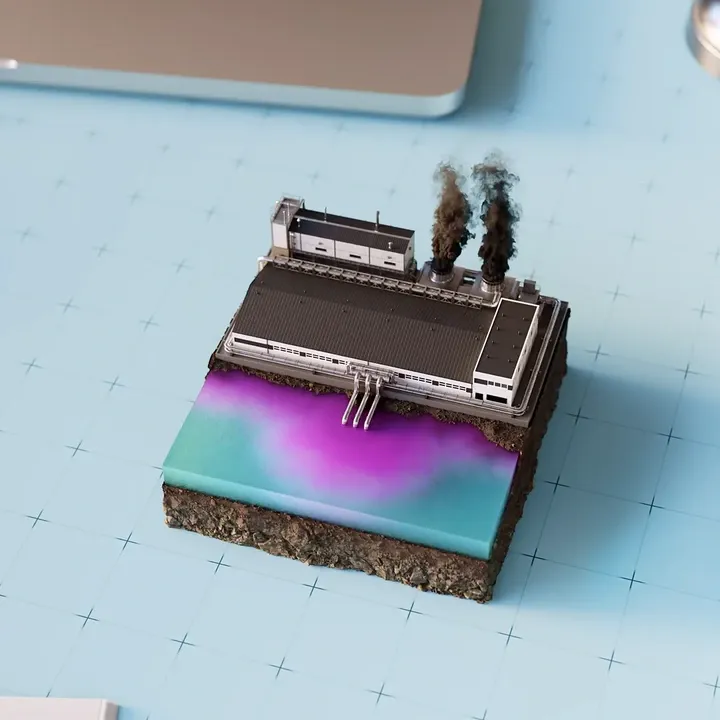
And unfortunately a lot of carbon dioxide. In fact, for every metric ton of steel produced, almost 2 metric tons of CO2 are released [29,30]. The steel industry emits roughly the same amount of CO2 as the entire European Union [4,31,32]. Steel isn’t as shiny and clean as it seems!
So how can humans get to the new age of green steel? There are six solutions to explore [2,33-35]:
- Recycling
- Carbon Capture
- Biocarbon
- DRI
- Green Hydrogen
- Molten Oxide Electrolysis
One option is steel recycling. Renewable energy sources like wind and solar can be used to power an Electric Arc Furnace to recycle steel [2,3,36,37,38]. This can melt existing scrap steel that would otherwise be wasted and recycle it to make new steel, reducing CO2 emissions by up to 85% compared to making it from scratch [39,40]. But while recycling is a start, steel is already the most recycled material on Earth [3,41], and recycling alone can’t meet humanity’s insatiable appetite for the shiny stuff! [3,9,21,34,42-44]
So the next solution is to try and catch all the carbon from traditional steelmaking [35,45], store it in underground reservoirs [46] and prevent it from polluting the air. This is called carbon capture, and in theory, it can significantly reduce the CO2 released by steelmaking [9,11,33-35,47]. But carbon capture can’t catch all the CO2 [11,47,48] and risks leaking the captured gas back into the environment [49-51]. And because it requires a lot of energy, and for the time being, comes with a pretty hefty price tag, it’s not going to bring about the age of green steel on its own [9,11,33,34,47,48].
A better approach is to replace the dirtiest and most polluting part of steelmaking entirely: Coal. And this is something that the next solutions can do…
The first way is with biocarbon [33,35,52]. Many companies are experimenting with replacing the coal used to react with iron ore in the blast furnace [53-56] with a source of carbon derived from sustainable biomass like wood or other plant matter. Biomass can also replace the coal used to heat the furnaces in both stages of steelmaking [35,57]. And since trees are planted specifically for this purpose, this makes most of the emissions from steelmaking carbon neutral [33,52,56,57], which sounds great! But because there are limits to how much biocarbon can be produced sustainably [9,52,58], it’s unlikely to play a large role in decarbonizing steel.
A much more promising method is by using a process called Direct Reduced Iron. This typically replaces coal in the blast furnace with fossil gas to separate iron from its ore at much lower temperatures and with much lower emissions [9,11,33-35,59,60]. It’s so effective that it’s already being rapidly scaled up around the world [61,62,63]. The only problem is that while using gas can reduce the emissions of the first stage of steelmaking, it can’t eliminate them from the process completely [47].
Fortunately, adding the next ingredient to iron ore can get pretty close: Green hydrogen. This is made using renewable energy from sources like wind and solar to split the hydrogen from water [64,65,66]. And, like fossil gas, it can be used to separate iron from its ore. But unlike gas, green hydrogen doesn’t produce any CO2 at all [9,11,33,35,67-70], essentially eliminating the carbon emissions from the first stage of steelmaking [44,71,72].
In Stage 2 of the process, the iron can be turned into steel in an Electric Arc Furnace [44,70,72]. There still needs to be some carbon added, but this can be from recycled materials like scrap steel, biowaste, or even plastic and old tires [73,74]. And all this can be powered by green electricity [69,70].
Together, these methods can reduce the carbon emissions of steelmaking by over 95% [9,44,60,67,71].
Sweden is already starting to produce green steel this way [75], and many other countries are trialing the technology too [11,63,76-81]. But to make hydrogen steel a global reality, both hydrogen production and renewable energy must be significantly ramped up, which is no mean feat [9,70,82-84].
But what if there was a way of bypassing the need to make hydrogen entirely?
Molten Oxide Electrolysis is a method being trialed in the USA and Brazil which uses renewable electricity directly to separate iron from its ore, producing only oxygen as a by-product [33,35,85,86]. Like hydrogen, this virtually eliminates direct CO2 emissions from the process, but could achieve this in a much more energy-efficient way [87], bypassing the expensive and energy-intensive process of producing hydrogen.
This method has yet to be proven at scale and currently uses a lot of heat and electricity [85], but other low-temperature alternatives are also being explored. Together, they represent an exciting glimpse of the future!
So is humanity on the cusp of a shiny new age?
With the right investment in research and development, the continued expansion of renewable electricity production, and a supportive policy environment [2,3,9,33-35], humanity can finally get to their destination: the age of green steel!
Expert Advisors
2
We would like to thank
Wido Witecka
Independent Expert
Consultant for Steel and Industry Decarbonization
Caitlin Swalec
Global Energy Monitor
Program Director: Heavy Industry
Further Videos
13 links
These resources are non-affiliated.
History and How Steel is Made
Green Steel Overviews
Hydrogen Steel and Real-World Projects
 Fossil free steel. Another giant step towards net carbon zero?Just Have a Think
 Can hydrogen powered plants turn steel production 'green'?DW News
 CO2 Free Steel becomes a reality at Volvo and Mercedes Benz.Just Have a Think
 Has Sweden Invented Green Steel? The Build — How The World is Made
 Sweden pioneers green steel production, using hydrogen rather than coalSky News
Molten Oxide Electrolysis
Further Reading
29 links
These resources are non-affiliated.
Steelmaking Overview
- About steel - World Steel Association
- Climate change and the production of iron and steel - World Steel Association
- How Iron and Steel Work - HowStuffWorks
- Environmental Impact of Steel - The World Counts
- Steel industry emissions are a big contributor to climate change. Can it go green? | Science - AAAS
Solutions — Recycling & Electric Arc Furnaces
- Raw materials - World Steel Association
- Shortfalls in Scrap Will Challenge the Steel Industry - BCG
- Understanding steel manufacturing methods - Elland Steel
Solutions — Carbon Capture & Storage
- Carbon Capture and Storage (CCS) - World Steel Association
- Carbon capture for steel? - IEEFA
- CO2 leakage: Implications of unlikely CO2 migration to the surface - IEAGHG
Solutions — Biocarbon
- Biomass in steelmaking - World Steel Association
- BioCarbon: how converting low-value biomass can pave the way towards sustainability - GreenSteelWorld.com
Solutions — Green Hydrogen & Hydrogen-based DRI
- What is Green Hydrogen and its importance - Iberdrola
- Direct-reduced iron becomes steel decarbonization winner - S&P Global
- A Direct Reduced Iron (DRI) plant - LIBERTY Steel Group
- Hydrogen sparks change for the future of green steel production | articles - ING THINK
- Hydrogen unleashed: Opportunities and challenges in the evolving H2-DRI-EAF pathway beyond 2024 - IEEFA
- The potential of hydrogen for decarbonising steel production - European Parliament
- In Sweden, companies are cleaning up steel production — one of the world's biggest carbon problems - MIT Climate Portal
Solutions — Molten Oxide Electrolysis
- Green steel without green hydrogen — can it work? - Canary Media
- Decarbonising steel: hydrogen or metal oxide electrolysis? - Carbon Commentary
- MOE Steel - Boston Metal
Markets, Finance and Standards
- Global Steel Sustainability Standards - ResponsibleSteel
- Steel decarbonization: How EACs scale low-carbon production by 2030 - Carbon Direct
Technical Roadmaps and Reviews
- Iron and Steel Technology Roadmap – Analysis - IEA
- Making Net-Zero Steel Possible: An industry-backed, 1.5°C-aligned transition strategy – Executive Summary - RMI
- Decarbonizing the iron and steel industry: A systematic review of sociotechnical systems, technological innovations, and policy options - Energy Research & Social Science
- Pedal to the Metal 2026 - Global Energy Monitor
References
97 links
- [1] The green arc of steel's transition | Impax Asset Management (cites: World Energy Outlook 2023 | IEA) (see Reference Notes*)
- [2] Iron & steel | IEA (see Reference Notes*)
- [3] Climate change and the production of iron and steel | World Steel Association http://worldsteel.org (see Reference Notes*)
- [4] Iron and Steel Technology Roadmap – Analysis | IEA (see Reference Notes*)
- [5] Transport CO2 emissions shares by type | Statista (see Reference Notes*)
- [6] Global Carbon Budget 2024 | Earth System Science Data - Copernicus (also 2018 & 2019) (see Reference Notes*)
- [7] What share of global CO₂ emissions come from aviation? | Our World in Data (see Reference Notes*)
- [8] Fourth Greenhouse Gas Study 2020 | International Maritime Organization (see Reference Notes*)
- [9] Making Net-Zero Steel Possible: An industry-backed, 1.5°C-aligned transition strategy – Executive Summary | RMI
- [10] Total production of crude steel | WorldSteel Association
- [11] Net-zero steel in building and construction: The way forward | McKinsey (Overview: On the path to net-zero steel in building and construction | McKinsey) (see Reference Notes*)
- [12] The flow of steel into the construction sector | Resources, Conservation and Recycling (see Reference Notes*)
- [13] Steel use by sector | WorldSteel Association (see Reference Notes*)
- [14] High-spatiotemporal-resolution mapping of global urban change from 1985 to 2015 | Nature Sustainability (see Reference Notes*)
- [15] World Mineral Production 2018 to 2022 | BGS (see Reference Notes*)
- [16] Iron Ore Statistics and Information | U.S. Geological Survey (see Reference Notes*)
- [17] Mineral Commodity Summaries 2023 | U.S. Geological Survey (see Reference Notes*)
- [18] The Steel Story | WorldSteel Association
- [19] The Steel Industry in the British Industrial Revolution | World History Encyclopedia
- [20] How The Bessemer Process Changed Steel Forever | Rotabroach
- [21] Raw materials | World Steel Association
- [22] Steelmaking | World Steel Association
- [23] How Iron and Steel Work | HowStuffWorks
- [24] Do you know how steel is made? | Ternium
- [25] Pig Iron & Pig Iron Production - blast furnace route | International Iron Metallics Association
- [26] Understand your steel emissions | Carbon Chain
- [27] Basic Oxygen Furnace (Steelmaking) | StudyMeta
- [28] Making iron & steel - Basic oxygen furnace | ArcelorMittal
- [29] Decarbonization in steel | McKinsey
- [30] Cleaning Up The Steel Industry: Reducing CO2 Emissions with CCUS | CarbonClean
- [31] The Emissions Database for Global Atmospheric Research | EDGAR
- [32] EU’s CO2 emissions from fossil fuel drop 8% to reach lowest levels in 60 years | CREA
- [33] Breakthrough technologies | World Steel Association
- [34] Technological pathways for cost-effective steel decarbonization | Nature
- [35] Decarbonizing the iron and steel industry: A systematic review of sociotechnical systems, technological innovations, and policy options | Energy Research & Social Science
- [36] The Future of Electric Steelmaking | Metals Magazine
- [37] Renewable Electrical Power And Energy Storage For EAF Steel Production | MPI
- [38] Electric Arc Furnace - an overview | ScienceDirect Topics
- [39] Electric Arc Furnaces vs. Blast Furnaces | Service Steel (see Reference Notes*)
- [40] Steelmaking Emissions Report 2022 | Steel Manufacturers Association (see Reference Notes*)
- [41] Advantages of Recycling Steel | The World Counts
- [42] Four Reasons Why Specifying Recycled Steel is not a Silver Bullet | Elliott Wood
- [43] Shortfalls in Scrap Will Challenge the Steel Industry | BCG
- [44] The Disruptive Potential Of Green Steel | RMI (see Reference Notes*)
- [45] CCS: a necessary technology for decarbonising the steel sector | Global CCS Institute (see also CCS is a Necessary Investment for the UK’s Net Zero Future | Global CCS Institute; Green steel | UK Parliament)
- [46] Carbon capture and storage (CCS) | WorldSteel Association
- [47] Iron and Steel CCS Study (Techno-Economics Integrated Steel Mill) | IEAGHG
- [48] Carbon capture for steel? | IEEFA (see Reference Notes*)
- [49] Deep Geological Storage of CO2 on the UK Continental Shelf: Containment Certainty: Supplementary Note B: Geological Leakage Risks (see Reference Notes*)
- [50] CO2 leakage: Implications of unlikely CO2 migration to the surface | IEAGHG (see Reference Notes*)
- [51] Wellbore leakage risk management in CO2 geological utilization and storage: A review | Energy Reviews (see Reference Notes*)
- [52] Possibilities for CO2 emission reduction using biomass in European integrated steel plants | Biomass and Bioenergy
- [53] Biocarbon | SOLER Group
- [54] Biocarbon | Airex Energy
- [55] BioCarbon: how converting low-value biomass can pave the way towards sustainability | GreenSteelWorld.com
- [56] Substitution of coke with pelletized biocarbon in the European and Chinese steel industries: An LCA analysis | Applied Energy
- [57] Biomass in steelmaking | WorldSteel Association
- [58] John Bell: Further efforts needed to address ‘ecological limits’ of biomass | CBE JU
- [59] Direct Reduced Iron: The New Age of HBI | Metals Magazine
- [60] Direct reduction of iron to facilitate net zero emissions in the steel industry: A review of research progress at different scales | Journal of Cleaner Production (see Reference Notes*)
- [61] Direct Reduced Iron [DRI] Market Size | Global Report, 2024-2032 | Fortune Business Insights
- [62] Global production of DRI increased by 7 percent in 2023 | GMK Center
- [63] Pedal to the Metal 2026 | Global Energy Monitor (see also Pedal to the Metal 2024 | Global Energy Monitor)
- [64] Towards hydrogen definitions based on their emissions intensity – Analysis | IEA (see Reference Notes*)
- [65] What is Green Hydrogen and its importance | Iberdrola (see Reference Notes*)
- [66] How Is Green Hydrogen Produced? | MECO (see Reference Notes*)
- [67] Hydrogen sparks change for the future of green steel production | ING Think (see Reference Notes*)
- [68] The potential of hydrogen for decarbonising steel production | European Parliament (see Reference Notes*)
- [69] Renewable hydrogen based direct iron ore reduction and steel making with grid assistance | Energy Conservation and Management
- [70] Europe's steel industry at a crossroads | Roland Berger
- [71] Opportunities for Near-Zero-Emissions Steel Production in the Great Lakes | RMI
- [72] Green steel: design and cost analysis of hydrogen-based direct iron reduction | Energy & Environmental Science | The Royal Society of Chemistry
- [73] Review on the Use of Alternative Carbon Sources in EAF Steelmaking | Metals (see Reference Notes*)
- [74] Alternative sustainable carbon sources as substitutes for metallurgical carbon | IEA Bioenergy (see Reference Notes*)
- [75] ‘Green steel’: Swedish company ships first batch made without using coal | The Guardian
- [76] Salzgitter orders one of Europe’s largest green hydrogen plants from ANDRITZ | Salzgitter AG
- [77] H2FUTURE: World’s largest “green” hydrogen pilot facility successfully commences operation | Voestalpine
- [78] Tata Steel invests 65 million euro in next phase hydrogen route | Tata Steel UK
- [79] Industrial Fuel Switching Programme, Phase 1: summaries of successful projects | GOV.UK
- [80] H2DRI Project | Materials Processing Institute
- [81] Breakthrough hydrogen reduction ironmaking technology with near-zero emission - Hyrex | POSCO
- [82] Renewables 2022 | IEA (In: Global green hydrogen production set to require 50GW of renewable energy by 2027: IEA | Hydrogen Insight)
- [83] A wake-up call on green hydrogen: the amount of wind and solar needed is immense | Recharge
- [84] Making the breakthrough: Green hydrogen policies and technology costs | IRENA
- [85] Decarbonising steel: hydrogen or metal oxide electrolysis? | Carbon Commentary
- [86] Green Steel Solution | Boston Metal
- [87] Green steel without green hydrogen — can it work? | Canary Media
Reference Notes
10
Global Steel Emissions
Precise annual emissions of global steelmaking figures vary between references with year and the system boundaries considered. [1] cites the 2023 IEA World Energy Outlook report that steelmaking was responsible for 8% of CO2 and 6% of GHG emissions in the year prior. [4] estimates direct iron-and-steel emissions at 2.6 GtCO₂ in 2019, equivalent to 7% of global energy-system CO₂. [3] places the industry at approximately 7-8% of anthropogenic greenhouse-gas emissions using a broader industry boundary. The script’s 8% figure is primarily drawn from [1] but also serves as a rounded overview of these overlapping estimates.
Global Carbon Emissions from Transport
Carbon dioxide emissions produced by the transportation sector worldwide in 2024 reached an estimated 9 GtCO₂, out of a total estimated 41.6 GtCO2 (i.e. total anthropogenic CO2 emissions from fossil fuel use and LULUCF [land-use, land-use change, and forestry], factoring in the man-made cement carbonation sink) [5,6]. Aviation (including international and domestic) accounted for a reported 9.9% of emissions from the transportation sector, which was equal to 2.14% of global carbon emissions (just under one billion metric tons). Shipping (including international, domestic and fishing) accounted for a reported 10.67% of emissions from the transportation sector, which was equal to 2.31% of global carbon emissions [5,6].
An earlier pre-pandemic comparison, using dedicated aviation and shipping studies against the same global CO2 emissions total, provides a useful cross-check on this 2024 estimate and produces a broadly similar result. In 2018, global aviation emitted approximately 1.034 GtCO2 [7], while shipping emitted approximately 1.056 GtCO₂ [8]. Combined emissions were therefore approximately 2.090 GtCO₂. Compared with the Global Carbon Budget’s total of 42.5 GtCO₂ for the same year [6], aviation and shipping together accounted for approximately 4.92%. An 8% share of emissions from the steelmaking sector would therefore be approximately 3.08 percentage points higher, or 1.63 times the combined aviation-and-shipping emissions. This compares annual CO₂ only and does not include aviation’s additional non-CO₂ warming effects.
At the time of writing, these represent the best available figures for comparing sectors directly, drawing wherever possible on recent, authoritative sources (e.g. shipping emissions provided by the International Maritime Organization). However, such comparisons require care, because published estimates may cover subtly different types or categories of greenhouse gases, activities and sources of emissions.
Firstly, different studies may report either CO₂ alone, all greenhouse gases, or carbon dioxide-equivalent (CO₂eq) values, which include gases like methane and nitrous oxide weighted by their global warming potential relative to that of CO2. These metrics are not interchangeable or directly comparable without consistent standardization, and presenting one versus another can shift the apparent share of sector emissions significantly. Sources, studies, and organizational reports often do not make it immediately clear which specific metric (/type of emissions measure) has been used, and regularly state one when they actually mean another (e.g. stating ‘CO2’ when they mean ‘CO2eq’).
Secondly, the choice of global baseline matters: some comparisons are made against energy-related CO₂ only, while others include all anthropogenic sources such as land-use, land-use change, and forestry (LULUCF), which dictates the denominator and thus the sector’s calculated percentage.
International shipping emissions in particular are difficult to track because emissions occur largely in international waters. Historically, data often came from bunker fuel sales rather than direct monitoring of ship activity, introducing further uncertainty. IMO now combines fuel-sales, vessel-activity (AIS modeling) and voyage allocation methods, and estimates can vary according to which methods are used. A similar story can be seen with aviation data as well. Together with the aforementioned issues in figure publishing, this can make available global emission estimates range considerably, even when based on the same sector/activity.
Global Steel Production
1.892 Gt of steel is produced annually, of which 52% is used in construction (983.84 Mt of steel).
[14] indicates that global urban extent expanded by 9,687 km2 per year between 1985 and 2015. This is equivalent to (9687/365 =) 26.539 km2 per day.
The area of Manhattan is 59.1 km2 A.: 59.1/26.539 = 2.2 days
However, it is worth noting that the current rate of growth may be even faster. The World Bank B estimates (as of April 2023) that 1.2 million km² of new urban built-up area is expected to be added to the world by 2030. This is equivalent to an average annual rate of urban expansion across the entire decade of the 2020s of roughly 120,000 km2 per year, 328.77 km2 per day or 13.698 km2 per hour, which is the equivalent of the area of Manhattan being built every 4 hours.
Additional comparisons may be drawn: If 983.84 Mt of steel is used annually in construction (see above), this is equal to 2.7 Mt daily. In comparison, the Golden Gate Bridge in San Francisco, USA, contains ~75,000 metric tons of steel C, meaning ~36 Golden Gate Bridges could be constructed from daily construction steel. Alternatively, the Empire State Building contains ~51,700 metric tons of steel D,E, meaning ~52.2 Empire State Buildings could be constructed from daily construction steel.
A Overview of New York City | NYMTC
B Urban Development Overview | World Bank Group
C Design & Construction Stats | Statistics & Data | Golden Gate
Mined metals used in steelmaking
94% of ore mined is iron ore and 98% of iron ore is used for steel. Therefore, 98% of 94% is equal to 92%. This is a derived mass-based estimate, and not a measured statistic.
EAF recycling emissions
[39] provides a maximum potential emissions reduction of up to 85%; however this may not be universally applicable, and the source does not clearly specify a complete system boundary for its estimate. In practice, emissions savings may depend heavily on the share of scrap metal in the electric arc furnace, electricity mix and the extent of the wider system boundaries considered. Nevertheless, WorldSteel F reports similarly substantial differences between ore- and scrap-recycling-based steelmaking routes: a global average of 2.34 tCO2/t of crude steel for the traditional blast-furnace/basic-oxygen-furnace route, and 0.69 tCO2/t for scrap-metal/electric-arc-furnace route, equivalent to an average reduction of approximately 70.5%.
F Sustainability Indicators Report 2025 | World Steel Association
Leakage of Carbon Capture Geological Storage sites
Leakage means CO₂ escaping from the intended containment - through a well, fault, fracture or caprock - and potentially reaching another geological formation, groundwater, the seabed or atmosphere. Storage failure can include leakage, but can also mean excessive pressure, unexpected migration or loss of injectivity that prevents the site operating as intended without necessarily releasing CO₂ into the atmosphere. Neither is an expected outcome from a properly selected and managed site. EU rules require proposed sites to demonstrate no significant leakage risk and to maintain monitoring and corrective-measure plans.
Direct Reduced Iron (DRI) Emission Impacts
Replacing ‘coal in the blast furnace’ refers to replacing the conventional coal-based blast-furnace reduction stage itself with gas-based direct reduction, which typically takes place in a separate shaft/direct-reduction furnace; it does not mean a one-for-one substitution of fossil gas inside the same blast furnace.
Other methods of DRI vary significantly in their emission outputs. [60] suggests that coal-based DRI can reduce emissions by 38% compared to the traditional blast-furnace/basic-oxygen-furnace method. Fossil gas, however, with its usual mix of CH4, H2, and CO, reduces emissions by 61%. Replacing fossil gas with H2 entirely can reduce emissions by 97%. However, these are not universal estimates, and exact emissions savings will depend not only on the key reductant used in the process, but also the rest of the DRI configuration, the energy mix and system boundary. Notably, emissions from the method of production of H2 prior to use in steelmaking have not been included in the hydrogen-DRI estimates. Green hydrogen uses low-carbon electricity, but emissions may still be embodied in transport & infrastructure (see below). Despite the use of fossil gas in DRI releasing fewer emissions compared to coal, fossil fuels are still involved so emissions are inevitable.
Types of hydrogen used in steelmaking: Green, Blue, and Gray hydrogen
Green hydrogen is produced by using renewable electricity to split water into hydrogen and oxygen through a process of electrolysis. This eliminates the emissions from producing hydrogen from fossil fuels. When the hydrogen enters the steelmaking process at the iron-reduction stage to separate iron from its ore, it reacts with iron oxides in the ore and combines with oxygen to produce water vapor rather than CO2.
However, the wider process may still cause some emissions. These indirect, associated emissions may arise from infrastructure used in production, transport and storage of green hydrogen, or from electricity drawn from a grid that’s energy mix is not yet completely carbon free. In practice, hydrogen described as ‘green’ may therefore not always be produced exclusively with renewable electricity throughout the entire process.
Green-hydrogen steel can thus come very close to zero emissions, without necessarily reaching absolute zero carbon emissions. In reality, steel made using renewable hydrogen produces approximately 0.08 kg CO2 per kg of steel [67].
Blue and gray hydrogen have more defined associated emissions. Gray hydrogen is generally produced from fossil gas using a process called steam methane reforming (SMR), which splits hydrogen from the methane in the fossil gas mixture, and releases CO2. This is currently the most common and cheapest way to produce hydrogen. Blue hydrogen is made through the same basic process, but combined with carbon capture and storage (CCS) technology to prevent most of those production emissions escaping into the atmosphere. Because the capture process tends not to catch everything, blue hydrogen still produces some atmospheric emissions.
When either form of hydrogen is used to separate iron from its ore, the reduction reaction itself still produces only water rather than CO₂. The main difference lies in the upstream emissions created earlier when the hydrogen was initially produced. Smaller emissions can also remain elsewhere in the steelmaking process, including from electricity and carbon used in the Electric Arc Furnace.
According to [67], steel made using blue hydrogen produces approximately 0.22 kg CO2 per kg steel, assuming that 85% of the emissions from producing hydrogen are captured. This compares with 1.87 kgCO₂ for conventional coal-based steel and 0.38 kgCO₂ for coal-based steel fitted with carbon capture itself, for which a separate capture rate of 80% is assumed [67].
More than 95% of hydrogen used worldwide is made using fossil gas, mostly without any form of carbon capture. If this conventional gray hydrogen is used in hydrogen-based DRI steelmaking, [67] estimates emissions of approximately 0.7 kg CO2 per kg steel [67]. This is substantially lower than conventional coal-based steel production, but considerably higher than that for steel made using green hydrogen.
In these calculations, most of the remaining emissions are those that have evaded CCS, because it does not capture all the CO2 produced during conventional steelmaking or blue-hydrogen production.
The potential emissions saving of more than 95% therefore describes a best-case green-hydrogen DRI route rather than a universal result that applies to every form of hydrogen-based steel [60,67]. [67] estimates approximately 0.08 kg CO₂ per kg steel for its renewable-hydrogen case; compared with 1.87 kgCO₂/kg for conventional coal-based steel, this equates to a reduction of 95.7% [67]. Ultimately, the outcome depends on hydrogen production, electricity carbon intensity, raw material and scrap inputs, and the wider emissions/system boundaries involved.
Scrap steel and waste as an alternative source of carbon in EAF steelmaking
Steel is not pure iron: it is an alloy that normally contains a small, carefully controlled amount of carbon, which helps give it the required properties. Consequently, even when hydrogen replaces carbon during the first, iron-reduction stage, some carbon is still needed when the iron is turned into steel.
Steelmakers also use carbon for several technical jobs inside an Electric Arc Furnace that are not covered in detail in the script. These include adjusting the final carbon content (including carburization), helping remove remaining oxygen (deoxidation) and slag formation (When steel melts, impurities float to the top and form a liquid waste layer called slag. Injecting carbon into the mix reacts with the iron ore to produce bubbles of carbon monoxide gas, which makes the slag expand into a foam. This foamy layer of slag helps to protect the furnace from the intense heat and improves furnace performance by trapping heat inside the molten metal, reducing necessary energy input).
Scrap steel serves primarily as a recycled source of iron and pre-made steel (metallic feedstock) rather than a substitute for purposeful carbon input, although the carbon already contained in the composition of the scrap contributes to the furnace’s final carbon balance. EAF steelmaking may therefore still require additional carbon to be added.
Biogenic waste residues can potentially supply an additional source of carbon, but they must first be processed into a suitable form of biocarbon or biochar. Suitably prepared waste plastics and end-of-life tires can also act as carbonaceous reducing or slag-foaming agents or help to provide energy, helping to replace some of the conventional coke or coal that would otherwise be used.
However, most plastics and much of the carbon contained in tires originally came from fossil fuels, so using them can still release fossil CO₂. The environmental benefit therefore depends on the waste material used (feedstock composition), how it is processed (pretreatment), how much newly mined (virgin) fossil carbon it replaces, furnace performance and which parts of the lifecycle are considered. Using waste can reduce demand for conventional fossil carbon, but does not automatically make the process zero-carbon.
Green Hydrogen DRI
Steel produced via the hydrogen method is being trialed across a range of countries:
[76] Germany, [77] Austria, [78] The Netherlands, [79,80] UK, [81] South Korea