
Electricity
Geothermal Energy
Can Geothermal Energy Replace Burning Fuels for Good?
There's an almost inexhaustible source of energy right under our feet. We tell the story of geothermal energy. Then compare traditional geothermal power plants with enhanced geothermal systems, which can be dialed up to balance wind and solar power, and ground-source heat pumps for individual buildings. We also look at new deep-drilling tech that vaporizes rock instead of cutting it, a path that could make geothermal possible almost anywhere on Earth.
Download the Guide3.4overall
How this solution scores
- Impact4 / 5Always-on clean power, with new drilling technology enabling more locations.
- Speed3 / 5Each plant takes years to drill; wider rollout needs cheaper drilling.
- Cost3 / 5Expensive to drill, then very cheap to run.
- Readiness4 / 5Proven for a century; next-generation drilling is still emerging.
- Nature3 / 5Tiny surface footprint; minor risk of small tremors.
Guide
This is the illustrated transcript of the film.
Quiz
Question 1 of 10
Who first generated electricity from the Earth's heat, in 1904?
Score 0 / 10
Transcript
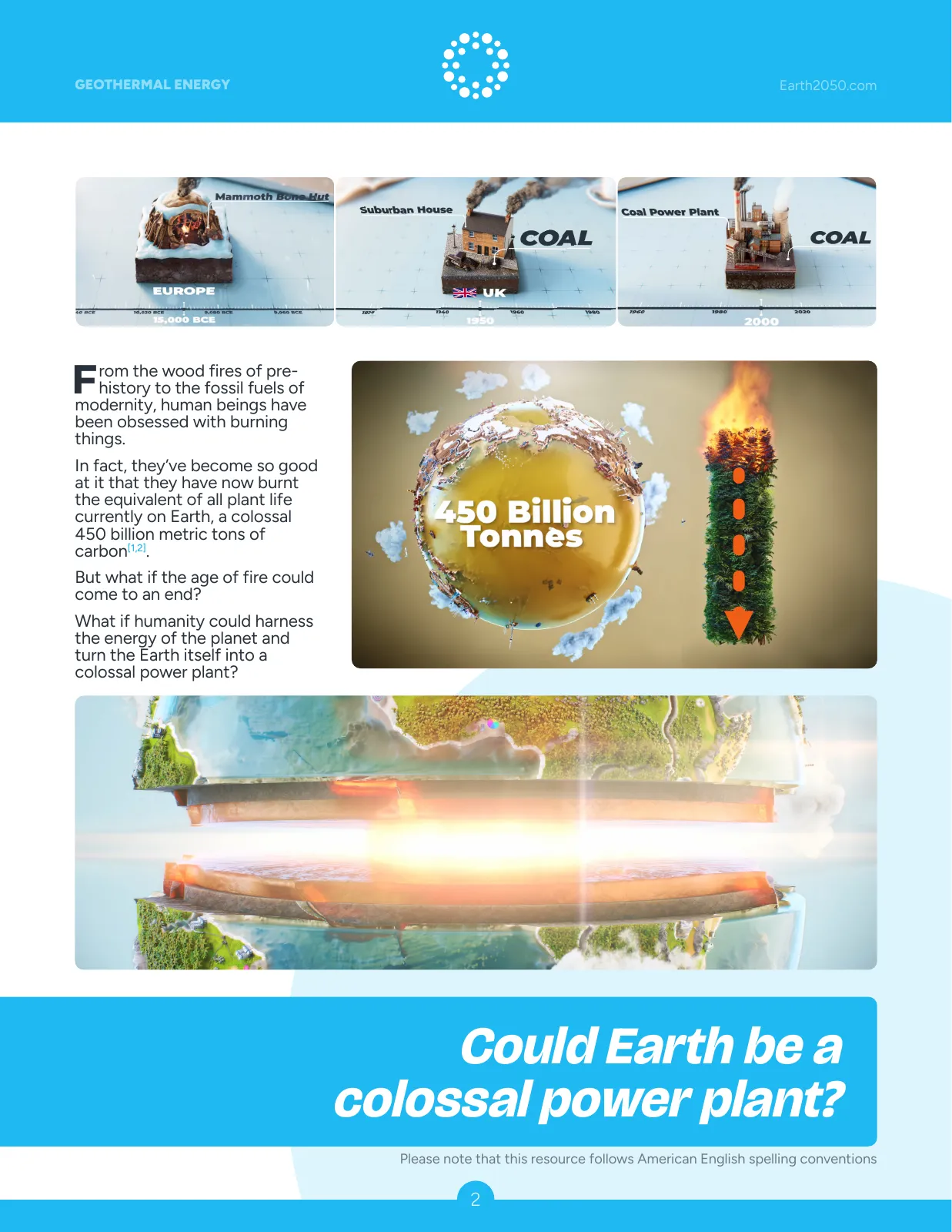
From the wood fires of prehistory to the fossil fuels of modernity, human beings have been obsessed with burning things. In fact, they’ve become so good at it that they have now burnt the equivalent of all plant life currently on Earth, a colossal 450 billion metric tons of carbon [1,2].
But what if the age of fire could come to an end? What if humanity could harness the energy of the planet and turn the earth itself into a colossal power plant?
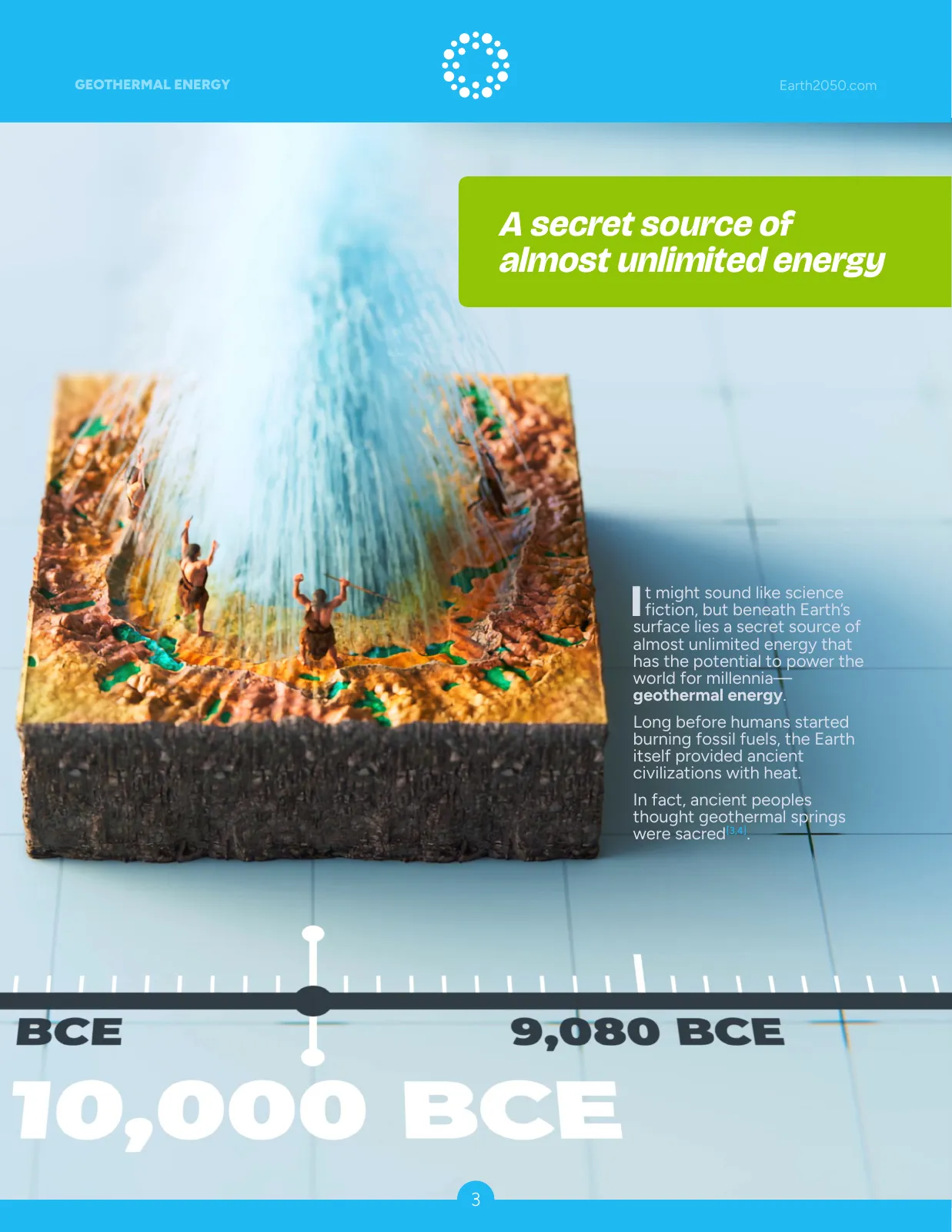
It might sound like science fiction, but beneath Earth’s surface lies a secret source of almost unlimited energy that has the potential to power the world for millennia: geothermal energy.
Long before humans started burning fossil fuels, the Earth itself provided ancient civilizations with heat. In fact, ancient peoples thought geothermal springs were sacred [3,4].
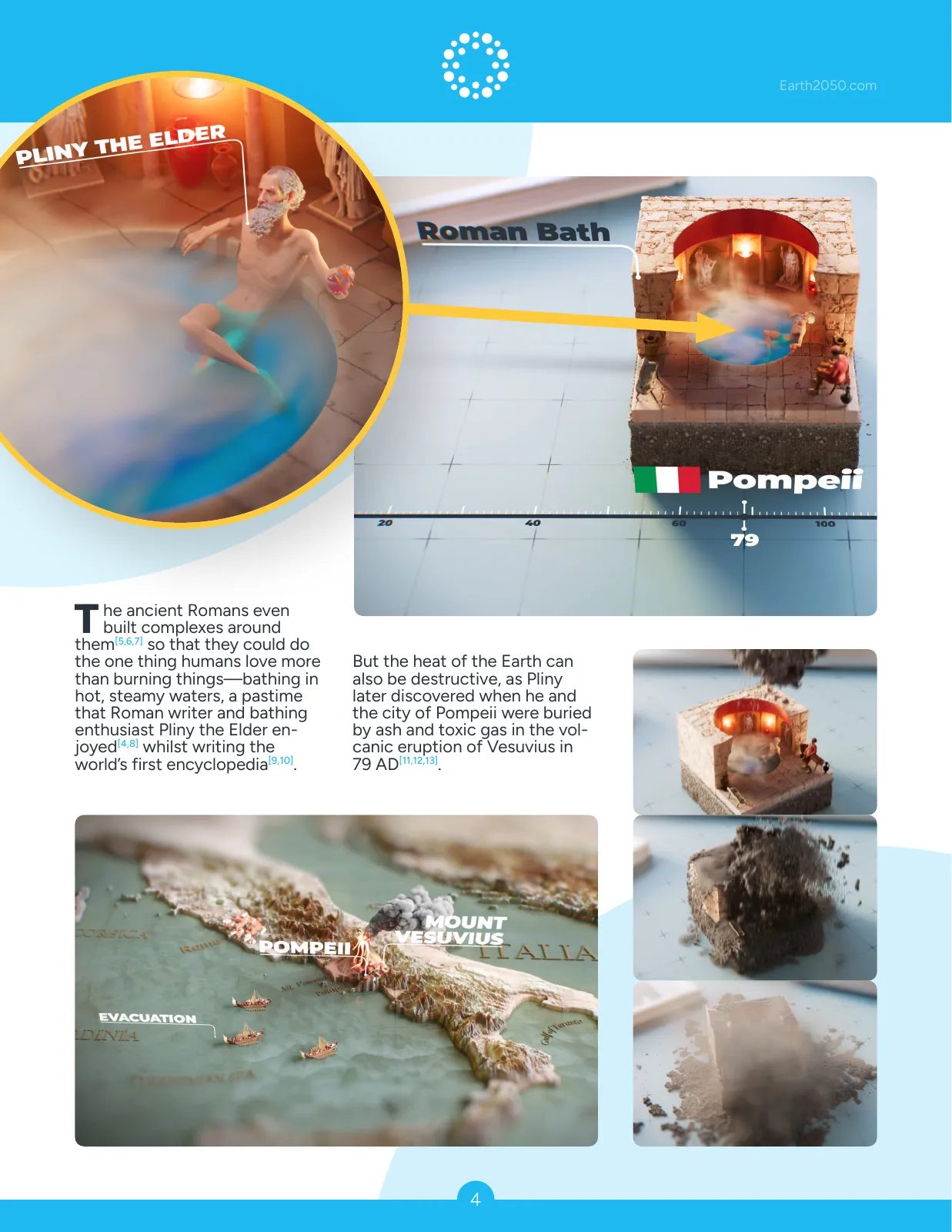
The ancient Romans even built complexes around them [5,6,7] so that they could do the one thing that humans love more than burning things: bathing in hot steamy waters, a pastime that Roman writer and bathing enthusiast Pliny the Elder enjoyed [4,8] while writing the world’s first encyclopedia [9,10].
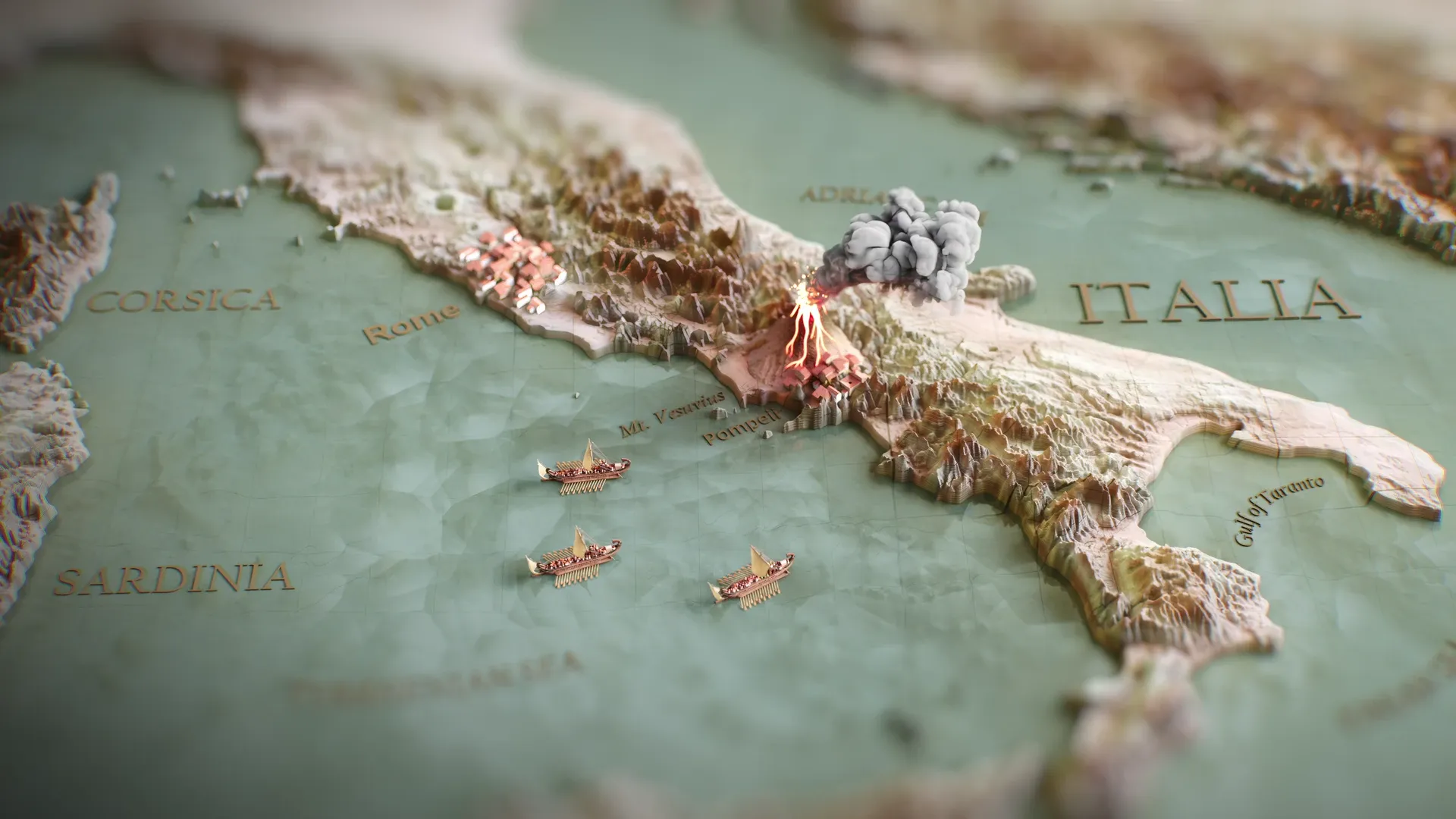
But the heat of the Earth can also be destructive, as Pliny later discovered when he and the city of Pompeii were buried by ash and toxic gas in the volcanic eruption of Vesuvius in 79AD [11,12,13].
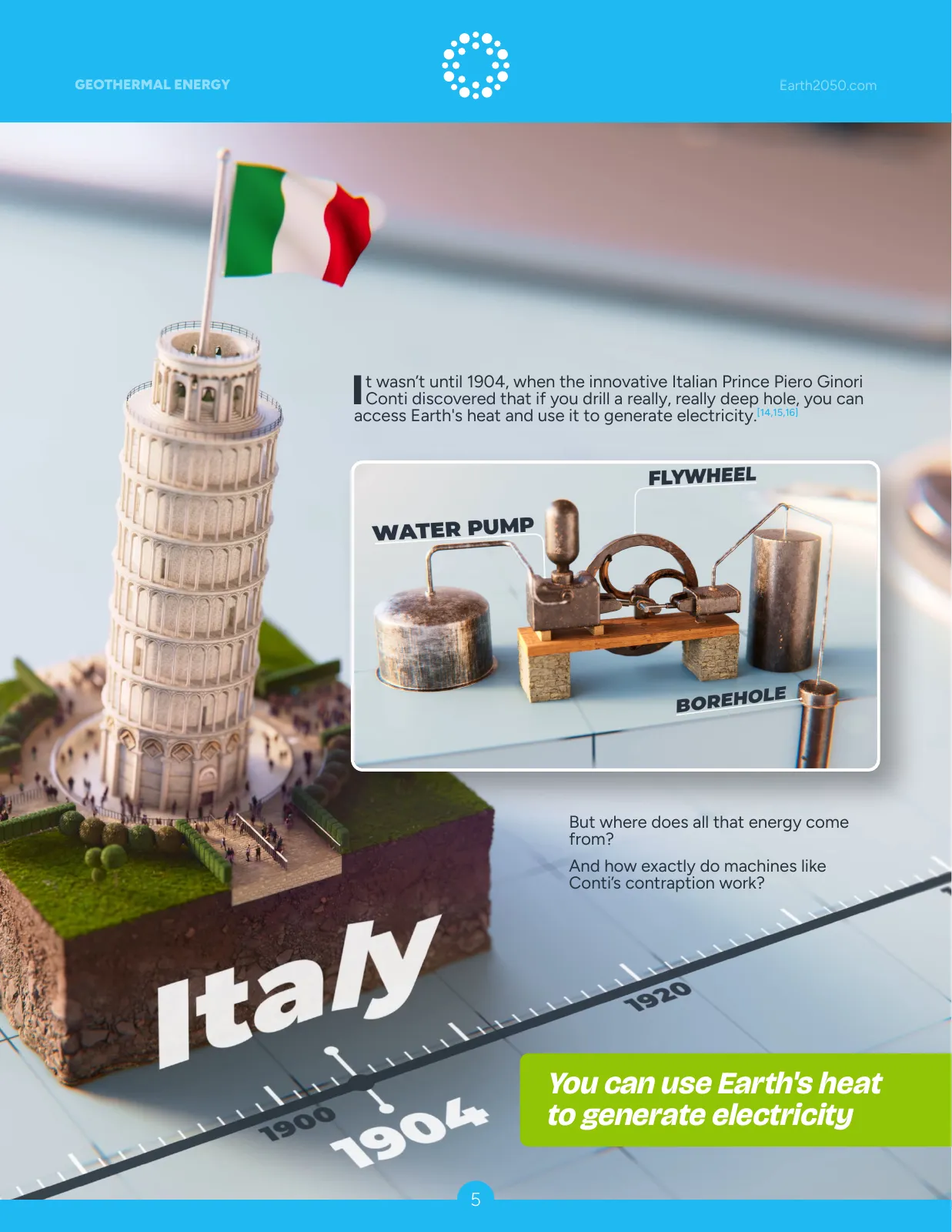
It wasn’t until 1904, when innovative Italian Prince Piero Ginori Conti discovered that if you drill a really, really deep hole, you can access Earth's heat and use it to generate electricity [14,15,16].
But where does all that energy come from? And how exactly do machines like Conti’s contraption work?
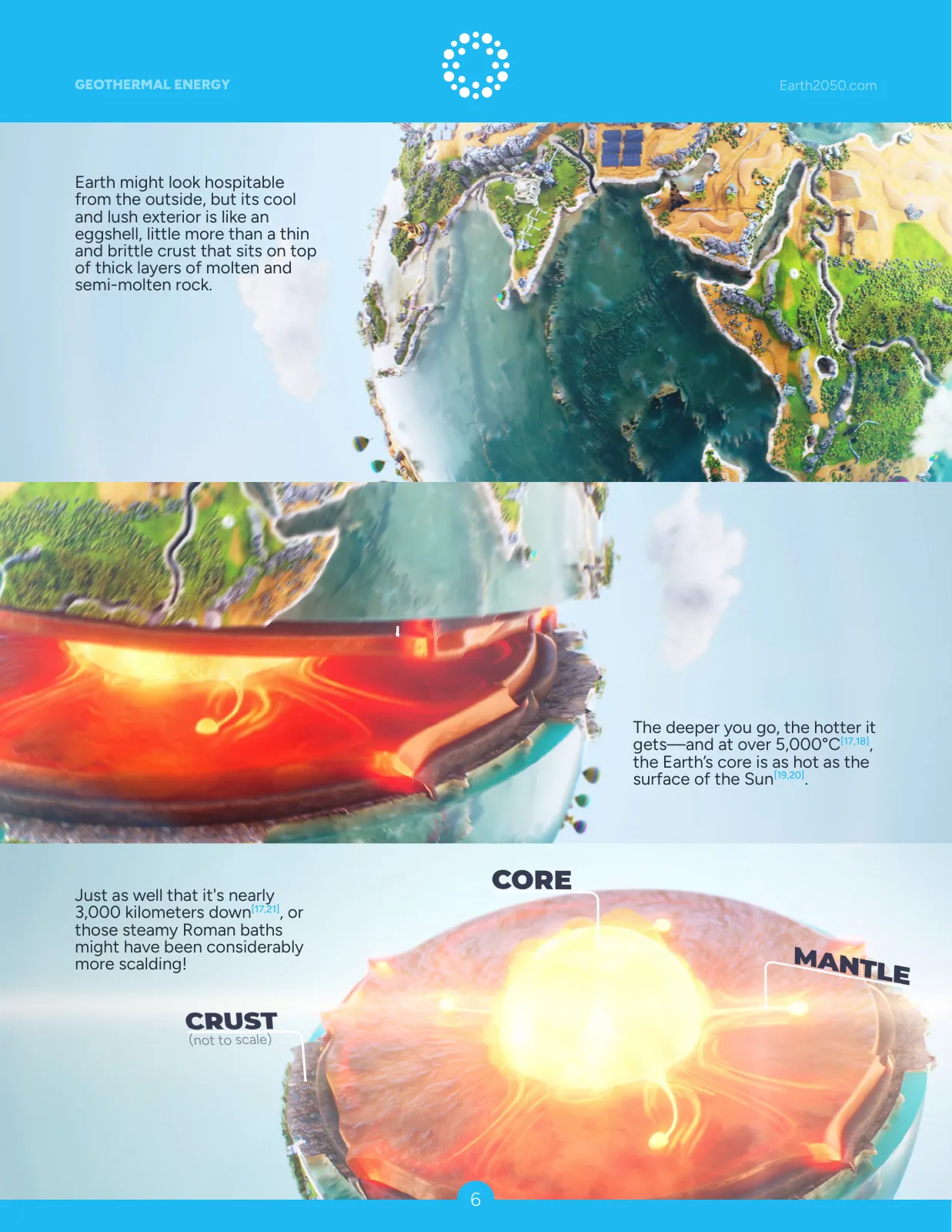
Earth might look hospitable from the outside, but its cool and lush exterior is like an eggshell, little more than a thin and brittle crust that sits on top of thick layers of molten and semi-molten rock. The deeper you go, the hotter it gets. And at over 5,000°C[17,18], the Earth’s core is as hot as the surface of the Sun [19,20].
Just as well that it's nearly 3,000 kilometers down [17,21], or those steamy Roman baths might have been considerably more scalding!
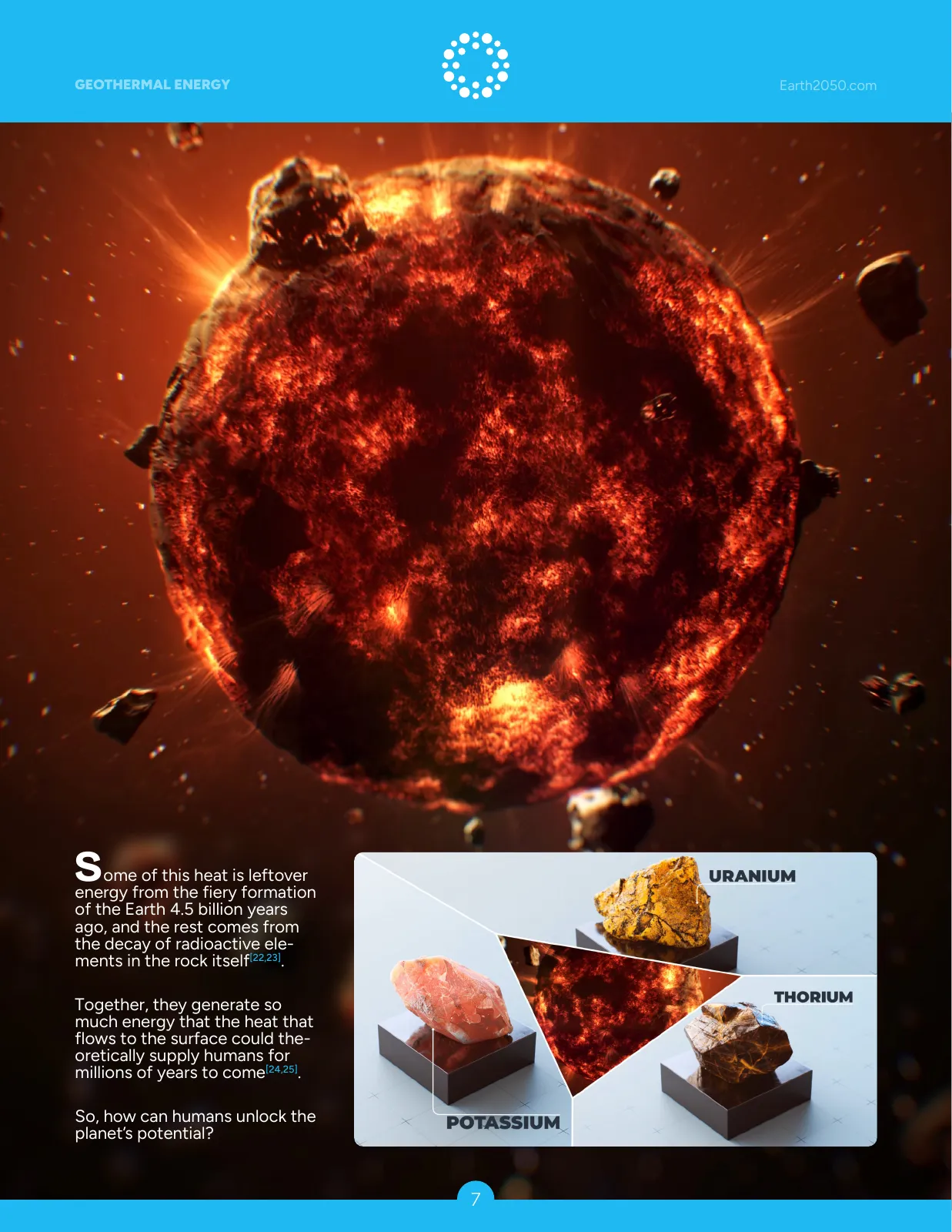
Some of this heat is leftover energy from the fiery formation of the Earth 4.5 billion years ago, and the rest comes from the decay of radioactive elements in the rock itself [22,23]. Together, they generate so much energy that the heat that flows to the surface could theoretically supply humans for millions of years to come [24,25].
So, how can humans unlock the planet’s potential?
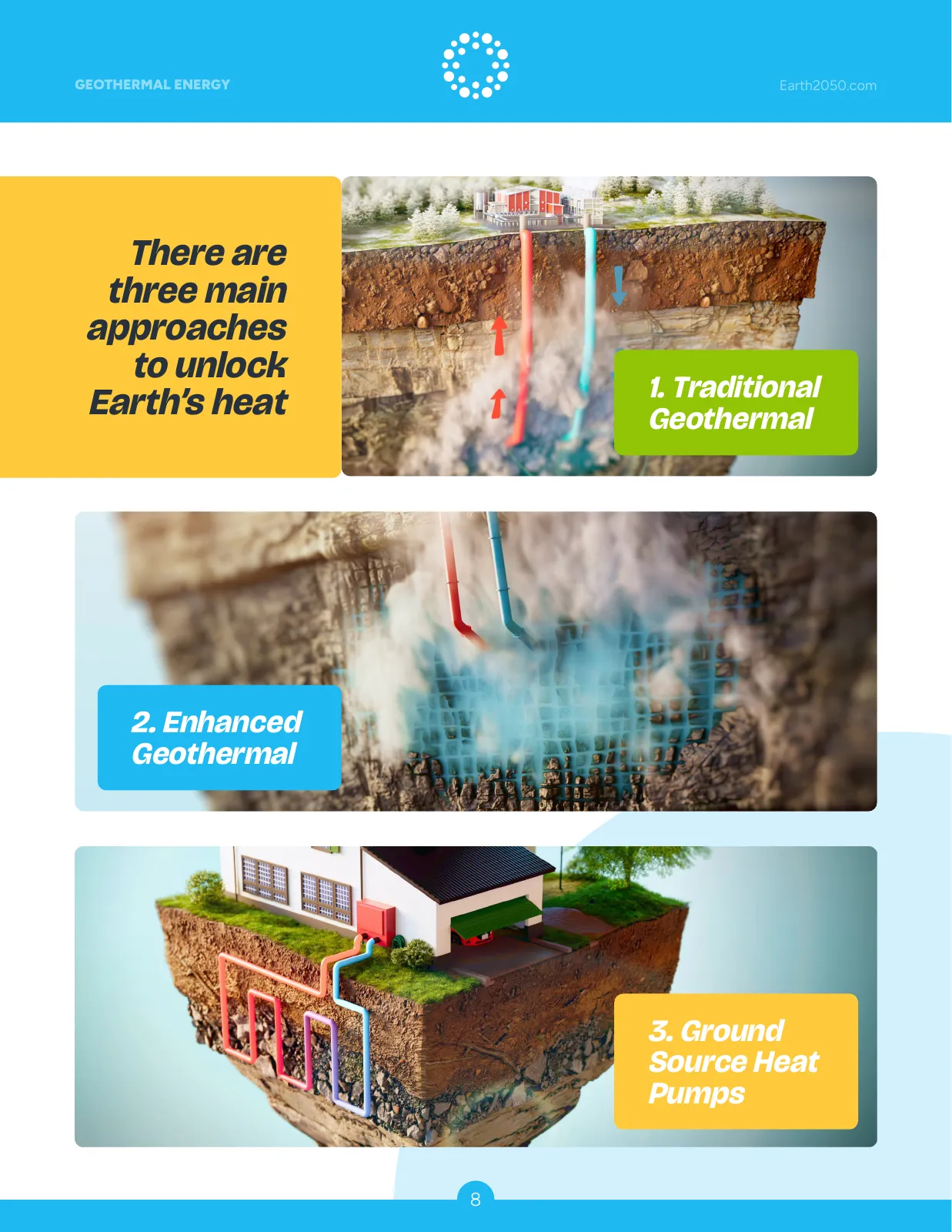
There are three main approaches:
1) Traditional geothermal
2) Enhanced geothermal
3) Ground Source Heat Pumps
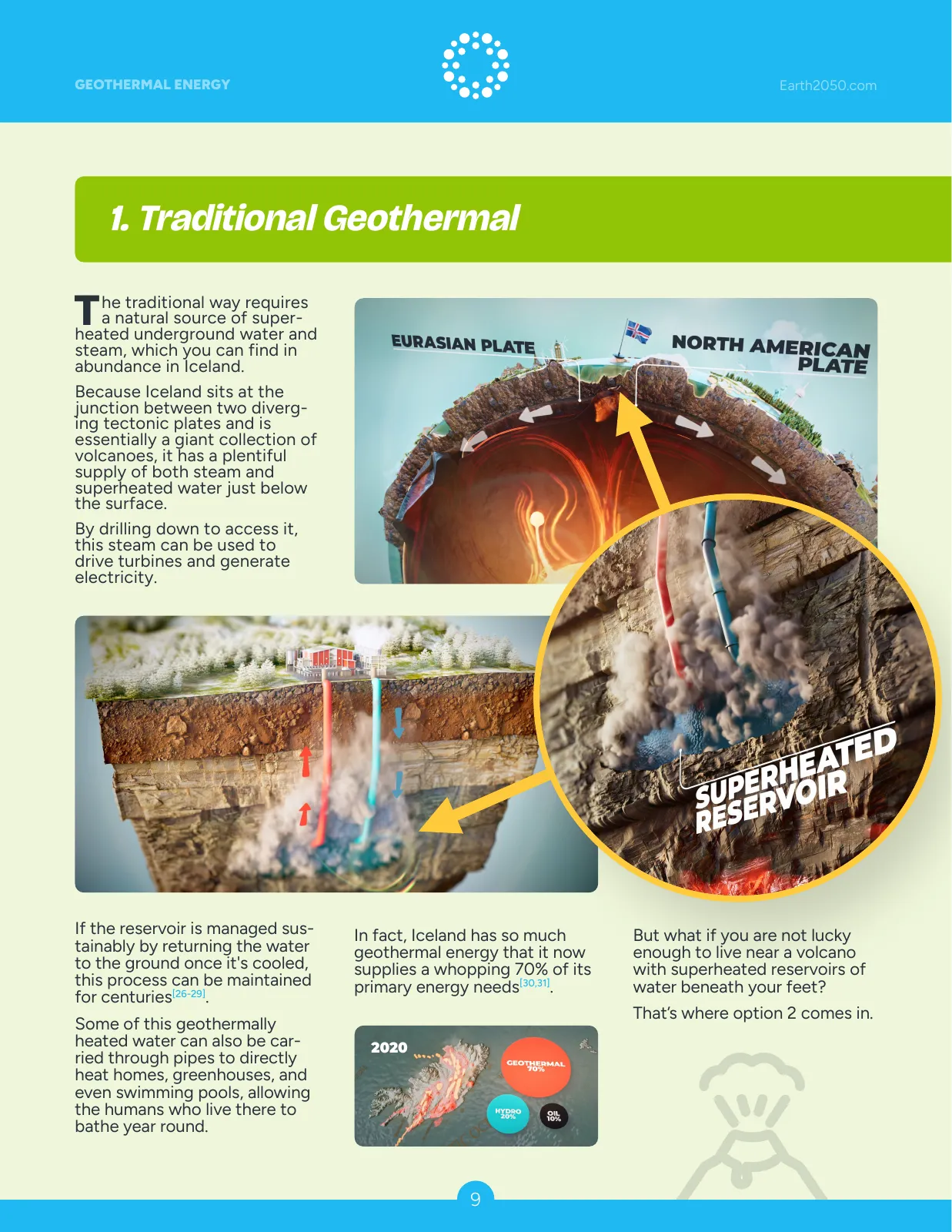
The traditional way requires a natural source of superheated underground water and steam, which you can find in abundance in Iceland. Because it sits at the junction between two diverging tectonic plates and is essentially a giant collection of volcanoes, it has a plentiful supply of both steam and superheated water just below the surface. By drilling down to access it, this steam can be used to drive turbines and generate electricity.
If the reservoir is managed sustainably by returning the water to the ground once it's cooled, this process can be maintained for centuries [26-29]. Some of this geothermally heated water can also be carried through pipes to directly heat homes, greenhouses, and even swimming pools, allowing the humans who live there to bathe year-round.
In fact, Iceland has so much geothermal energy that it now supplies a whopping 70 percent of its primary energy needs [30,31].
But what if you’re not lucky enough to live near a volcano with superheated reservoirs of water beneath your feet? That’s where option 2 comes in.
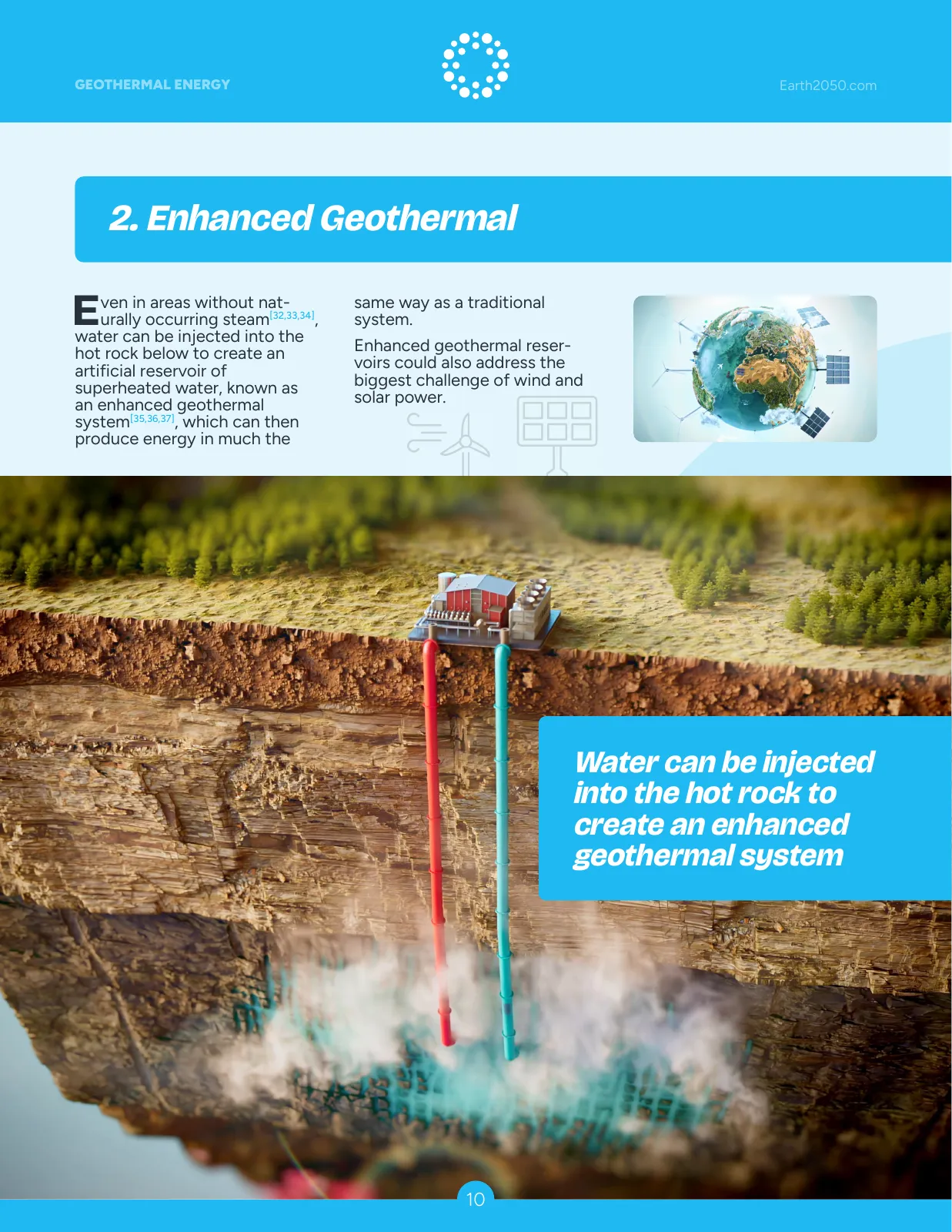
Even in areas without naturally occurring steam [32,33,34], water can be injected into the hot rock below to create an artificial reservoir of superheated water, known as an enhanced geothermal system [35,36,37], which can then produce energy in much the same way as a traditional system.
Enhanced geothermal reservoirs could also address the biggest challenge of wind and solar power.
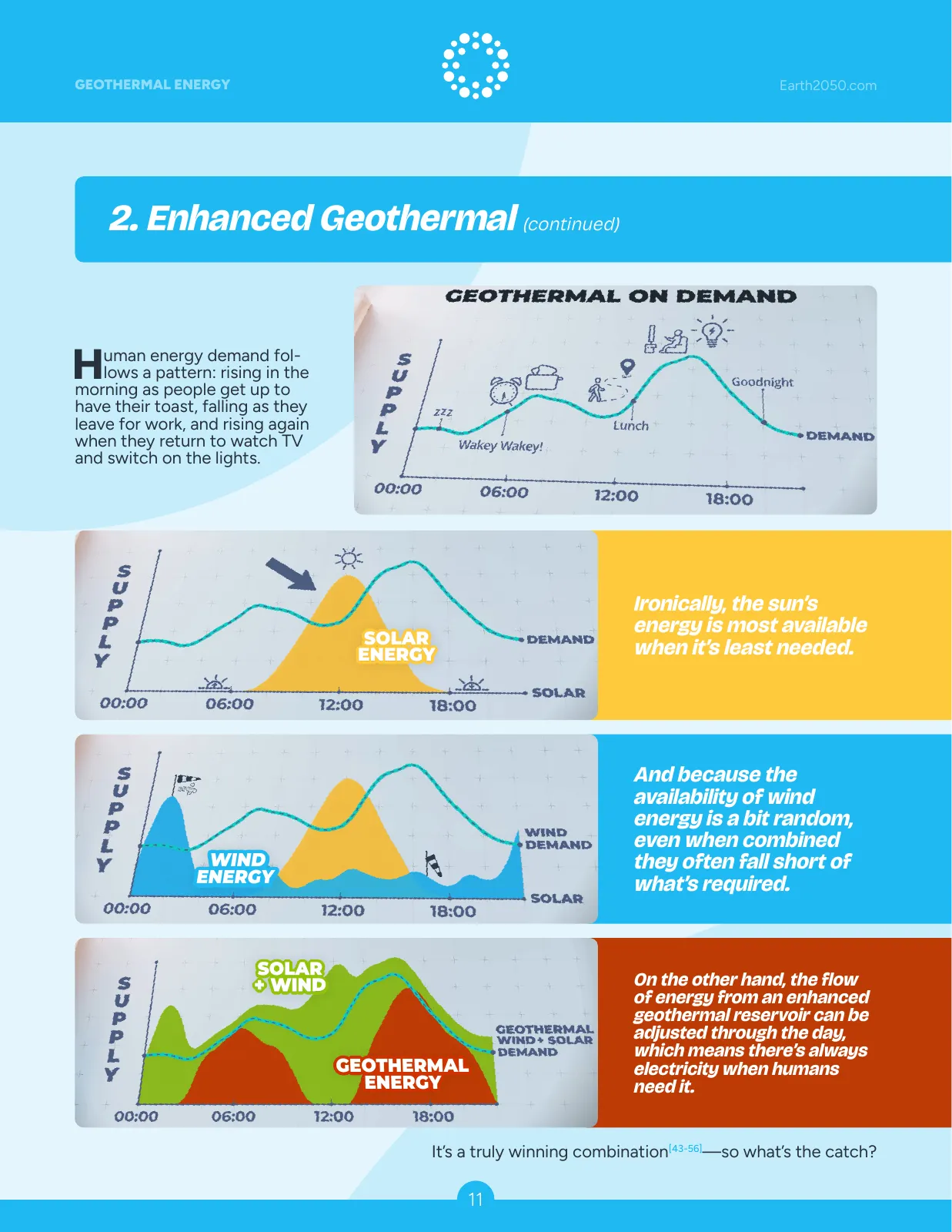
Human energy demand follows a pattern: rising in the morning as people get up to have their toast, falling as they leave for work, and rising again when they return to watch TV and switch on the lights.
Ironically, the Sun’s energy is most available when it’s least needed.
And because the availability of wind energy is a bit random, even when combined they often fall short of what’s required.
On the other hand, the flow of energy from an enhanced geothermal reservoir can be adjusted through the day, which means there’s always electricity when humans need it.
It’s a truly winning combination [43-56]. So what’s the catch?
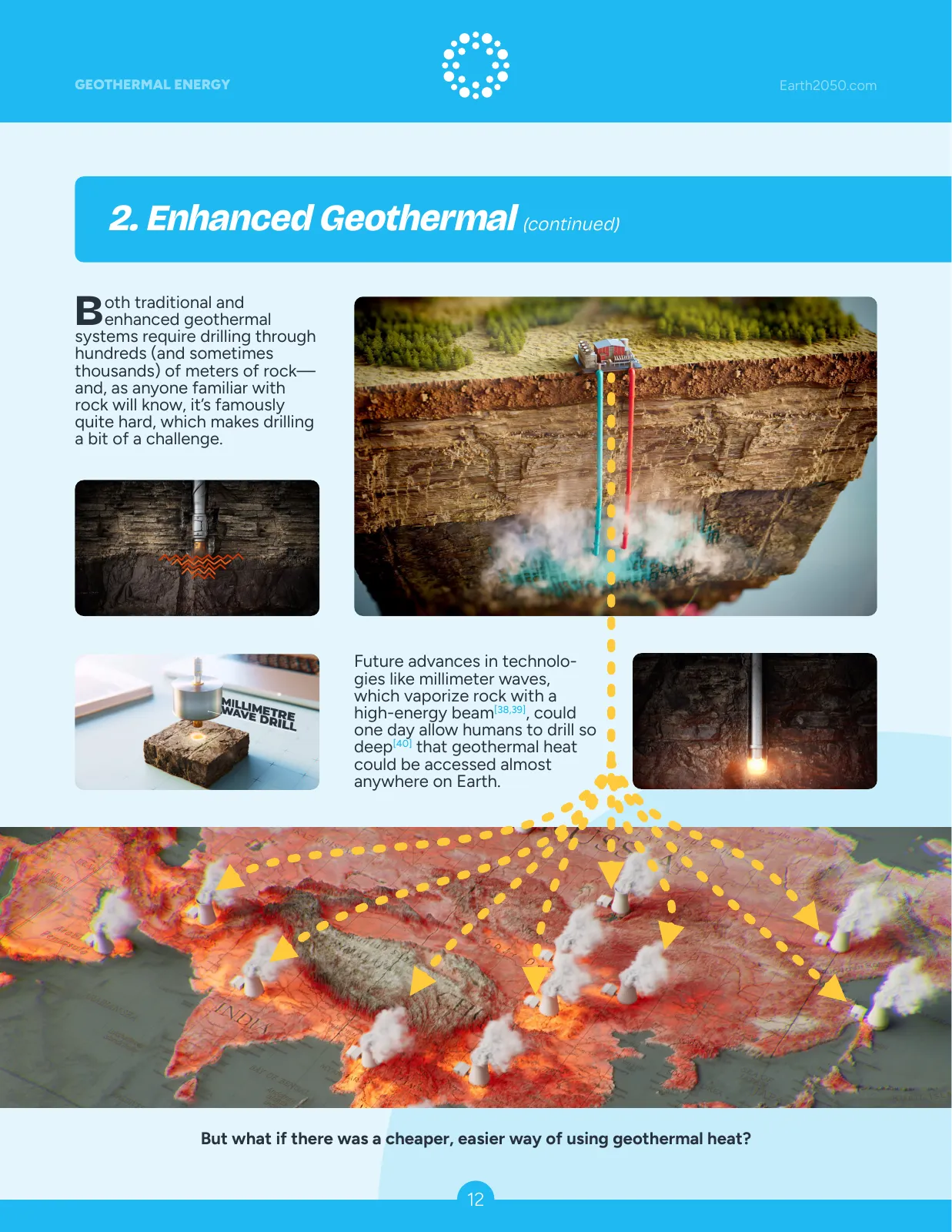
Both traditional and enhanced geothermal systems require drilling through hundreds (and sometimes thousands) of meters of rock. And, as anyone familiar with rock will know, it’s famously quite hard, which makes drilling a bit of a challenge.
Future advances in technologies like millimeter waves, which vaporize rock with a high-energy beam [38,39], could one day allow humans to drill so deep [40] that geothermal heat could be accessed almost anywhere on Earth.
But what if there was a cheaper, easier way of using geothermal heat?
That’s where the third option comes in: Ground Source Heat Pumps!
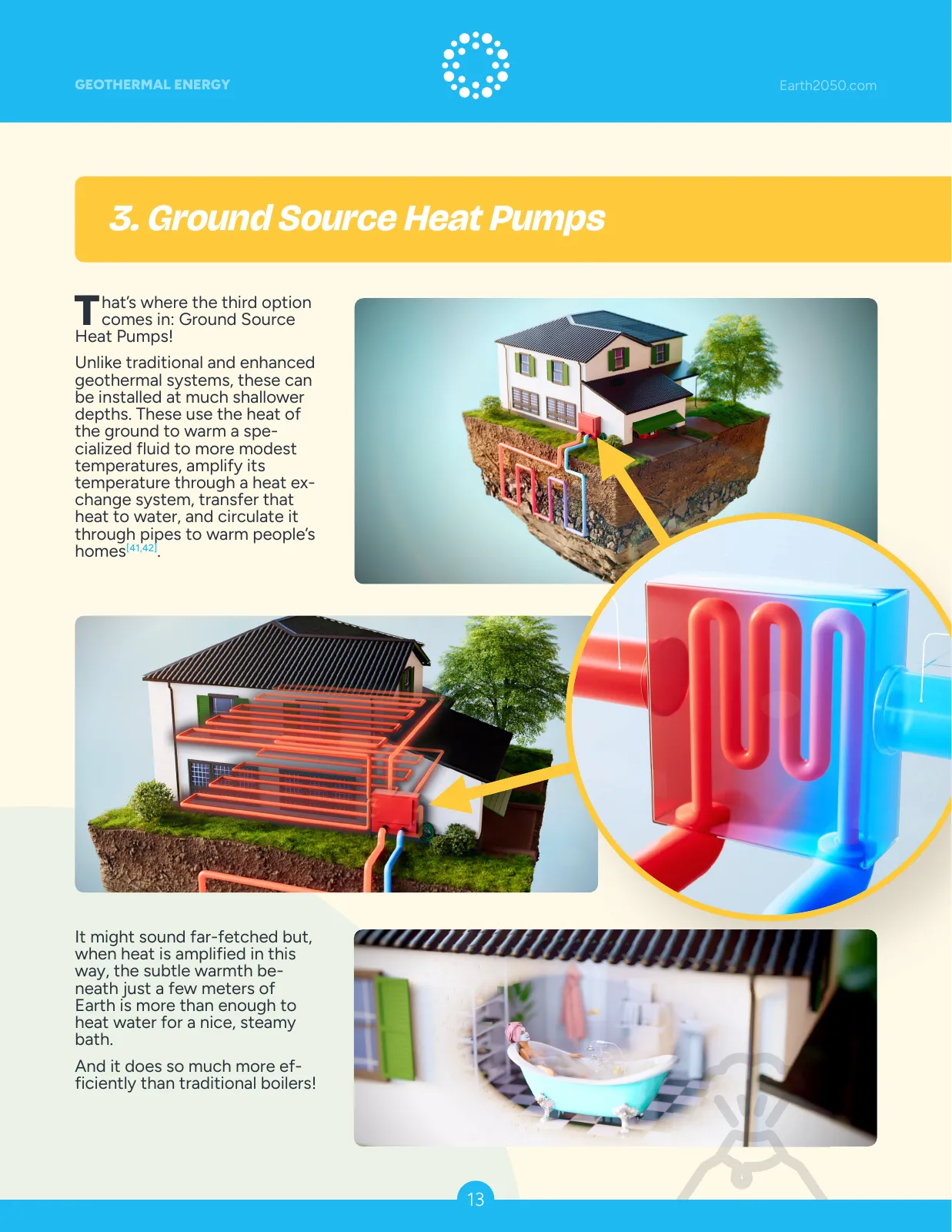
Unlike traditional and enhanced geothermal systems, these can be installed at much shallower depths. These use the heat of the ground to warm a specialized fluid to more modest temperatures, amplify its temperature through a heat exchange system, transfer that heat to water, and circulate it through pipes to warm people’s homes [41,42].
It might sound far-fetched but, when heat is amplified in this way, the subtle warmth beneath just a few meters of Earth is more than enough to heat water for a nice, steamy bath.
And it does so much more efficiently than traditional boilers!
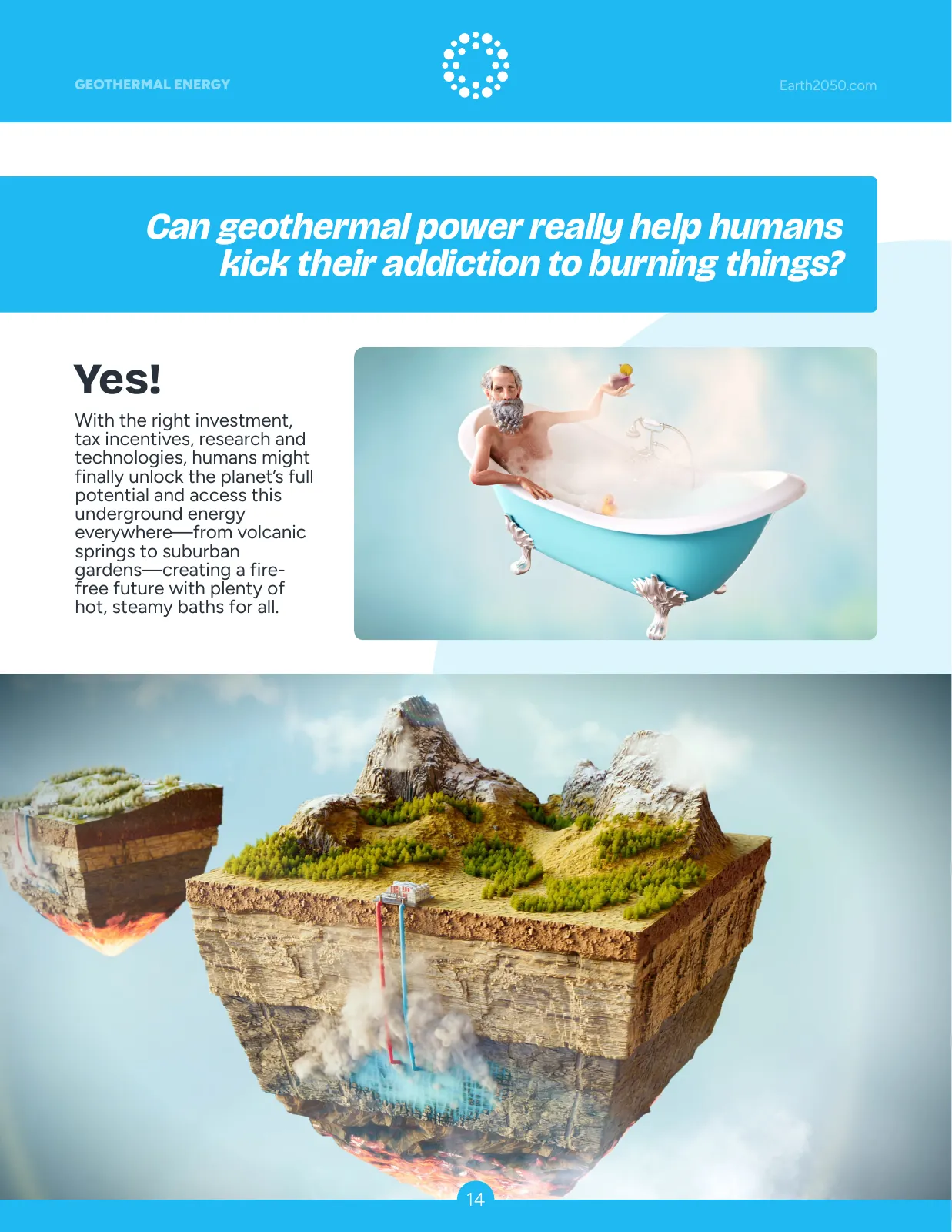
Can geothermal power really help humans kick their addiction to burning things? Yes!
With the right investment, tax incentives, research and technologies, humans might finally unlock the planet’s full potential and access this underground energy everywhere, from volcanic springs to suburban gardens, creating a fire-free future with plenty of hot steamy baths for all.
Expert Advisors
2
We would like to thank
Prof. Jon Gluyas
Durham University
President, The Geological Society
Department of Earth Sciences
Dr. Andrea Paulillo
University College London
Dept of Chemical Engineering
Further Videos
22 links
These resources are non-affiliated.
Geothermal Energy – Overview
 Renewable Energy 101: How Does Geothermal Energy Work?Green Mountain Energy
 GCSE Physics - Geothermal PowerCognito
 Energy 101: Geothermal EnergyU.S. Department of Energy
 Geothermal energy is renewable and powerful. Why is most of it untapped?DW Planet A
 Why don't we all just use Geothermal Energy?Just Have a Think
 Batteries are dirty. Geothermal power can helpVox
 This Overlooked Energy Source Could Supply 50% Of ElectricityCNBC
 Could Earth's Heat Solve Our Energy Problems?Real Engineering
Enhanced Geothermal
 Enhanced Geothermal Could Revolutionize Clean EnergyDistilled
 This Groundbreaking Clean Energy Source Could Power AmericaTDC
 Geothermal Energy in Utah [FULL EPISODE: Utah's Power Pivot E4]PBS Utah
 The Big Business of Drilling Deep Into the EarthBloomberg Primer
 Geothermal energy’s massive leap forwardThe Economist
 This Tech Solves Geothermal's BIGGEST Problem - Gamechanger?Two Bit da Vinci
Geothermal (Ground Source) Heat Pumps
Millimeter Wave Drilling and Beyond
 Geothermal Energy is ChangingReal Engineering
 Millimeter Wave Drilling | The Future of Clean EnergyQuaise Energy
 An El Dorado of Clean Energy: Millimeter Wave Geothermal Drilling with Quaise EnergyARPA-E
 New DRILLING Machine Unlocks Unlimited ENERGY!?Motor Explorer
 How Deep Could We Dig for Infinite Geothermal Energy?Interesting Engineering
 This Fusion Tech is Solving the Geothermal Energy ProblemDr Ben Miles
Further Reading
24 links
These resources are non-affiliated.
Summary Information
- Geothermal Basics - Department of Energy
- Geothermal Energy Information and Facts - National Geographic
- Geothermal Energy - MIT Climate Portal
- Geothermal Energy - National Geographic Education
- Geothermal heat pump | Description, Mechanism, Design, Advantages, Disadvantages, & Facts - Britannica
History
- The Geothermal City: History - MIT
- Geothermal Energy throughout the Ages - Electricity & Alternative Energy - Alberta's Energy Heritage
- Larderello, Italy celebrates 120 years of geothermal electricity generation - Think GeoEnergy
- The First National Exposition of History of Science 1929 | Piero Ginori Conti - Museo Galileo
How It Works
- Why is the earth's core so hot? And how do scientists measure its temperature? - Scientific American
Overview (Traditional)
- An Overview of Geothermal Resources - ThinkGeoEnergy
- Geothermal Energy: An Overview - Wright-Ingraham Institute
- Iceland, a world leader in clean energy, supports Africa's push for geothermal power - UNEP
- Iceland is closing the circle on geothermal - Energy Monitor
Enhanced Geothermal
- Enhanced Geothermal Systems - Department of Energy
- Enhanced Geothermal System (EGS) Fact Sheet - US Department of Energy
- Geothermal Technologies Program: Enhanced Geothermal Systems - NLR (NREL)
Ground Source Heat Pumps
- Geothermal Heat Pumps - Department of Energy
- Clean Energy 101: Geothermal Heat Pumps - RMI
- Ground source heat pumps: costs, savings and benefits - Energy Saving Trust
Millimeter Wave Drilling
- Geothermal Energy with Millimeter Wave or Direct Energy Drilling - Geoengineering Global
- High-power millimetre wave drilling for geothermal energy - Environmental Science
- Quaise Energy achieves drilling milestone with millimetre wave technology - Energy Global
- (see Quaise Energy)
References
57 links
- [1] Analysis: Which countries are historically responsible for climate change? | Carbon Brief (see Reference Notes*)
- [2] The weight of all life on Earth | ESALQ – College of Agriculture, University of São Paulo
- [3] A Short History of the Long Relationship Between the Human Race and Geothermal Phenomena | Proceedings World Geothermal Congress
- [4] Geothermal Energy throughout the Ages - Electricity & Alternative Energy | Alberta's Energy Heritage
- [5] Roman Baths Hot Spring Water Heat Recovery System | Buro Happold
- [6] Taking the waters: recovering heat from the Roman Baths | CIBSE Journal
- [7] Bath Abbey to be heated using water from city's hot springs | Energy | The Guardian
- [8] Medicinal Hot Springs And Healing Spas In The Graeco-Roman World (In: Leisure, Pleasure and Healing) | Supplements to the Journal for the Study of Judaism
- [9] Encyclopedias of Nature: Reading Pliny | Leonardo's Library | Spotlight at Stanford
- [10] Remembering Pliny the Elder and the first encyclopedia | Knowable Magazine
- [11] On the Death of Pliny the Elder | Memoirs of the American Academy of Arts and Sciences
- [12] The Tragic Death of Pliny the Elder and Pompeii’s Final Days | The Collector (see Reference Notes*)
- [13] The casts of Pompeii: Post-depositional methodological insights | PLOS ONE (see Reference Notes*)
- [14] The Geothermal City: History | MIT
- [15] Did you know… Italy is home to the oldest geothermal plant in the world? | Utah FORGE
- [16] The First Geothermal Power Plant in The World | World-Energy
- [17] Earth’s Core | National Geographic
- [18] Why is the earth's core so hot? And how do scientists measure its temperature? | Scientific American
- [19] Why doesn’t Earth’s core melt the planet? | BBC Science Focus
- [20] Strong Evidence For Coronal Heating Theory Presented at 2015 TESS Meeting | NASA
- [21] Thermal and electrical conductivity of iron at Earth’s core conditions | Nature
- [22] What Is Geothermal Energy? | Planète Energies
- [23] Geothermal energy: Potential for heat and power in Great Britain | House of Lords Library
- [24] A global review of enhanced geothermal system (EGS) | Renewable and Sustainable Energy Reviews
- [25] Geothermal energy as a means to decarbonize the energy mix of megacities | Communications Earth & Environment | Nature
- [26] Reinjection in geothermal fields: An updated worldwide review 2020 | Geothermics
- [27] Reinjection - an overview | ScienceDirect Topics
- [28] Longevity and power density of intermediate-to-deep geothermal wells in district heating applications | The European Physical Journal Plus
- [29] Geothermal Energy | National Geographic
- [30] Geothermal energy exploitation in an island-based 100% renewables strategy. Case study of Tenerife (Spain) | Journal of Cleaner Production
- [31] Energy Figures 2021 | Orkustofnun (Also Primary Energy Use in Iceland 1940-2020 | Orkustofnun)
- [32] Predicting geographical suitability of geothermal power plants | Journal of Cleaner Production
- [33] CGG Licenses Geothermal Multi-Client Studies Supporting Energy Transition to US Energy Company | Viridien
- [34] From hot rock to useful energy: A global estimate of enhanced geothermal systems potential | Applied Energy
- [35] Enhanced Geothermal System (EGS) Fact Sheet | US Department of Energy
- [36] Geothermal Technologies Program: Enhanced Geothermal Systems | NLR (NREL)
- [37] Enhanced Geothermal System - an overview | ScienceDirect Topics
- [38] Geothermal Energy with Millimeter Wave or Direct Energy Drilling | Geoengineering Global
- [39] Quaise Energy
- [40] Deep Geothermal Drilling Using Millimeter Wave Technology | OSTI.GOV
- [41] Clean Energy 101: Geothermal Heat Pumps | RMI
- [42] Geothermal Heat Pumps: How They Work | AHRI
- [43] Flexible Resources Help Renewables | Fast Facts | California ISO
- [44] Why pumped hydro? | Queensland Hydro
- [45] Real-time Operating Grid | U.S. Energy Information Administration (EIA)
- [46] Capturing variation in daily energy demand profiles over time with cluster analysis in British homes | Applied Energy
- [47] The demand is smart and adapts to changes in the price profile | AleaSoft Energy Forecasting
- [48] Figure 1: Wind power and solar energy generation curves compared with power (In: The New Hybrid Model of Compressed Air for Stable Production of Wind Farms) | International Journal of Emerging Technology and Advanced Engineering
- [49] Figure 1: Daily supply and demand with storage of renewable energy (In: Geophysical assessments of renewable gas energy compressed in geologic pore storage reservoirs) | SpringerPlus
- [50] Figure 4: Forecasting and actual power output of wind farm (In: Wind power forecasting error-based dispatch method for wind farm cluster) | Journal of Modern Power Systems and Clean Energy
- [51] Figure 1: Wind and thermal electricity generation and the half hourly spot price (In: Changing winds: how wind energy interacts with the New Zealand power system) | Electricity Authority
- [52] Figure 1: Mean half-hourly electricity consumption per half hour (In: Electricity consumption and household characteristics: Implications for census-taking in a smart metered future) | Computers Environment and Urban Systems
- [53] Figure 1: Simulated hourly profiles of wind, solar, wind-solar hybrid system output and load profile (In: Exploiting wind-solar resource complementarity to reduce energy storage need) | AIMS Energy
- [54] Figure 2: Average half-hourly Electricity Demand during the control period (In: How Does Daylight Saving Time Affect Electricity Demand? An Answer Using Aggregate Data from a Natural Experiment in Western Australia) | Energy Economics
- [55] The value of in-reservoir energy storage for flexible dispatch of geothermal power | Applied Energy
- [56] Figure 15 (In: Quantitative techno-economic comparison of a photovoltaic/wind hybrid power system with different energy storage technologies for electrification of three remote areas in Cameroon using Cuckoo search algorithm) | Journal of Energy Storage
Reference Notes
3
reports 1718 Gt CO2 which is equivalent to 468.54 Gt carbon.
Bonus Material – Pliny the Elder, bathing in his last moments (see animation)
[12] Pliny the Elder observed a large, ominous cloud emerge from the top of Mount Vesuvius. Upon deciding something wasn’t right, he chose not to escape and save himself, but instead launch a fleet of warships to help others along the coast, and set off with them. Upon receiving a note from his friend Rectina calling for help, the journey quickly became clear as that of a rescue mission. Pliny reached Rectina in his home 5km from Pompeii, and was advised by his helmsman to retreat - instead, Pliny refused, and carried onwards to help his other friend, Pomponianus, in Stabiae. It was here that both men tried to relax, have dinner, bathe, and see out the danger overnight. But during the night, ash and pumice began to rain down, tremors shook their foundations and the flow of lava swallowed distant houses and was fast approaching the house. Conditions worsened, and dangers rose both inside and out. By morning, they made the decision to evacuate and head for the beach - sadly to be overcome in their flight by the rising heat, flames, and suffocating fumes.
[13] clarifies that there was no single event that resulted in catastrophe, but multitudinal cumulative disasters, and time for citizens of Pompeii to attempt escape while hot ash and pumice rained down before the pyroclastic surge claimed the lives of most citizens. This reinforces the conclusion that Pliny the Elder had time to bathe and relax before an evacuation effort was made.
Energy Demand Chart
The chart shown is a simplified representation of daily changes in energy demand and the issues of renewable intermittency based on [43-56], visualized through 4 main parameters:
- Demand for energy typically varies throughout the day as people go about their daily routines. Consumption of electricity tends to peak in the morning and evening when people get up or get home from work – switching on lights, televisions, cooking appliances etc. – and typically levels off or decreases during the middle of the day when people are at work, on the move, or outside. Predictably, demand is lowest at night when people are asleep.
(Specific demand patterns vary throughout the literature; several sources were consulted and simplified for the purposes of this graph.) - Solar Power – Supply of power from solar generation peaks during the middle of the day when sunlight is at its maximum and decreases into the evening as the sun sets. This familiar pattern shows discrepancy with people’s consumption of electricity, creating shortfalls in supply when demand is at its greatest: Even as the sun rises and supply increases, it is not sufficient to overcome the morning peak in demand. On-the-other-hand, there is a surplus of power during the middle of the day when the sun is at its highest, but demand is relatively low.
- Wind Power – Supply of power from wind generation is relatively variable and erratic by nature. There is no consistent, predictable pattern to wind in the short term (hourly) like that of sunlight (though some sources quote a tendency for wind to peak during the afternoon). But like solar, wind power can create surpluses at some points of the day and fail to meet demand at others. Entire days of stillness could pass where wind is insufficient for demand, or relentlessly windy days provide a continuous surplus of power. Ultimately, on its own, wind power is an unreliable source of energy. Even with wind and solar combined, they can often fail to provide sufficient power during periods of peak demand, and especially on cloudy, windless days.
- Complementary power – Other sources of energy can be utilized to compensate for the intermittent shortfalls of power associated with wind and solar and help supply meet demand. Energy supplied from sources like hydropower, biofuels, and enhanced geothermal can be adjusted throughout the day, providing additional energy when needed or reducing overgeneration and wasted surpluses across off-peak periods. This allows demands to be met consistently at all times of day by using a consortium of energy sources. Using a renewable source (as opposed to fossil fuels) as the adjustable, complementary supply helps in meeting demands without creating further unnecessary carbon emissions.
Load-tracking vs Baseload power:
Enhanced geothermal power is a key example of an energy source that can be flexibly and dynamically adjusted to follow real-time changes in demand created by intermittencies and human consumption patterns, and is known as a ‘load-tracking’ supply. Other energy sources, such as fossil fuel or nuclear power plants, are traditionally known as ‘baseload’ power supplies A. This means they can provide continuous, reliable power to meet our most basic-level energy demands; however, unlike enhanced geothermal, they are not easily adjustable, and output cannot be quickly ramped up or down to keep up with demand. Additional power plants, known as ‘peak-load’, are integrated into the grid network to provide additional power during periods of peak demand. But even peak-load power stations take time to be switched on and off, creating inefficiency, overproduction and waste.
Our graph is a simplified variation of The Duck Curve B, a widely recognized graphic illustrating the difference between demand and supply from solar(/wind) and the resulting load on our electrical grid system - i.e. it shows the net demand remaining after already accounting for that met by solar(/wind) power, thereby combining those parameters into a single curve. It highlights that while wind and solar can help towards meeting energy requirements, they cannot (currently) replace baseload entirely. By not fulfilling 100% of demand at all times, they can place additional strain on the grid by necessitating rapid and more frequent adjustments of traditional, slow-ramping baseload plants to compensate (or at least, not without resulting in redundancies, substantial inefficiencies and wasted power). For example, as solar production wanes in the evening just as electricity demand peaks, utility companies operating baseload power plants must quickly ramp up production in solar’s stead. This not only creates operational stress, but these plants are only economical when running constantly - switching them on and off throughout the day makes them economically unviable.
Solutions to this issue aim to ‘flatten the belly of the duck’ (and thus reduce the extent baseload plants must be ramped up or down), and include:
- Improve baseload operations to adjust output more flexibly
- Adjust our behavior of energy consumption so it's more consistent throughout the day
- Redirect surplus power to alternative applications
- Incorporate grid-scale energy storage
- Switch to other, more flexible ‘load-tracking’ sources like enhanced geothermal or hydroelectric power
See also: Ten Years of Analyzing the Duck Chart: How an NREL Discovery in 2008 Is Helping Enable More Solar on the Grid Today | NLR (NREL) (archived)