
Electricity
Nuclear Power
Nuclear Power: Yes or No?
Few topics split the room like nuclear energy. We explain how fission makes electricity without burning fossil fuels, why steady output can help alongside renewables, and what history tells us about accidents and waste. We also look at costs and timelines, long-term waste storage, and where newer designs like small modular reactors (SMRs) could show up next, from nuclear-powered container ships to data centers.
Download the Guide3.2overall
How this solution scores
- Impact5 / 5Large, steady low-carbon power that runs whatever the weather.
- Speed2 / 5New plants often take a decade or more to come online.
- Cost2 / 5Very high upfront costs, with a long history of overruns.
- Readiness5 / 5A mature technology running worldwide for decades; smaller reactors are developing.
- Nature2 / 5Tiny land footprint, but uranium mining, radioactive waste and water use are problems.
Guide
This is the illustrated transcript of the film.

Quiz
Question 1 of 10
Who first came up with the idea of atoms, around 430 BC?
Score 0 / 10
Transcript
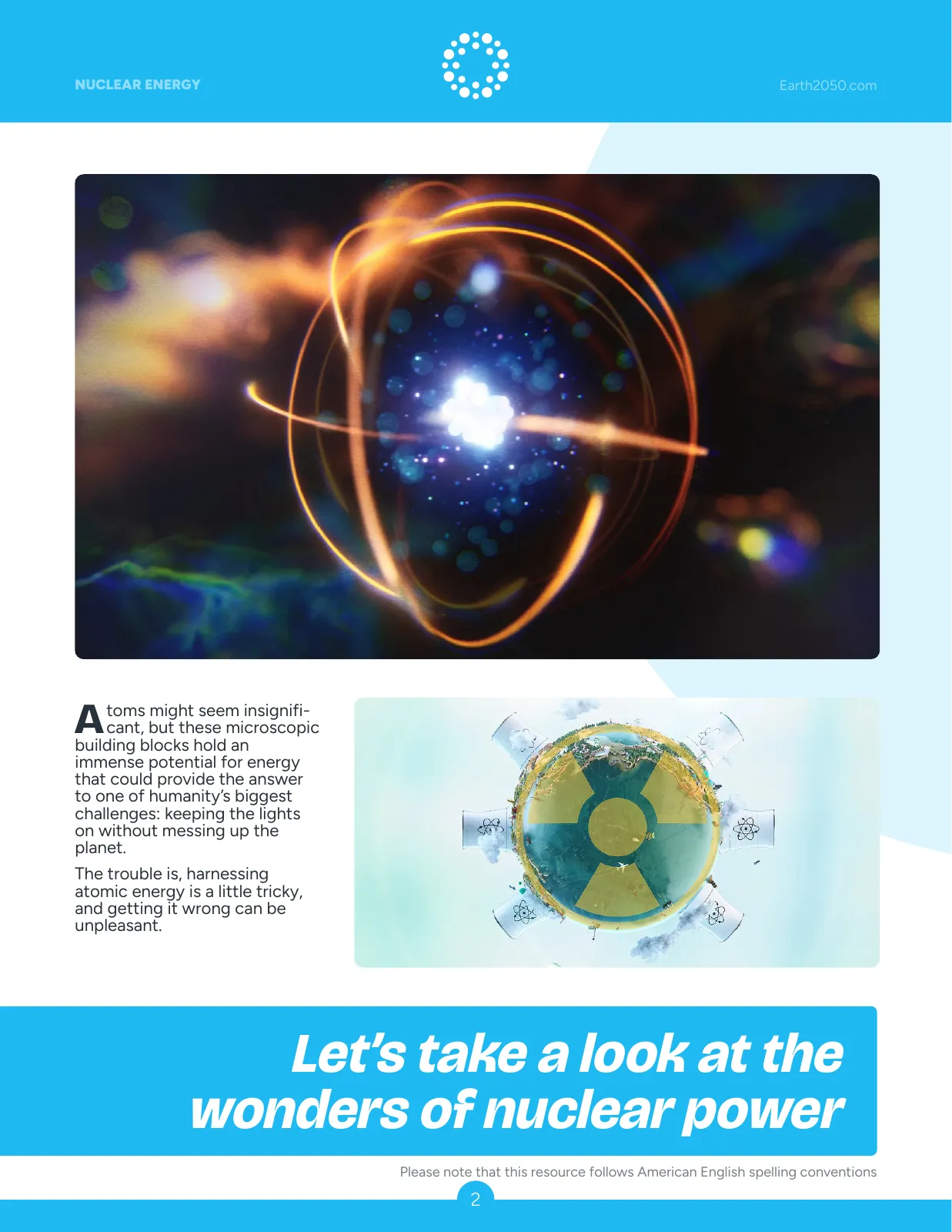
Atoms might seem insignificant, but these microscopic building blocks hold an immense potential for energy that could provide the answer to one of humanity’s biggest challenges: keeping the lights on without messing up the planet.
The trouble is, harnessing atomic energy is a little tricky, and getting it wrong can be unpleasant. Let’s take a look at the wonders of nuclear power.
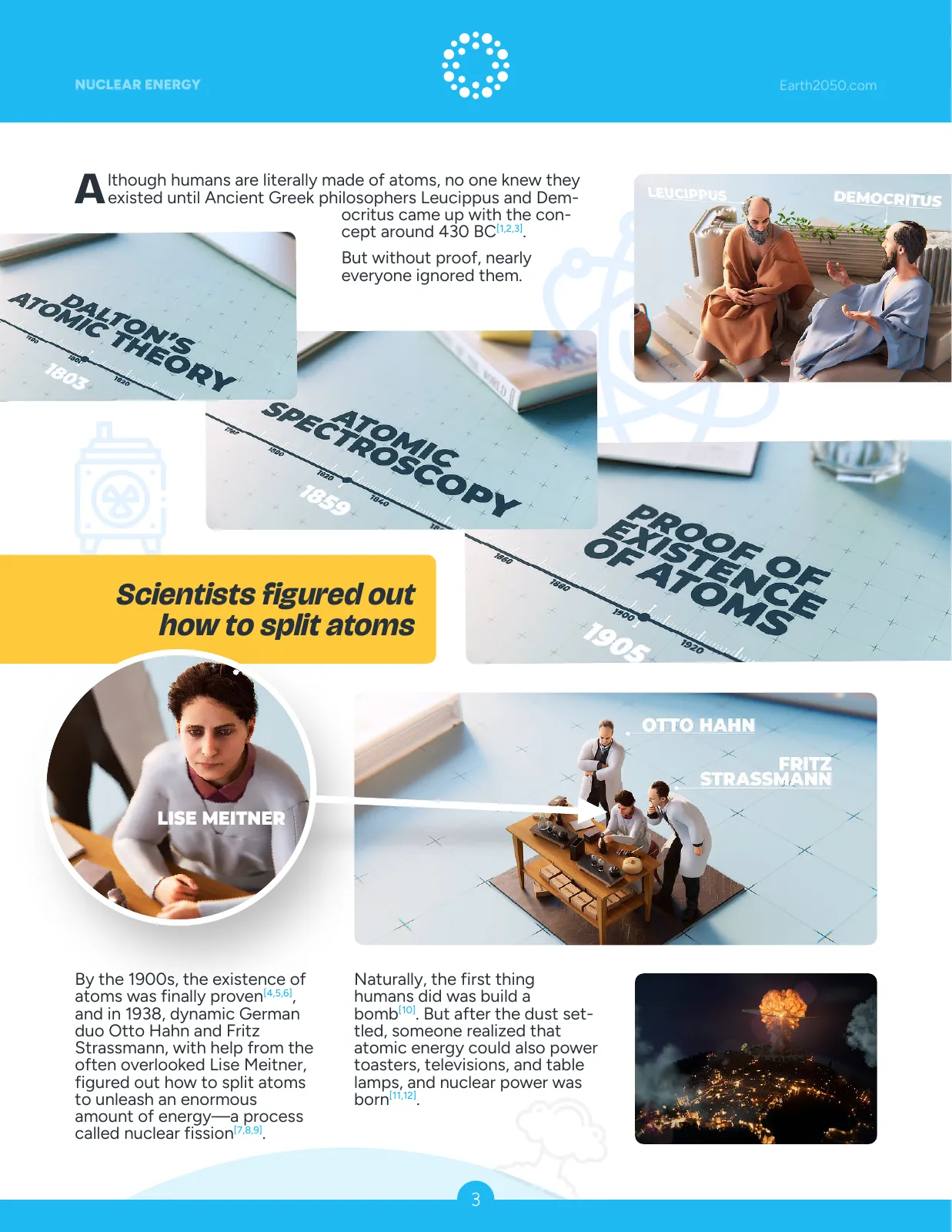
Although humans are literally made of atoms, no one knew they existed until Ancient Greek philosophers Leucippus and Democritus came up with the concept around 430 BC [1,2,3]. But without proof, nearly everyone ignored them.
By the 1900s, the existence of atoms was finally proven [4,5,6], and in 1938, dynamic German duo Otto Hahn and Fritz Strassmann, with help from the often overlooked Lise Meitner, figured out how to split atoms to unleash an enormous amount of energy - a process called Nuclear Fission [7,8,9].
Naturally, the first thing humans did was build a bomb [10]. But after the dust settled, someone realized that atomic energy could also power toasters, televisions, and table lamps, and nuclear power was born [11,12].
But how exactly can atomic energy be released?
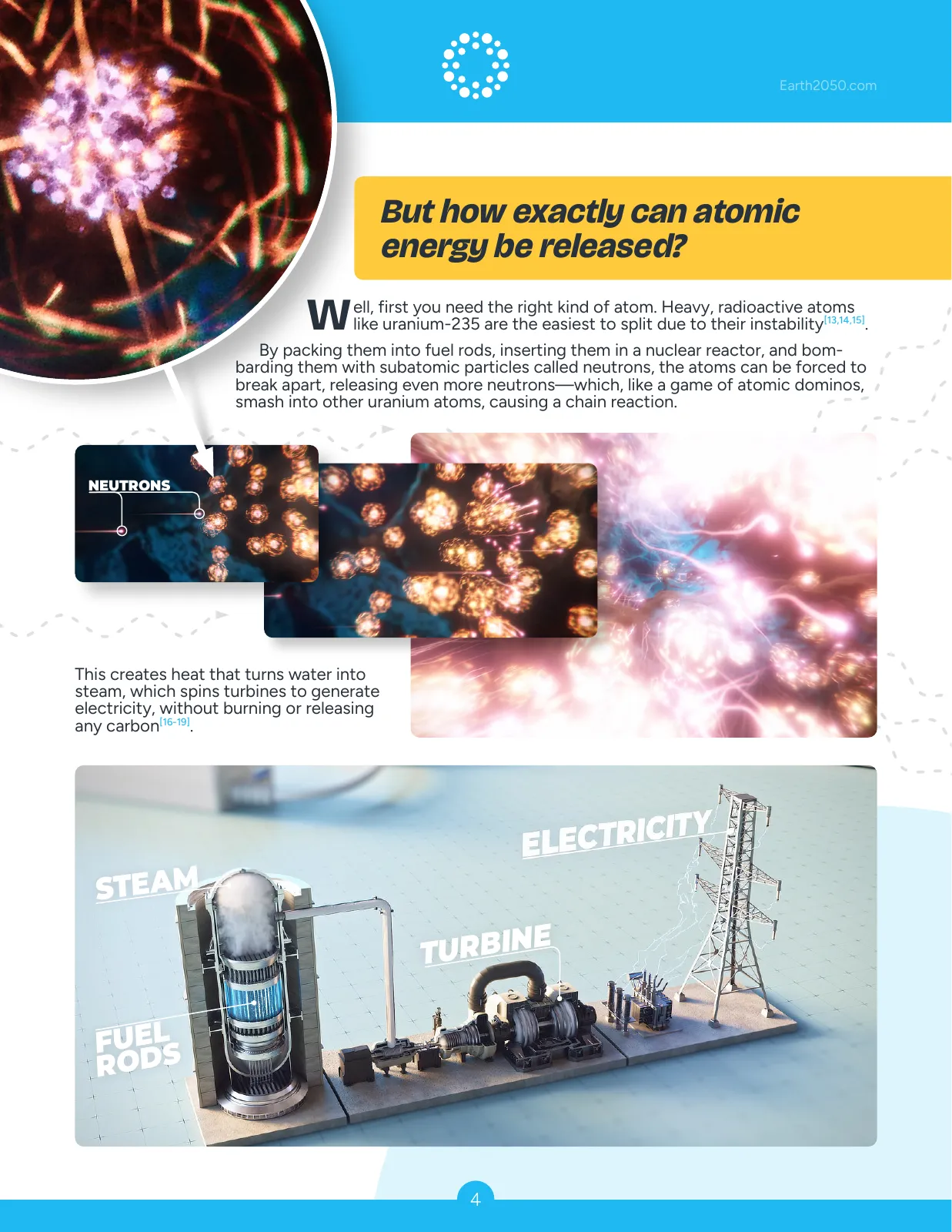
Well, first you need the right kind of atom. Heavy, radioactive atoms like uranium-235 are the easiest to split due to their instability [13,14,15].
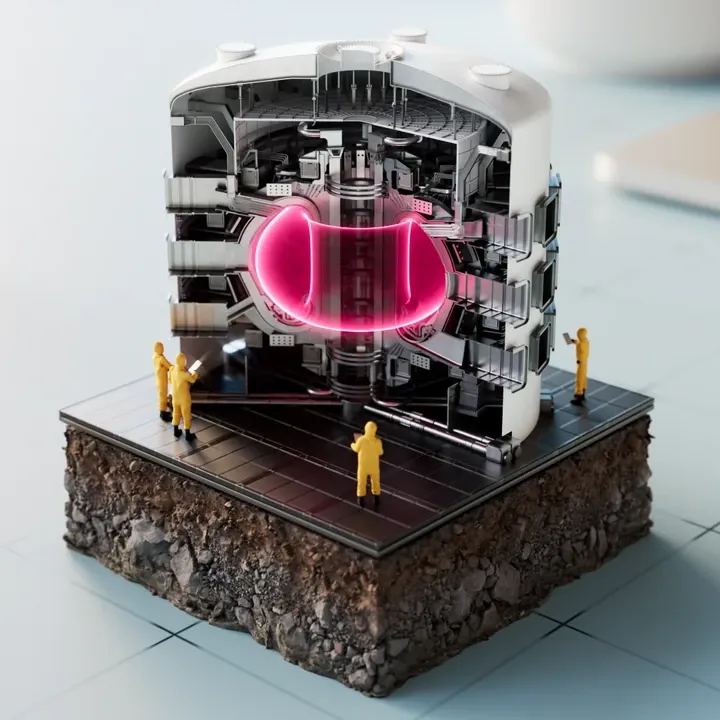
By packing them into fuel rods, inserting them in a nuclear reactor, and bombarding them with subatomic particles called neutrons, the atoms can be forced to break apart, releasing even more neutrons. These, like a game of atomic dominos, smash into other uranium atoms, causing a chain reaction.
This creates heat that turns water into steam, which spins turbines to generate electricity, without burning or releasing any carbon [16-19].
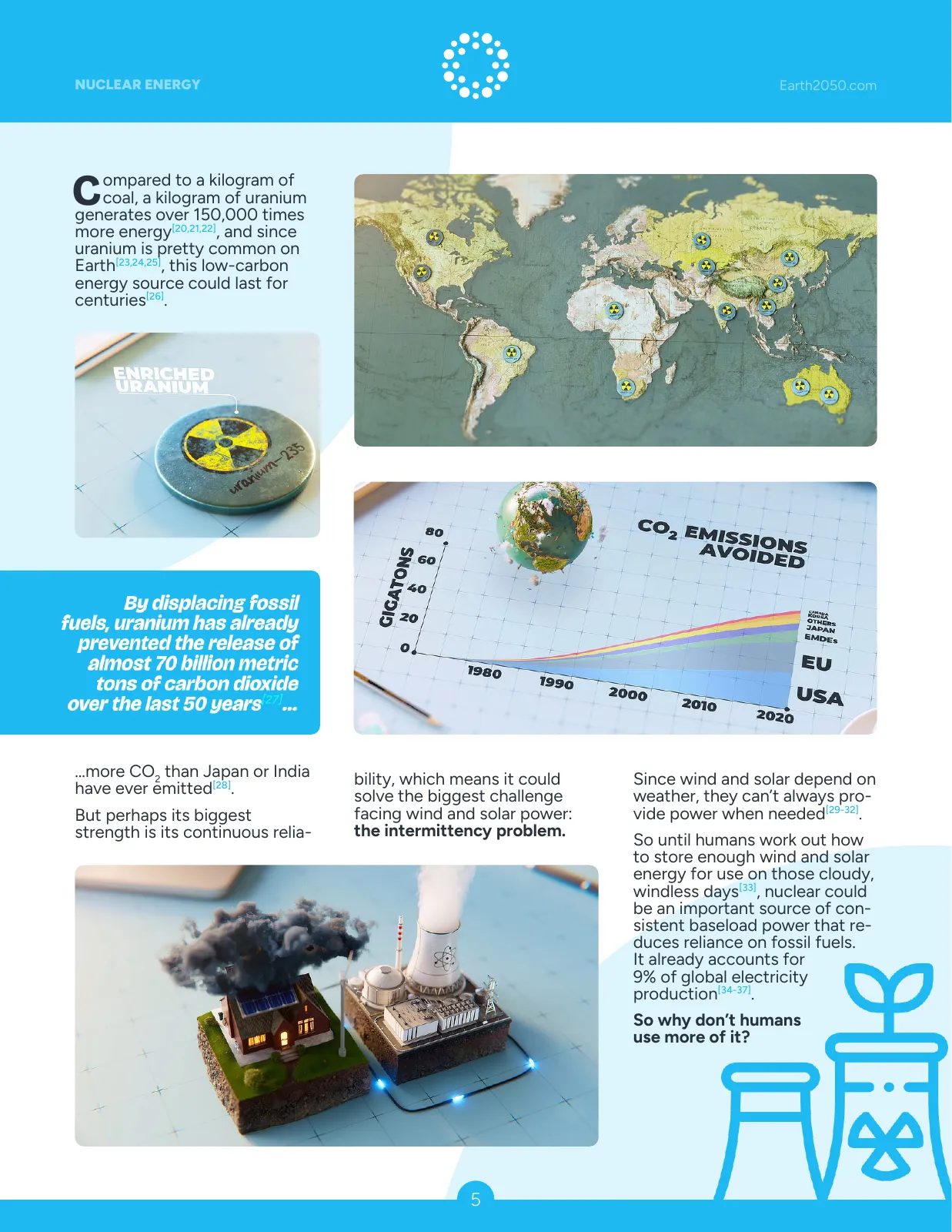
Compared to a kilogram of coal, a kilogram of uranium generates over 150,000 times more energy [20,21,22], and since uranium is pretty common on Earth [23,24,25], this low-carbon energy source could last for centuries [26].
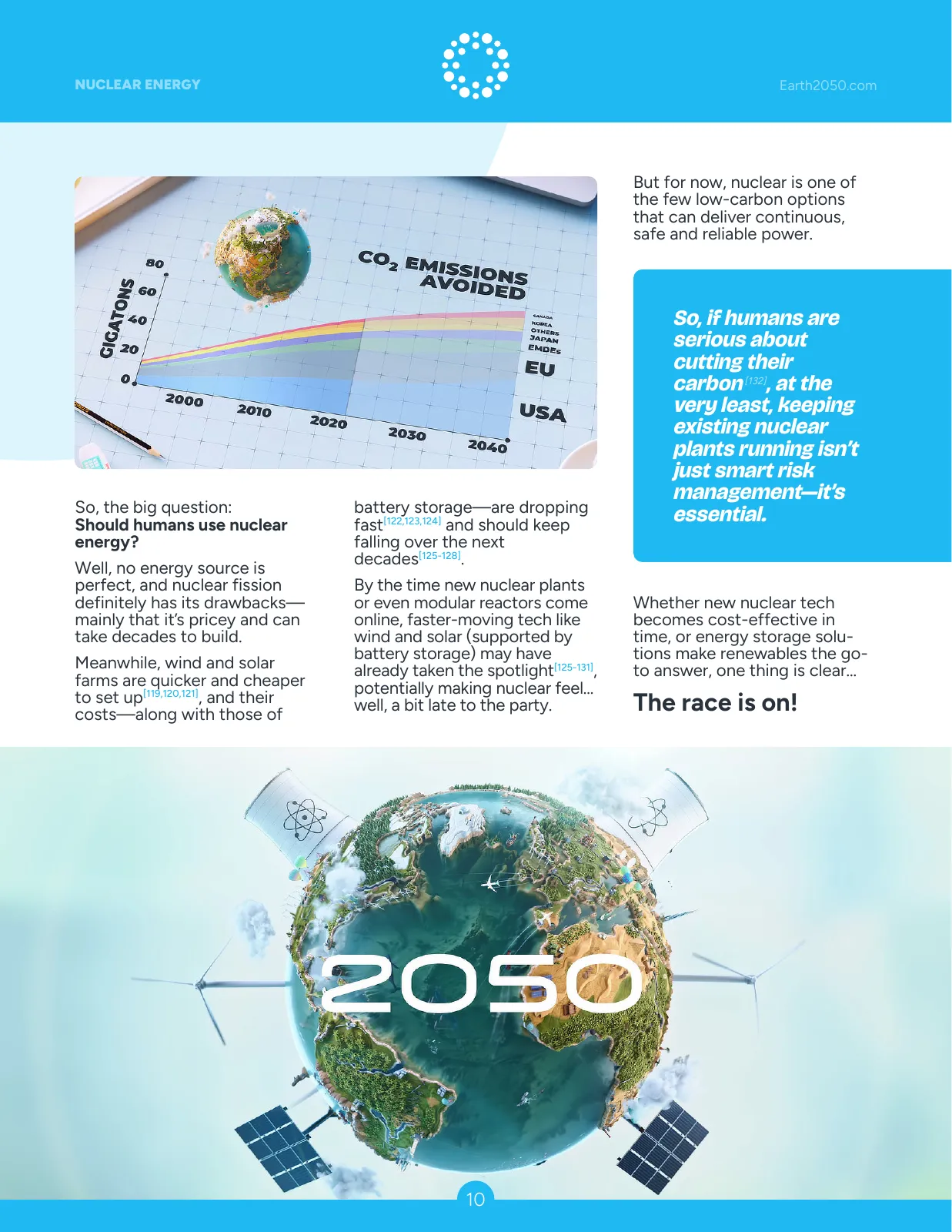
By displacing fossil fuels, it’s already prevented the release of almost 70 billion metric tons of carbon dioxide over the last 50 years [27] …more CO2 than Japan or India have ever emitted [28].
But perhaps its biggest strength is its continuous reliability, which means it could solve the biggest challenge facing wind and solar power: the intermittency problem. Since wind and solar depend on weather, they can’t always provide power when needed [29-32].
So until humans work out how to store enough wind and solar energy for use on those cloudy, windless days [33], nuclear could be an important source of consistent baseload power that reduces reliance on fossil fuels. It already accounts for 9% [34-37] of global electricity production.
So why don’t humans use more of it?
Let’s address the elephant in the room: Three Mile Island [38,39], Chernobyl [40,41], Fukushima [42,43]. These nuclear accidents weren’t exactly great for PR: they all involved failures in cooling the reactor cores and human error.
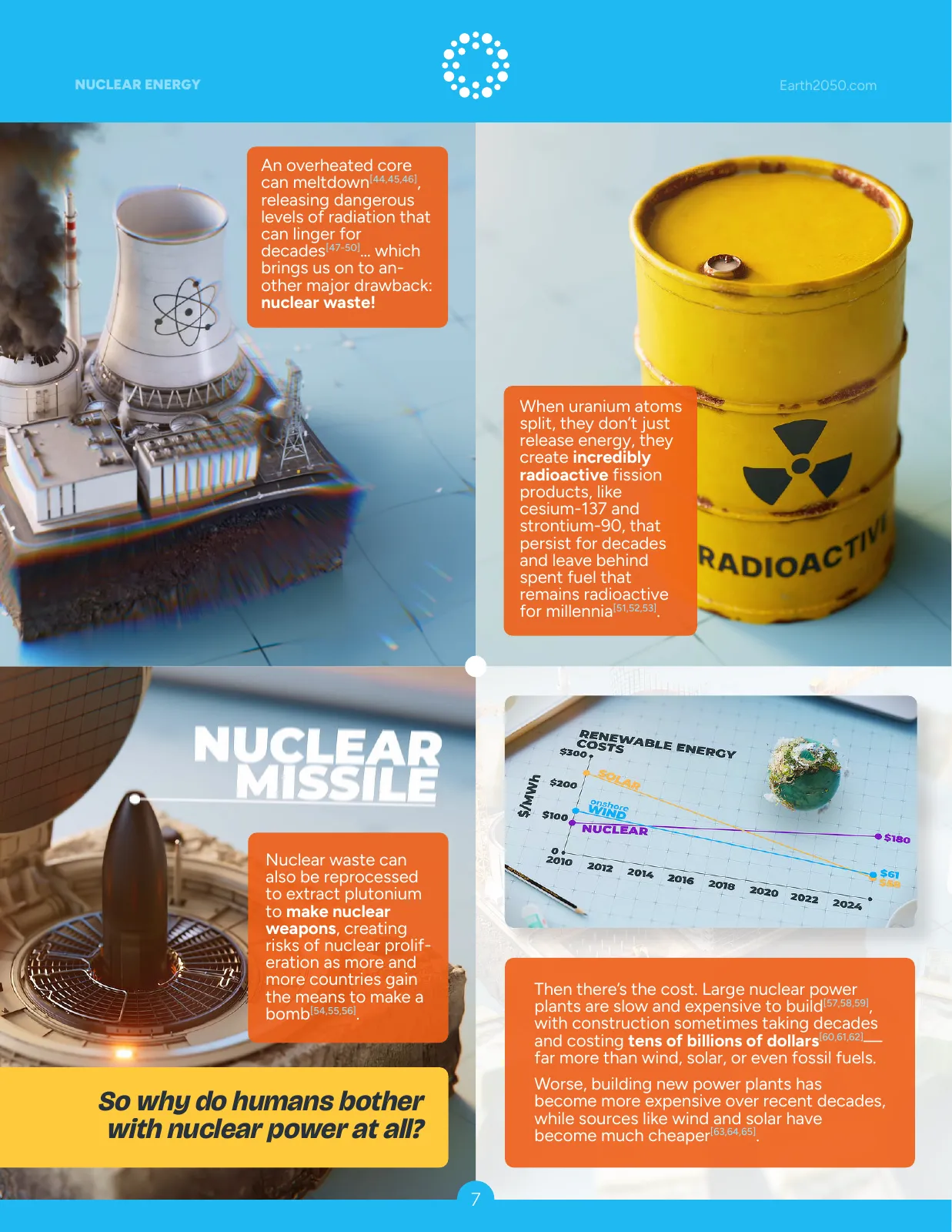
An overheated core can meltdown [44,45,46], releasing dangerous levels of radiation that can linger for decades… [47-50] which brings us on to another major drawback: nuclear waste!
When uranium atoms split, they don’t just release energy, they create incredibly radioactive fission products, like cesium-137 and strontium-90, that persist for decades and leave behind spent fuel that remains radioactive for millennia [51,52,53].
Nuclear waste can also be reprocessed to extract plutonium to make nuclear weapons, creating risks of nuclear proliferation as more and more countries gain the means to make a bomb [54,55,56].
Then there’s the cost. Large nuclear power plants are slow and expensive to build [57,58,59], with construction sometimes taking decades and costing tens of billions of dollars [60,61,62], far more than wind, solar, or even fossil fuels.
Worse, building new power plants has become more expensive over recent decades, while sources like wind and solar have become much cheaper [63,64,65].
So why do humans bother with nuclear power at all?
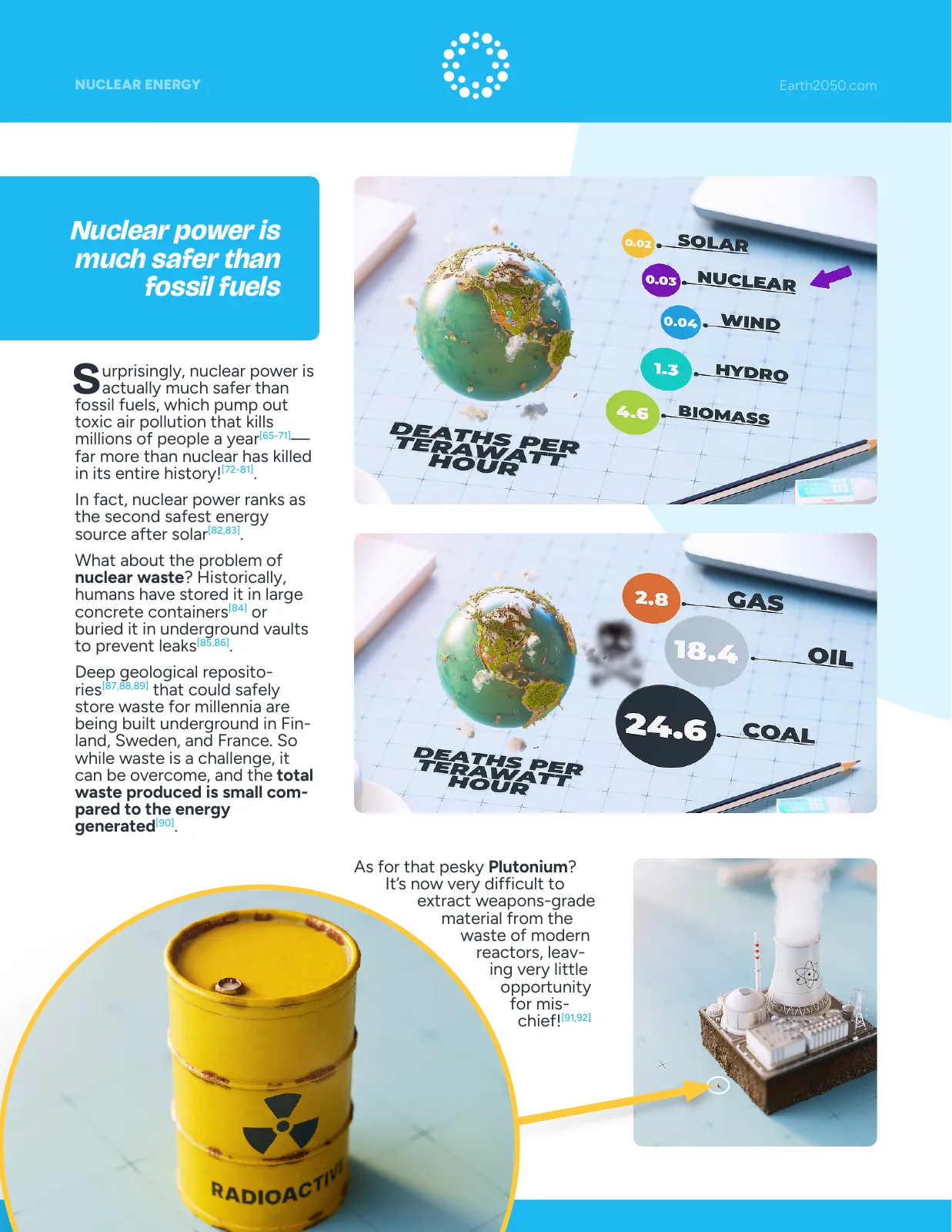
Surprisingly, nuclear power is actually much safer than fossil fuels, which pump out toxic air pollution that kills millions of people a year [65-71], far more than nuclear has killed in its entire history! [72-81].
In fact, nuclear power ranks as the second safest energy source after solar [82,83].
But what about the problem of nuclear waste? Historically, humans have stored it in large concrete containers [84] or buried it in underground vaults to prevent leaks [85,86].
Deep geological repositories [87,88,89] that could safely store waste for millennia are being built underground in Finland, Sweden, and France. So while waste is a challenge, it can be overcome, and the total waste produced is small compared to the energy generated [90].
As for that pesky Plutonium? It’s now very difficult to extract weapons-grade material from the waste of modern reactors, leaving very little opportunity for mischief! [91,92].
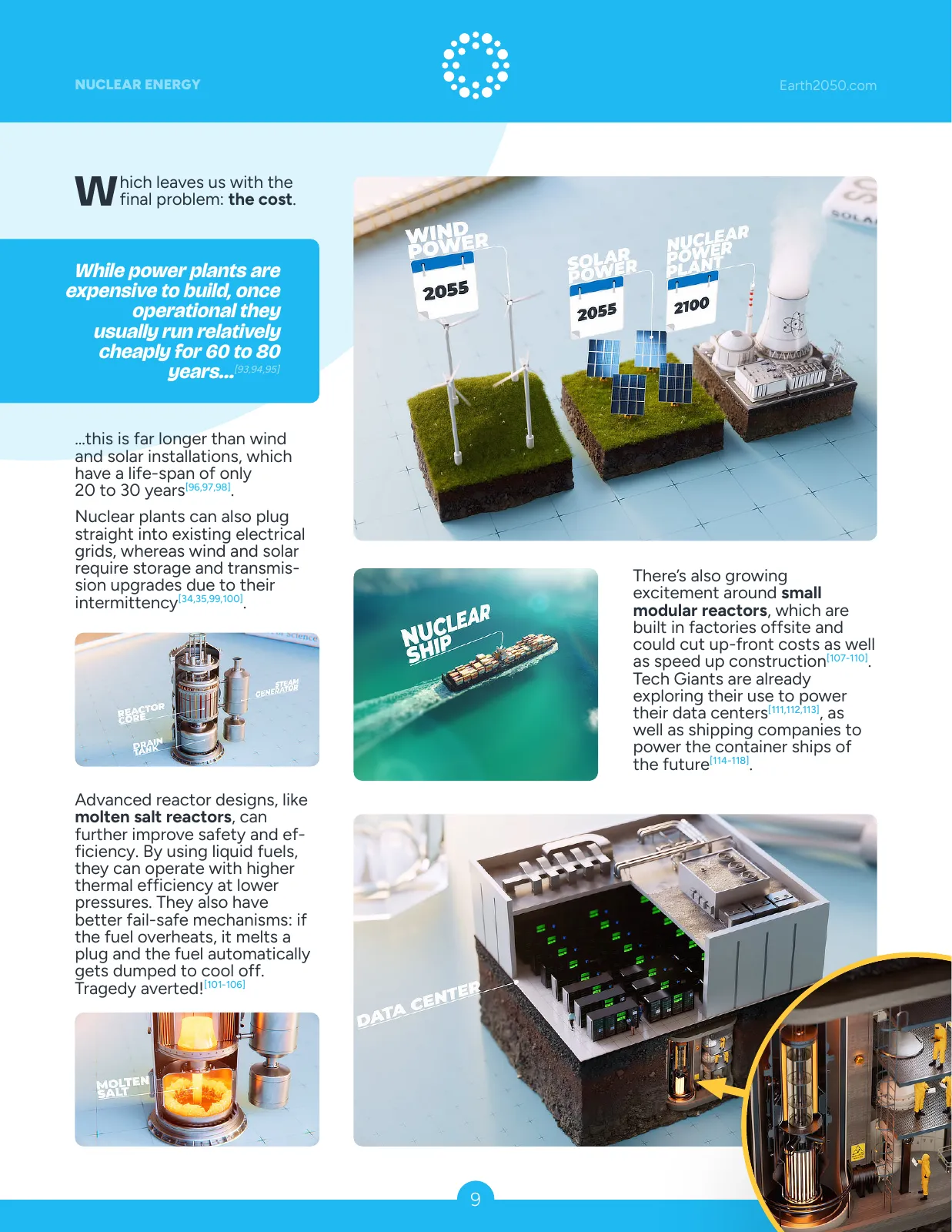
Which leaves us with the final problem: the cost. While power plants are expensive to build, once operational they usually run relatively cheaply for 60 to 80 years [93,94,95], far longer than wind and solar installations, which have a life-span of only 20 to 30 years [96,97,98]. Nuclear plants can also plug straight into existing electrical grids, whereas wind and solar require storage and transmission upgrades due to their intermittency [34,35,99,100].
Advanced reactor designs, like molten salt reactors, can further improve safety and efficiency. By using liquid fuels, they can operate with higher thermal efficiency at lower pressures. They also have better fail-safe mechanisms: if the fuel overheats, it melts a plug and the fuel automatically gets dumped to cool off. Tragedy averted! [101-106]
There’s also growing excitement around small modular reactors, which are built in factories offsite, and could cut up-front costs as well as speed up construction [107-110]. Tech giants are already exploring their use to power their data centers [111,112,113], as well as shipping companies to power the container ships of the future [114-118].
So, the big question: Should humans use nuclear ener gy? Well, no energy source is perfect, and nuclear fission definitely has its drawbacks, mainly that it’s pricey and can take decades to build.
Meanwhile, wind and solar farms are quicker and cheaper to set up [119,120,121], and their costs, along with those of battery storage, are dropping fast [122,123,124] and should keep falling over the next decades [125-128].
By the time new nuclear plants or even modular reactors come online, faster-moving tech like wind and solar (supported by battery storage) may have already taken the spotlight [125-131], potentially making nuclear feel… well, a bit late to the party.
But for now, nuclear is one of the few low-carbon options that can deliver continuous, safe and reliable power. So, if humans are serious about cutting their carbon [132], at the very least, keeping existing nuclear plants running isn’t just smart risk management. It’s essential.
Whether new nuclear tech becomes cost-effective in time, or energy storage solutions make renewables the go-to answer, one thing is clear… The race is on!
Expert Advisors
4
We would like to thank
Prof. Ian Farnan
University of Cambridge
Cambridge Nuclear Energy Centre
Dr. Nathaniel Read
University of Cambridge
Department of Engineering
Prof. Simon Middleburgh
Bangor University
Nuclear Futures Institute
Prof. James Marrow
Mansfield College, University of Oxford
Department of Materials
Further Videos
20 links
These resources are non-affiliated.
Overview - How it Works
 Nuclear Energy Explained: How does it work? 1/3Kurzgesagt
 3 Reasons Why Nuclear Energy Is Terrible! 2/3Kurzgesagt
 3 Reasons Why Nuclear Energy Is Awesome! 3/3Kurzgesagt
 Do we Need Nuclear Energy to Stop Climate Change?Kurzgesaft
 How does a nuclear power plant work?ENGIE
 How do nuclear power plants work?TED-Ed
Nuclear’s Comeback
Nuclear Waste
Issues and Economics
Issues and Economics — Situation in the US
Issues and Economics — Situation in France & Germany
Small Modular Reactors
Molten Salt Reactors
Further Reading
23 links
These resources are non-affiliated.
Summary of Nuclear Reactors
- NUCLEAR 101: How Does a Nuclear Reactor Work? - Department of Energy
- Nuclear Essentials - World Nuclear Association
- Nuclear Power Reactors - World Nuclear Association
- Nuclear Energy - MIT Climate Portal
History
- Atom - Development, Theory, Structure - Britannica
- History of nuclear energy - US Department of Energy
- History of nuclear power | The Grainger College of Engineering - University of Illinois Urbana-Champaign
- What are the safest and cleanest sources of energy? - Our World in Data
Drawbacks and Solutions
- The Advantages and Disadvantages of Nuclear Energy - Earth.org
- Nuclear power and the environment - U.S. Energy Information Administration (EIA)
- Meltdown | nuclear power, reactor safety, thermal-hydraulic - Britannica
- How does a nuclear meltdown work? (w/ Video) - PHYS.org
- Economics of Nuclear Power - World Nuclear Association
- Infographic: What Makes Nuclear Energy Safe? - IAEA
- Storage and Disposal of Radioactive Waste - World Nuclear Association
- What is nuclear waste, and what do we do with it? | Nuclear Essentials - World Nuclear Association
- Safeguards to Prevent Nuclear Proliferation - World Nuclear Association
- Decommissioning Nuclear Facilities - World Nuclear Association
- What's the Lifespan for a Nuclear Reactor? Much Longer Than You Might Think - Department of Energy
Innovation
- Molten salt reactors (MSR) - IAEA
- What are Small Modular Reactors (SMRs)? - IAEA
- Google turns to nuclear to power AI data centres - BBC News
- Nuclear-power container shipping could be possible within the decade - The Chemical Engineer
References
134 links
- [1] A Short History of Atomism: from Democritus to Bohr | Nature
- [2] Atom - Development, Theory, Structure | Britannica
- [3] Ancient Atomism | Stanford Encyclopedia of Philosophy
- [4] The Atom: discovery | Block by Block: The Historical and Theoretical Foundations of Thermodynamics (see Reference Notes*)
- [5] Atoms | Matter: A Very Short Introduction (see Reference Notes*)
- [6] 100 Years of Atomic Theory | Science (see Reference Notes*)
- [7] Lise Meitner: A Life in Physics | California Studies in the History of Science (see Reference Notes*)
- [8] The Discovery of Nuclear Fission | Max Planck Institute for Chemistry (see Reference Notes*)
- [9] Pioneering Nuclear Science: The Discovery of Nuclear Fission | IAEA (see Reference Notes*)
- [10] Now It Can Be Told: The Story Of The Manhattan Project – General Leslie R. Groves
- [11] History of nuclear energy | US Department of Energy
- [12] History of nuclear power | The Grainger College of Engineering | University of Illinois Urbana-Champaign
- [13] The Fission Process | MIT Nuclear Reactor Laboratory
- [14] Uranium 235 - an overview | ScienceDirect Topics
- [15] Uranium-235 (U-235) | Definition, Uses, Half-Life, & Facts | Britannica
- [16] NUCLEAR 101: How Does a Nuclear Reactor Work? | US Department of Energy
- [17] Nuclear Essentials | World Nuclear Association
- [18] How a Nuclear Reactor Works | NEI
- [19] Nuclear Power Reactors | World Nuclear Association
- [20] Energy Sources on Earth | The Sun, Energy, and Climate Change (see Reference Notes*)
- [21] Uranium: The Fuel for a Utopian Energy Economy | Visual Capitalist (see Reference Notes*)
- [22] The Uranium Revolution | Atha Energy (see Reference Notes*)
- [23] Uranium Mining Overview | World Nuclear Association
- [24] Nuclear Fuel Facts: Uranium | US Department of Energy
- [25] Uranium | British Geological Survey
- [26] Nuclear fuel resources: Enough to last? | OECD Nuclear Energy Agency
- [27] Nuclear Power | IEA
- [28] Who has contributed most to global CO2 emissions? | Our World in Data
- [29] Space-time variability of climate variables and intermittent renewable electricity production – A review | Renewable and Sustainable Energy Reviews
- [30] Ten Years of Analyzing the Duck Chart: How an NREL Discovery in 2008 Is Helping Enable More Solar on the Grid Today | NLR (NREL)
- [31] Nuclear Power in a Clean Energy System – Analysis | IEA
- [32] Nuclear–Renewable Synergies for Clean Energy Solutions | News | NLR (NREL) (archived) (see Reference Notes*)
- [33] Energy storage important to creating affordable, reliable, deeply decarbonized electricity systems | MIT News (see Reference Notes*)
- [34] Nuclear Power in the World Today | World Nuclear Association (see Reference Notes*)
- [35] Global Progress Toward Renewable Electricity: Tracking the Role of Solar (Version 3) | IEEE Journal of Photovoltaics (see Reference Notes*)
- [36] Global Electricity Review 2024 Report | Ember Energy (Cited in: Renewable Energy In Energy Supply | REN21)
- [37] Nuclear Share of electricity in 2023 | PRIS | IAEA (nuclear share of electricity generation by country)
- [38] Three Mile Island accident | 1979, Pennsylvania, US | Britannica
- [39] Backgrounder On The Three Mile Island Accident | NRC.gov
- [40] Chernobyl disaster | Causes, Effects, Deaths, Videos, Location, & Facts | Britannica
- [41] Backgrounder On Chernobyl Nuclear Power Plant Accident | NRC.gov
- [42] Fukushima accident | Summary, Date, Effects, & Facts | Britannica
- [43] Fukushima Daiichi Nuclear Accident | IAEA
- [44] Core Meltdown - an overview | ScienceDirect Topics
- [45] Meltdown | nuclear power, reactor safety, thermal-hydraulic | Britannica
- [46] How does a nuclear meltdown work? (w/ Video) | PHYS.org
- [47] Fallout from a Nuclear Detonation | Radiation Emergency Medical Management | US Department of Health
- [48] Long-Term Consequences of the Chernobyl Radioactive Fallout: An Exploration of the Aggregate Data | The Millbank Quarterly
- [49] Steep declines in radioactive caesium after 30 years of monitoring alpine plants of central Norway | Journal of Environmental Radioactivity
- [50] Cesium-137 in grass from Chernobyl fallout | Journal of Environmental Radioactivity
- [51] Status and Trends in Spent Fuel and Radioactive Waste Management | IAEA
- [52] Backgrounder On Radioactive Waste | NRC.gov
- [53] High-Level Radioactive Waste | NIRS
- [54] Nuclear Reprocessing: Dangerous, Dirty, and Expensive | Union of Concerned Scientists
- [55] The Nuclear Fuel Cycle and the Proliferation “Danger Zone” | Journal for Peace and Nuclear Disarmament
- [56] Proliferation Risks of Civilian Nuclear Power Programs | National Defense University
- [57] Economics of Nuclear Power | World Nuclear Association (see Reference Notes*)
- [58] Why Does Nuclear Power Plant Construction Cost So Much? | Institute for Progress (see Reference Notes*)
- [59] Why nuclear power plants cost so much—and what can be done about it | Bulletin of the Atomic Scientists (see Reference Notes*)
- [60] Hinkley Point C could go £28bn over budget as EDF predicts further delays | News | The Chemical Engineer (see Reference Notes*)
- [61] UK nuclear plant hit by new multiyear delay and could cost up to £46bn | Financial Times (see Reference Notes*)
- [62] El Dabaa Nuclear Power Plant, Egypt's first nuclear power plant | Power Technology (see Reference Notes*)
- [63] Nuclear costs: Why do they keep rising? | Energy Policy (see Reference Notes*)
- [64] Better late than never, but never late is better: Risk assessment of nuclear power construction projects | Energy Policy
- [65] Lazard LCOE+ | June 2025 (In: Why did renewables become so cheap so fast? | Our World in Data) (see Reference Notes*)
- [66] Air pollution deaths from fossil fuels, 2015 | Our World in Data (see Reference Notes*)
- [67] Global mortality from outdoor fine particle pollution generated by fossil fuel combustion | Environmental Research (see Reference Notes*)
- [68] Air pollution deaths attributable to fossil fuels: observational and modelling study | BMJ (see Reference Notes*)
- [69] Effects of fossil fuel and total anthropogenic emission removal on public health and climate | PNAS (see Reference Notes*)
- [70] Loss of life expectancy from air pollution compared to other risk factors: a worldwide perspective | Cardiovascular Research (see Reference Notes*)
- [71] NASA GISS | Science Brief: Coal and Gas are Far More Harmful than Nuclear Power (archived) (see Reference Notes*)
- [72] Historical Deaths from Nuclear Energy | Environmental Progress (see Reference Notes*)
- [73] Nuclear Accident Knowledge Taxonomy | IAEA (see Reference Notes*)
- [74] What was the death toll from Chernobyl and Fukushima? | Our World in Data (see Reference Notes*)
- [75] One Decade After Chernobyl | IAEA (see Reference Notes*)
- [76] Estimates of cancer burden in Europe from radioactive fallout from the Chernobyl accident | International Journal of Cancer (see Reference Notes*)
- [77] Special Report: Counting the dead | Nature (see Reference Notes*)
- [78] Torch 2016: An Independent Scientific Evaluation of the Health-Related Effects of the Chernobyl Nuclear Disaster (see Reference Notes*)
- [79] Fukushima Daiichi Accident | World Nuclear Association (see Reference Notes*)
- [80] The Daily Yomiuri: 573 Deaths Related to Nuclear Crisis | NRC (see Reference Notes*)
- [81] The radiological and psychological consequences of the Fukushima Daiichi accident | Bulletin of the Atomic Scientists (see Reference Notes*)
- [82] What are the safest and cleanest sources of energy? | Our World in Data
- [83] Infographic: What Makes Nuclear Energy Safe? | IAEA
- [84] Backgrounder On Dry Cask Storage Of Spent Nuclear Fuel | NRC.gov
- [85] Storage and Disposal of Radioactive Waste | World Nuclear Association
- [86] Near Surface Disposal Facilities for Radioactive Waste | IAEA
- [87] The Future of Radioactive Waste Governance | Lessons from Europe
- [88] Recent Advances from Finland’s R&D, Supporting Final Operation of the Deep Geological Repository | Waste Management Symposium 2024
- [89] Deep Geological Disposal of Radioactive Waste | Radioactivity in the Environment
- [90] What is nuclear waste, and what do we do with it? | Nuclear Essentials | World Nuclear Association
- [91] Safeguards to Prevent Nuclear Proliferation | World Nuclear Association
- [92] Fact Sheet: Nuclear Proliferation Risks in Nuclear Energy Programs | Center for Arms Control and Non-Proliferation
- [93] Decommissioning Nuclear Facilities | World Nuclear Association
- [94] What's the Lifespan for a Nuclear Reactor? Much Longer Than You Might Think | US Department of Energy
- [95] Why the lifetime of nuclear plants is getting longer | MIT Technology Review
- [96] Wind Turbines and Solar Panels are Aging Prematurely | IER
- [97] How long do Solar Panels last in the UK? | The Renewable Energy Hub
- [98] Wind Turbine Life Span | The Renewable Energy Hub
- [99] Smart, stable, reliable | IAEA
- [100] Renewable Energy Integration in Power Grids | IRENA
- [101] Molten salt reactors (MSR) | IAEA
- [102] Molten Salt Reactor - an overview | ScienceDirect Topics
- [103] Molten Salt Reactors | Gateway for Accelerated Innovation in Nuclear
- [104] Safety assessment of molten salt reactors in comparison with light water reactors | Journal of Radiation Research and Applied Sciences
- [105] Exploring the benefits of molten salt reactors | Digital Chemical Engineering
- [106] Molten Salt Reactors - Safety Options Galore | OSTI.GOV
- [107] What are Small Modular Reactors (SMRs)? | IAEA
- [108] Advanced Small Modular Reactors (SMRs) | US Department of Energy
- [109] Small modular reactors: Simpler, safer, cheaper? | Energy
- [110] Small Modular Reactors — key to future nuclear power generation in the US | EPIC | University of Chicago
- [111] Google turns to nuclear to power AI data centres | BBC News
- [112] Amazon enlists nuclear small modular reactors in push for net carbon-zero | Amazon
- [113] Microsoft Can Take The Lead In Small Modular Reactors For Powering AI | Forbes
- [114] Maersk to explore viability of nuclear-powered container shipping | Ship Technology
- [115] Nuclear-power container shipping could be possible within the decade | The Chemical Engineer
- [116] Shipping’s nuclear option in the move towards net zero: Is it viable? | HFW
- [117] Floating Nuclear Power Plants Will be Operating at Several Sites Around the World by the End of the 2020s | The Lyncean Group of San Diego
- [118] Ulstein’s Nuclear-powered Thor and its All-electric Companion Vessel Are a Zero-Carbon Solution for Marine Tourism | The Lyncean Group of San Diego
- [119] Historical diffusion of nuclear, wind and solar power: implications for climate mitigation pathways | Environmental Research Letters
- [120] Nuclear Power vs. Renewables: a scale perspective | SSRN
- [121] A comparative analysis of electricity generation costs from renewable, fossil fuel and nuclear sources | Journal of Cleaner Production
- [122] Low-cost renewable electricity as the key driver of the global energy transition towards sustainability | Energy
- [123] Plummeting costs of renewables - Are energy scenarios lagging? | Energy Strategy Reviews
- [124] Batteries and Secure Energy Transitions – Analysis | IEA
- [125] Battery storage and renewables: costs and markets to 2030 | IRENA
- [126] Cost Projections for Utility-Scale Battery Storage: 2023 Update | NLR (NREL)
- [127] Rethinking Energy 2020-2030 100% Solar, Wind, and Batteries is Just the Beginning | ReThinkX (archived)
- [128] Are we too pessimistic? Cost projections for solar photovoltaics, wind power, and batteries are over-estimating actual costs globally | Applied Energy (see Reference Notes*)
- [129] Rethinking Energy | ReThinkX (archived)
- [130] Changes in the Power Sector Are an Opportunity, Not a Threat | RMI
- [131] Nuclear Power's Future Role in a Decarbonized U.S. Electricity System | NLR (NREL)
- [132] New Perspectives for Financing Nuclear New Build | Nuclear Technology & Development Economics | OECD NEA
Reference Notes
8
Who first split the atom versus nuclear fission
Cockroft and Walton split atoms of Li-7 by bombarding with protons in 1932. This work provided experimental proof of the mass/energy equivalence (E=mc2) for which they received the Nobel prize, and demonstrated the release of ‘nuclear energy’ (about 8 MeV - Megaelectronvolt). Meitner, Hahn and Strassman later bombarded uranium with neutrons to cause fission of a uranium nucleus, releasing 200 MeV of energy and liberating 2-3 neutrons to allow a nuclear chain reaction, which was originally conceived in 1933 by Leo Szilard.
Energy density of uranium
Some sources say that the energy density of uranium is millions of times higher than that of coal. While true, this is misleading since only a fraction of this energy can be usefully generated in a reactor.
- U-235 = 3,900,000 MJ/kg
- Coal = 24 MJ/kg
- Crude Oil = 44 MJ/kg
Nuclear baseload power - dispatchable vs load-following
Once constructed, nuclear power plants can provide continuous, reliable, readily integrated, and ‘dispatchable’ power that avoids the costs and complexities of grid connection, distribution, and storage currently associated with grid-scale wind and solar, factors often excluded from cost-benefit analyses. However, nuclear power constitutes a ‘baseload’ energy source that is not ‘load-following’, in a way that can be quickly ramped up or down in response to energy surpluses or peaks in demand. Therefore, they are met by the same challenges as traditional baseload power sources A. To address this problem, advanced reactors are using heat reservoirs of molten salt to store surplus power, and networks of nuclear reactors like those in France can respond effectively by relatively small, complementary adjustments in output.
(Commentary from Prof. Ian Farnan, 2024)
Costs of nuclear
Cost and performance estimates for new utility-scale electric power generating technologies. (2019 - USA only) B
Base cost estimates:
- Advanced Nuclear: $6,041/kW
- Hydroelectric Plant 100MW: $5,316/kW
- Offshore Wind: $4,375/kW
- Biomass: $4,097/kW
- Ultra-Supercritical Coal (without CO2 Capture): $3,676/kW
- Geothermal Plant: $2,521/kW
- Onshore Wind, Small: $1,677/kW
- Onshore Wind, Large: $1,265/kW
- Solar PV: $1,313/kW
- Gas (Combined-cycle - single shaft): $1,084/kW
- Gas (Combined-cycle - multi shaft): $958/kW
- Gas (Combustion turbine - aeroderivative): $1,175/kW
- Gas (Combustion turbine - industrial frame): $713/kW
“New nuclear units are currently indicating that total costs will be $5,500/kW to $8,100/kW or between $6 billion and $9 billion for each 1,100 MW plant.” (2008) C
“In 2007, Moody’s quoted an “all-in price” of a new 1,000 MW nuclear power reactor in the US as ranging from $5-6 billion each.” D
(See Bonus Material for Future of Nuclear Economics)
Levelized Cost Of Energy (LCOE) graph
The featured graph constitutes a summation of that published in Lazard’s LCOE+ report June 2025, and reflects the average unsubsidized LCOE values for yearly LCOE studies. It primarily relates to the North American energy landscape but reflects broader/global cost developments. Globally averaged utility-scale LCOE trajectories can be found for other renewable technologies at source E.
Commentary on fossil fuel-related deaths
The exact number of premature deaths attributed to fossil fuel use varies significantly between sources and are all estimates as exact attribution is difficult, so a precise number could not be provided.
- [66] Establishes annual excess mortality in 2015 as a result of health impacts from air pollution produced from the combustion of fossil fuels. It provides a value of 3.61 million deaths globally, with China reporting the highest death toll at 1.5 million alone.
- [67] Estimates a premature death toll of 10.2 million in 2012 as a result of PM2.5 exposure (airborne particulate matter emitted from the combustion of fossil fuels), 3.9 million in China and 2.5 million in India.
- [68] Estimates excess deaths to be 8.34 million in 2019 as a result of fine particulate matter and ozone pollution, the majority (52%) caused by cardiometabolic conditions in direct response to said pollution.
- [69] Models a total annual excess mortality rate of 8.79 million a year globally as a result of air pollution (ozone and fine particulate matter exposure), with a mean life expectancy reduction of 26.5 years per affected individuals, as well as a global mean loss of life expectancy of 2.9 years, due to negative health complications. The model involved an atmospheric chemistry–general circulation model and a global exposure mortality model, running for 20 and 30 year periods matching IPCC recommendations.
- [70] Uses similar methods as [69] but for the year of 2015, estimating a global excess mortality of 8.8 million annually from all ambient air pollution, including anthropogenic fossil fuel emissions and natural air pollution (from wildfires, arguably an indirect result of fossil fuel emissions, becoming more intense/frequent from increased global warming). Also estimates a global mean life expectancy reduction of 2.9 years, 1.7 years of which is from all anthropogenic emissions and 1.1 years of which is from solely fossil fuel emissions. In context, tobacco kills 7.2 million a year with a life expectancy loss of 2.2 years.
- [71] Summarizes the argument of replacing fossil fuels with nuclear energy and the subsequent decrease in mortality rate, stating a prevention of 1.8 million net deaths from 1971-2009, averaging 76,000 a year, ranging from 19,000-300,000. It also clarifies that nuclear power is responsible for 99.9% fewer deaths than brown coal, 99.8% fewer than coal, 99.7% fewer than oil, and 97.6% fewer than gas.
Commentary on nuclear-related deaths
The exact number of premature deaths resulting from nuclear power and related incidents is almost impossible to calculate exactly due to the long-term impacts of nuclear radiation, the level of risk involved, and the quality of incident reporting.
- [72] A list of direct deaths from nuclear power plant maintenance. They are all non-civilian, equalling 50 in total.
- [73] 30 incidents have been reported globally since the inception of nuclear power, the most major and significant being Chernobyl (1986), Fukushima Daiichi (2011), and Three Mile Island (1979).
- [74] The Chernobyl incident is representative of the most severe impact of nuclear power incidents. 30 people died in the immediate aftermath. However, the exact death toll from associated conditions is still contested, with a maximum death toll projected to be as high as 16,000-60,000 by 2065 from cancer risk, according to some reports from the early 2000s. The WHO released a report in 2005 stating the maximum death toll would be closer to 4,000 based on exposure, and in 2018 UNSCEAR published a follow-up report with the same conclusions as its findings from 2008, that exposure to the general public was very low.
- [75] Provided the basis for the aforementioned WHO report, released soon after the incident, which estimated a projected death toll closer to 9,000. However, only Belarus, the Russian Federation, and Ukraine were included in the study.
- [76] An updated report following [75] by the same author, now including the rest of Europe and released after the WHO report, projected a death toll of 14,000 from various cancers.
- [77] Explains the variation in death tolls and highlights the differences, criticizing the lack of context from the WHO.
- [78] A more recent report that reduces a Europe-wide death toll down from their previous 60,000 estimate to 40,000, as well as highlighting the large margin of uncertainty, with context to [76].
- [79] In context to the next-most-severe nuclear disaster - Fukushima - [79] reports a 0 death toll related to the nuclear accident itself, as well as 0 for radiation sickness, but reports a death toll of 2313 as ‘disaster-related deaths’ as a result of the evacuation, where 100,000 people were evacuated for their safety. This number does not include deaths from the earthquake or tsunami.
- [80] The official report from 2012 reflects 0 deaths from radiation (Fukushima). However, they state a death toll of 573 due to evacuation stress.
- [81] A maximum estimate of 1000 deaths from radiation is projected by this study, although this figure is contested due to the lack of long term data and exposure estimates (Fukushima).
As highlighted, almost all civilian deaths from nuclear energy result from two incidents, with total death tolls projected into the future, whereas fossil fuel related air pollution impacts all regions globally and constantly. Therefore, despite large uncertainties when calculating deaths attributed to fossil fuels and nuclear energy, due to estimations, attribution of deaths and illness, and lack of high quality data, deaths attributed to fossil fuel combustion far exceed those attributed to nuclear energy incidents, with an excess mortality rate in the millions annually from fossil fuels, compared to a total projected death toll of ~60,000 (upper estimate) since the 1950s for all nuclear energy.
Solar PV, wind, and battery cost graph and future projections
The featured graphs present the projected global average cost of electricity generation using Onshore Wind and Utility-Scale Solar PV renewable energy sources (LCOE in USD per MWh), and the projected cost of energy storage in stationary 4-h Li-Ion Batteries (BESS) (CAPEX in USD per kWh-capacity of installed storage), from 2020 until 2050. This data was collected from [128] which presents a global assessment of mean cost projections. For each technology and cost metric (LCOE & CAPEX), the study aggregated mean cost projections from numerous regional and global studies. Across these studies, projected yearly estimates were reported across a variety of different temporal resolutions, horizons (e.g. annually or every 5 years, up to 2030, 2040 or 2050), and consistencies. The overall mean of the available projections was calculated to create a single representative trajectory for each technology for the purposes of the featured graphs.
Due to the inconsistencies of yearly projections, the mean pattern was occasionally skewed at certain intervals where sample size of contributing estimates varied. Projection resolutions, intervals, and resultant gaps in data were, nevertheless, consistent across most datasets. Therefore, a simple linear interpolation was applied to all data to generate annual values between the first and last reported estimates of each study, based on estimates available. Projections were not extrapolated beyond any study’s individual range; therefore, sources that lacked estimates up to 2050 or started later than around 2020 were excluded.
The final sample comprised 11 interpolated datasets for Solar PV, 9 for Wind, and 9 for Batteries. The mean annual projected cost was calculated from these sources and plotted as seen. LCOE of Wind/Solar are shown in USD/MWh of generated electricity, while CAPEX of Batteries is shown in USD/kWh-capacity as the standard cost metric of storage. Levelized Cost of Electricity (LCOE) represents the full system costs of electricity generation averaged over time, including all capital, operating, and maintenance costs. Batteries do not generate electricity themselves, and an equivalent Levelized Cost of Storage (LCOS) was not provided by [128]. Instead, the study provided CAPEX which represents upfront investment. While not directly comparable with lifetime generation-weighted LCOE, the system-level CAPEX cost projections modelled by [128] of fully installed 4-h Li-ion BESS encompasses broad and comprehensive system boundaries including battery modules and all balance-of-system costs, which effectively serves as the best, most comparable metric that avoids data conversions, additional assumptions, and moving beyond the scope of [128]’s work.
These projections each represent an average from across multiple studies and therefore represent a clear consensus of cost trajectories for each of these technologies. However, it is worth noting that [128] suggest these projections may be overly ‘pessimistic’. They draw comparisons with historical global market data compiled from several empirical sources to highlight clear overestimations in projected costs, and clear underestimations in rate of cost reductions in recent years. From the onset of most projections to the present (~2020-2024), mean projected values are generally greater than historical values for each of utility-scale Solar PV, onshore Wind and Li-Ion BESS. Solar shows some conformity with projected values but predicted costs of onshore Wind and Batteries are far higher than reported. All have fallen faster than anticipated. If these subverting trends continue, then the future real-world costs of these technologies may be even lower than today’s outlooks suggest, reinforcing expectations that costs of renewables and energy storage are dropping fast and will continue to drop towards 2050.
Bonus Material
4
Bombs vs Reactors
In contrast to a nuclear bomb, the fission chain reaction is regulated in power plant reactors by the use of passive thermal feedback processes, control rods, moderators and ‘low-enriched’ fuel.
Reactors are designed with materials and fuel types that exhibit negative temperature coefficient of reactivity, meaning that as heat is released and the temperature of the fuel increases, the reactivity of the core decreases. Higher temperatures increase vibration and spacing between atoms which reduces the likelihood of capturing neutrons. This natural behavior keeps the reaction steady and under control (i.e. critical†), providing an inherent layer of safety if the system starts to overheat.
Control rods, made of neutron absorbing, non-fissile materials (typically boron), absorb excess neutrons and help to keep the chain reaction under control. Operators can manipulate the chain reaction by raising or lowering the control rods, thereby adjusting the power output of the reactor: raising the rods speeds up the reaction, while lowering them slows it down or stops it altogether. Control rods are designed to be failsafe, so they automatically shut down the reactor in cases of emergency or the event of malfunction or power failure. Otherwise, they’re used for fine tuning, while passive feedback processes do most of the work.
Nuclear reactors typically use uranium-235 (U-235) as the main fuel within their cores, but will contain a variety of other uranium isotopes that are less ‘fissile’ or effective in sustaining a chain reaction. Fuel enrichment refers to the process of increasing the concentration of U-235 within the core, relative to other isotopes. Natural uranium contains only about 0.7% U-235, with the rest being mostly U-238. Most civilian reactors use low-enriched uranium (LEU), typically enriched to 3-5% U-235 for a steady, manageable reaction and release of energy, whereas weapons-grade high-enriched uranium (HEU) contains around 90% U-235, enough for a fast, uncontrolled chain reaction and a rapid, explosive release of energy necessary for a bomb. Enrichment to this level is challenging and restricted by international regulations, and otherwise carefully controlled and monitored to prevent nuclear proliferation (see more below). LEU might be enough to produce a power surge big enough to meltdown a reactor, but nowhere near big enough to match a nuclear bomb.
Finally, many nuclear reactors include a moderator. U-235, while more fissile, do not readily absorb high energy neutrons in the first place, and so need a little help. To encourage neutron capture, neutrons are slowed down using a moderator, typically ordinary or ‘light’ water used to cool the reactor core, deuterated or ‘heavy’ water (D2O), and high-purity graphite, both of which are excellent at slowing neutrons without absorbing them.
-
†A reactor is said to be ‘critical’ when operating at a steady and controlled rate.
Recycling, Reprocessing and Nuclear Proliferation
During operation, reactor fuel will either absorb neutrons and transform into other, heavy elements, or undergo fission and release energy (and more free neutrons) by splitting into much lighter elements called ‘fission products’.
Some uranium-238 (U-238), an isotope abundant in reactor fuel, captures neutrons and eventually transforms into plutonium-239 (Pu-239). Pu-239 is much more ‘fissile’ and desirable as the primary isotope used for nuclear weapons around the world, because of its ability to sustain a rapid and explosive chain reaction. As Pu-239 is created, it absorbs further neutrons to produce other, less fissile plutonium isotopes (like Pu-240), that quickly accumulate within the reactor and are less ideal for weapons - a bit like LEU.
Spent nuclear fuel contains a mixture of these plutonium isotopes and other fission products; some leftover, unspent uranium; and depleted, less fissile uranium isotopes together as waste. Scientists are developing ways to recycle this waste, with some reactor designs, like fast breeder reactors (FBRs), even able to re-use it as fuel. Typically, this takes the form of MOX (mixed oxide) fuel, containing a mixture of uranium and plutonium isotopes that would otherwise be less appropriate for conventional reactors.
FBRs work by bombarding spent fuel with faster neutrons without any use of a moderator to slow neutrons down (and require more advanced safety features as a result). This drives faster chain reactions that can make effective use of mixed fuels like MOX with higher concentrations of plutonium and less fissile isotopes to release energy. They can even transform them into new, more-fissile isotopes that can be reused as conventional fuel. This is known as ‘breeding’ as it creates more fissile material than was originally present. Therefore, FBRs improve fuel utilization, extending the life of uranium resources and reducing long-term waste.
Before nuclear waste can be re-used as fuel, however, it must be chemically reprocessed to remove other, unrecyclable products that accumulate during fission††. These fission products also absorb neutrons and interfere with chain reactions, reducing reactor efficiency and increasing reactivity control challenges. Reactors also require certain concentrations of fissile material (like Pu-239 or U-235) to sustain chain reactions. Reprocessing allows the extraction and concentration of these materials into MOX, leaving other fission products behind.
Reprocessing can also be used to concentrate and extract Pu-239 to make nuclear weapons. However, international safeguards are in place to effectively prevent the diversion of plutonium for weapons use, including strict regulations, monitoring and control measures on national and international fuel cycle activities. Civilian reactors typically use slowed neutrons that are predominantly absorbed for fission of U-235 (opposed to U-238) and produce Pu-239 less efficiently†††. Any plutonium recovered from spent commercial reactor fuel has a mixed isotopic composition that makes it unsuitable for weapons. To obtain pure, weapons-grade Pu-239, it would need to be extracted and reprocessed early in the reactor cycle before other isotopes accumulate. Otherwise, the separation process is extremely difficult, complex and expensive, demanding specialized techniques, extensive resources and vast expertise.
Nuclear weapons are typically made through more practical routes based on uranium enrichment or using specialized reactors, like those in military programs, that are dedicated and optimized to produce weapons-grade plutonium. Therefore, civilian nuclear power plants themselves are not considered a high proliferation risk because it is difficult to make weapons-usable material from reactor fuel. However, some argue the risk remains that states can use the civilian nuclear fuel cycle as a source or cover for the material, technology and expertise needed to develop nuclear weapons.
-
††Unlike conventional reactors, FBRs can consume some fission byproducts like minor actinides (elements like americium and curium), which are among the longest-lived and most radiotoxic components of nuclear waste. This is known as ‘actinide burning’. Reprocessing plants can separate out many of the fission products while allowing actinides to remain in the fuel mix to be consumed, rather than needing to be stored. FBRs thereby contribute further to the reduction of long-term, potentially harmful radioactive waste.
†††FBRs are specifically designed to breed fissile isotopes like Pu-239 from U-238 (which occurs in conventional reactors but less efficiently), potentially contributing greater risk of nuclear proliferation. However, FBRs both produce (breed) and consume (burn) Pu-239 as it’s made in a balanced cycle. And just like conventional reactors, any not already consumed is quickly mixed or transformed into other less-fissile plutonium isotopes like Pu-240. By converting plutonium into usable fuel rather than allowing it to accumulate as waste, FBRs also help reduce the amount of plutonium available for potential diversion or theft.
(Based on the following additional references and commentary from Dr. Nathaniel Read, 2024).
Additional References & Reading
Nuclear Fuel Cycle & Enrichment
Nuclear Fuel Cycle Overview | World Nuclear Association
Uranium Enrichment | World Nuclear Association
Uranium processing | Mining, Refining & Enrichment | Britannica
Fast Neutron Reactors | World Nuclear Association
Recycling Waste
Nuclear Fuel Reprocessing | Idaho National Laboratory | US Department of Energy
Processing of Used Nuclear Fuel | World Nuclear Association
Implications of Partitioning and Transmutation in Radioactive Waste Management | IAEA
Shrinking nuclear waste and increasing efficiency for a sustainable energy future | IAEA
When Nuclear Waste is an Asset, not a Burden | IAEA
Nuclear Control and Safety Systems
Safety of Nuclear Power Reactors | World Nuclear Association
Basic Safety Principles for Nuclear Power Plants | INSAG | IAEA
Nuclear Safety - an overview | ScienceDirect Topics
The Resilience and Safety of Nuclear Power in the Face of Extreme Events | IAEA
Restructuring nuclear regulations | Environmental Health Perspectives
Future of Nuclear Economics
Of the soaring costs of nuclear power construction projects, as much as two-thirds can be attributed to financing costs. These projects are typically funded by utilities and other investors using project finance with high interest rates. With high upfront costs (predominantly costs of capital and insurance to cover construction risks), long construction periods and frequent delays, the overall price-tag of new plants can more than triple through the course of construction, leading to many write-offs and cancellations. This is compounded further by complex factors including public opposition, long decommissioning processes and gradual loss of nuclear expertise.
However, the way that nuclear is financed could be about to change. SMRs could overcome many of these issues through smaller up-front costs and quicker build times. Although fundamentally the same technology, these reactors are altering the financial commitments and economics of nuclear power in such a way that many countries are now considering them for grid-scale integration. AI and data center providers may pay cash, as may large chemical, industrial and mining corporations, thus avoiding interest. With nuclear energy generation on-site, they can also avoid the grid-connection and distribution costs of intermittent renewables.
(Based on the following additional references and commentary from Prof. Ian Farnan & Prof. Simon Middleburgh, 2024)
Additional References & Reading
New Nuclear Build Cost Reduction | Sector Deal Working Group | NIA (archived)
Net zero needs nuclear energy: Tripling nuclear energy needs finance | OECD Nuclear Energy Agency
Nuclear safety and affordable reactors: Can we have both? | Bulletin of the Atomic Scientists
Nuclear Decommissioning | IAEA
Costs of Decommissioning Nuclear Power Plants | OECD Nuclear Energy Agency
Nuclear engineering workforce in the United States | Journal of Applied Clinical Medical Physics
The Nuclear Skills Gap and Our Future Diversity | Nuclear Institute
Nuclear Wasted: Why the Cost of Nuclear Energy is Misunderstood | Mackinac Center
Additional benefits of Nuclear Power
- Heat production - Due to basic thermodynamics, two thirds of heat generated by nuclear reactors is wasted. Combined heat and power production is an area of growing interest and possibility among many forms of power generation, including nuclear. Waste heat can be recovered and diverted for various complementary applications, such as district heating or desalination, to improve overall efficiency. Waste heat could be diverted to power direct air carbon capture, and there’s growing excitement around high-temperature reactors to feed hard-to-decarbonize industrial processes.
- Nuclear medicine - Radioisotopes are used regularly for both diagnostics and treatment for cancer and other conditions. There is a growing shortage because the reactors relied on for producing these products are old and gradually closing down. Investment in nuclear power and construction of new reactors could help address this problem.
(Based on the following additional references and commentary from Dr. Nathaniel Read, 2024)