
Electricity
Hydrogen
Could Hydrogen Really Power the World?
Hydrogen is the universe's most abundant element and has the potential to transform the world. But it's surprisingly hard to get hold of. Green hydrogen can be made using renewable-powered electrolysis. It can store clean energy and fuel trucks, ships and planes, and help decarbonize important industries such as steelmaking. But there are major efficiency and infrastructure challenges standing between hydrogen and widespread use.
(Illustrated guide coming soon)
2.6overall
How this solution scores
- Impact4 / 5Can cut emissions from steel, fertilizer and shipping, and store clean energy for long periods.
- Speed2 / 5Production, pipelines and storage infrastructure all have to be built first.
- Cost2 / 5Green hydrogen still costs several times more than fossil hydrogen.
- Readiness2 / 5Electrolyzers are proven, but green hydrogen is still at very small scale.
- Nature3 / 5Clean in use, but production needs lots of power and water.
Quiz
Question 1 of 10
Hydrogen makes up what percentage of atoms in stars?
Score 0 / 10
Transcript
Hydrogen is a game changer. It has the potential to transform the planet by supplying and storing green energy. It could be used to power trucks, ships, planes and even cities. But in order to make the hydrogen revolution a reality, humanity must overcome several technical and economic challenges. So let's get ready to take a trip to the atomic level and see if hydrogen has what it takes to change the world!
If you opened a book of the universe, you would find hydrogen in the very first chapter. That's because it's one of the building blocks of the universe. It makes up 90% of the atoms in the stars [1-4] and on Earth, hydrogen is one of the main components of water, plants and even the DNA of all living things [4-7].
It's also an extremely energetic fuel, which is why NASA uses it to power rockets for space exploration [8,9,10]. Clearly, hydrogen is already taking humanity to new heights. And best of all, it doesn’t produce any CO2!
So why isn't it the top energy choice worldwide? Well, it's not that simple.
Hydrogen is difficult to extract from Earth in its pure form, even though natural deposits exist [11-17]. It is usually combined with other elements to form compounds. For example, when partnered with oxygen, it makes water or H2O. It can also team up with carbon to make fossil gas, also known as methane or CH4.
So in order to obtain pure hydrogen, it must be separated from whatever elements it's paired with. When hydrogen is taken from water, this releases oxygen. When it is separated from fossil gas, this releases carbon. So whether using hydrogen as a fuel is good or bad for the planet depends on how that hydrogen is produced.
Currently, there are three main ways to produce hydrogen fuel, classified as grey, blue, and green: [18-21]
Today, most is made from fossil fuels [22-28] and the most common type is grey hydrogen, made from fossil gas. But whether you use gas, coal or oil, producing hydrogen from fossil fuels releases a lot of CO2 into the atmosphere [19,26,27,28]. Sadly, these forms account for over 99% of all hydrogen production [23,24,28]. Ouch!
In fact, production of grey hydrogen alone emits more CO2 than the United Kingdom and Australia combined [28,29]!
In recent years, advances in technology known as carbon capture and storage have allowed power plants to catch their CO2 emissions and store them underground [30,31,32]. When this is paired with hydrogen production, the result is called blue hydrogen [33,34].
But while this method reduces CO2 emissions, it’s currently prone to leaking methane (CH4) [34-37] which can be more than 80 times worse for the atmosphere over a 20-year period [38,39,40]. One study even found that if done incorrectly, the increased CH4 emissions can be so high that it would be better to just burn fossil fuels in the first place [35].
What scientists are really looking for, the El Dorado of clean energy, is called green hydrogen. This is produced from water in a chemical process known as electrolysis: [41-45]
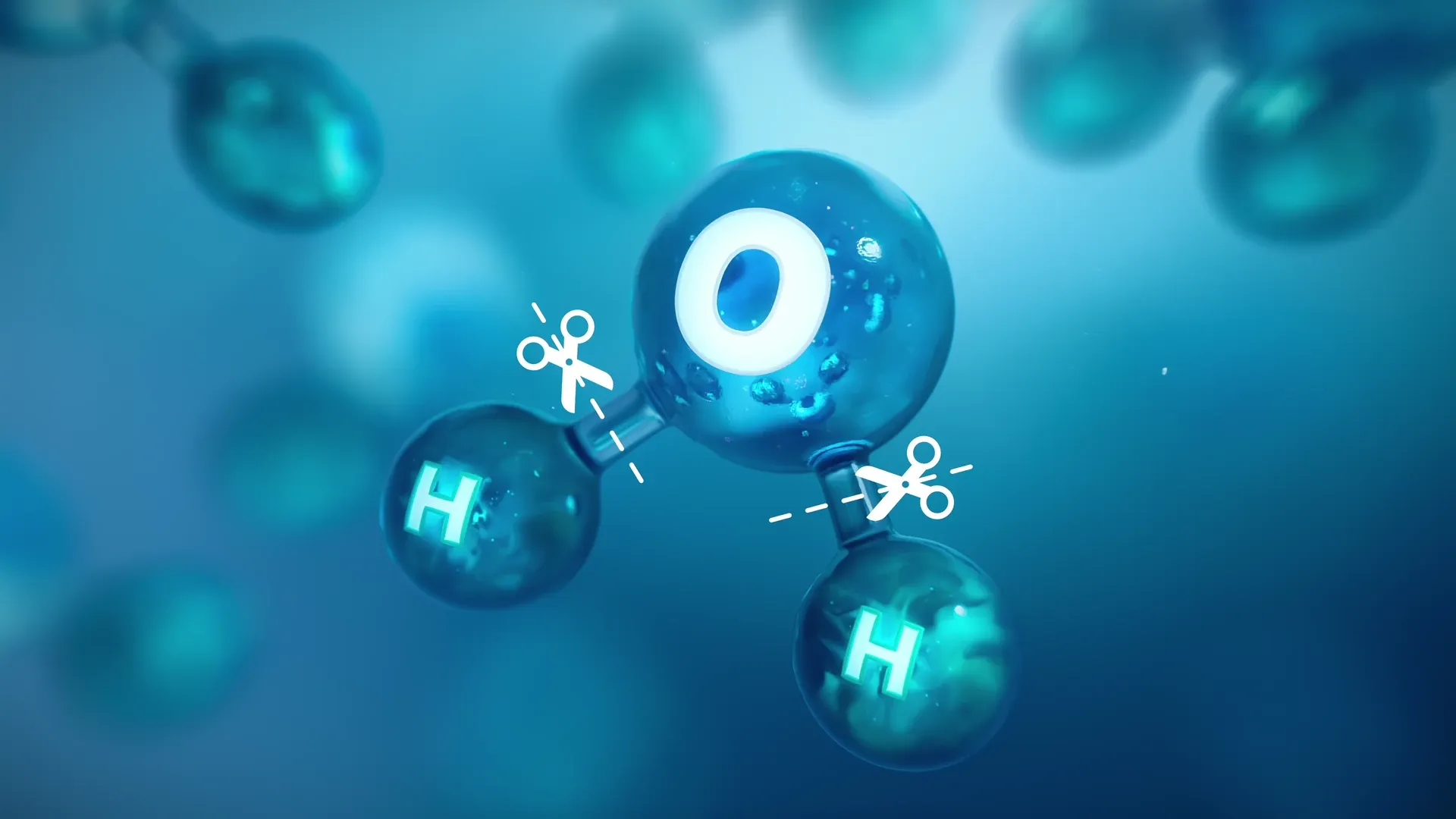
Imagine a big tank of water, or H2O. In order to get the hydrogen, you first need to break its bonds with oxygen. To achieve that, you use electricity to break apart the bonds in the water molecules, producing precious hydrogen gas. Simple!
All of this can be powered by renewable energy like solar and wind with close to zero emissions [41-45].
This green hydrogen has the potential to reshape the world [21,28,43,44,45]. Industries like petrochemical production and steelmaking [44-47], which account for around 3.6% and 7.2% of global emissions [48], are beginning to be cleaned up by using green hydrogen instead of fossil fuels. Some countries are investing in it to decarbonize the production of ammonia, a compound used in fertilizers, which would cut a further 1-2% of global emissions [44-46,49-53].
Experts are investigating its use in the transportation system too. Cars are a low priority due to the proficiency of electric vehicles, but long-distance trucks, international shipping, and long-range aircraft have a higher priority. Since they can't use heavy batteries for power, green hydrogen is an ideal alternative [21,28,44,45,54].
In theory (and as long as it’s made sustainably), the only direct emission from using hydrogen fuel is water. In fact, this water is even used on NASA's space shuttles, where astronauts actually drink it! [55,56]
So what’s the catch?
Well, if you simply burn hydrogen, it can also cause nitrogen in the air to react and produce nitrogen oxides, which are harmful air pollutants [57-61].
This is still cleaner than burning fossil fuels, but the cleanest option is to avoid burning it at all and use a hydrogen fuel cell, which directly converts hydrogen’s chemical energy into electricity [62-65]. Not only is this more efficient, but it produces zero nitrogen oxide emissions and of course zero CO2! [57-59,63-65]
Sounds good, right? So why is less than 1% of the hydrogen produced today green? [23,24,28] Why isn't everyone jumping on this eco-friendly version?
At the moment, hydrogen is expensive and requires a lot of electricity to produce [66-69]. If you wanted to power your phone with green hydrogen instead of directly charging it with renewable energy, you would first need to convert electricity from renewable sources into hydrogen and then use a fuel cell to convert it back into electricity. Doing this could lose up to 70% of the energy you would have received if you’d directly charged your phone with solar panels in the first place! [70,71,72]
Looks like green hydrogen doesn't give you a lot of bang for your buck. So why should people use it to power their homes and cities?
The answer lies in one of hydrogen’s most powerful properties… Its ability to store large amounts of energy for future use.
Since wind turbines need wind and solar panels need sunlight, gas and coal often have to step in on dark and windless days to keep electricity up and running. But here's a greener idea:
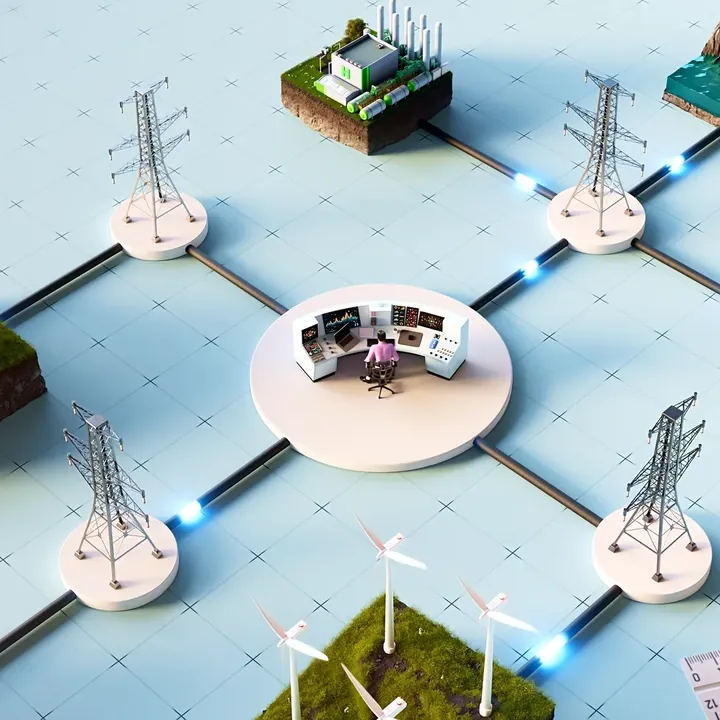
You power homes with renewable energy through a flexible smart grid, and build enough wind and solar farms to generate an energy surplus. Excess power can then be funneled to green hydrogen plants where it is used to make hydrogen. This hydrogen can then be stored and used to generate electricity when solar and wind can’t meet demand [73-76].
And if that wasn’t enough, hydrogen can be stored in vast quantities underground for long periods of time in old mines, salt caverns or even depleted oil and gas reservoirs [77-80]. This means it can be used year-round, even in the cold winter months.
This is called interseasonal storage and many countries are already investing in it [23,81,82,83]. One day, it could even help eliminate dependence on fossil fuels. Better yet, these huge hydrogen supplies give countries more energy independence, making them less reliant on energy imports so they won’t need to rely on other countries to keep the lights on [84,85,86].
But couldn’t batteries do the same thing?
Not quite. The amount of batteries required to store weeks or months of reserve energy for a city would be way, way more expensive [87-90]. Hydrogen, on the other hand, can be very cheap to store at scale and could solve this energy storage problem [91,92].
So could hydrogen play a role in decarbonizing the planet? Well, only if it is green hydrogen made from renewables [93], and only if the cost is realistic [66-69]. To make that happen requires expanding and updating infrastructure, and deploying renewable energy at scale.
But there’s good news! Wind and solar power are now cheaper than fossil fuels [27,94-97]. And thanks to recent technological advancements in electrolyzers, the price of green hydrogen production is also rapidly decreasing [98-102].
So provided humanity supports this emerging technology, green hydrogen could be one of the shining stars we've been waiting for.
Expert Advisors
4
We would like to thank
Dr. Jennifer Johnstone-Hack
University of Sheffield
School of Chemical, Materials and Biological Engineering
Dr. Adrien Chauvet
University of Sheffield
School of Mathematical and Physical Sciences, Energy Institute
Huazhang Tian
University of Sheffield
Advanced Resource Efficiency Centre
Colin Nolden
University of Sheffield
Energy Institute
Further Videos
20 links
These resources are non-affiliated.
Overview & Production
 Hydrogen: fuel of the future?The Economist
 The truth about hydrogenDW Planet A
 How Green Hydrogen Could End The Fossil Fuel EraTED
 Can hydrogen help the world reach net zero?Financial Times
 What Is Green Hydrogen And Will It Power The Future?CNBC
 The Truth About Hydrogen's Dirty Problem - Green Hydrogen ExplainedUndecided with Matt Ferrell
 How Cheap Hydrogen Could Become the Next Clean FuelBloomberg Originals
 Blue Hydrogen. The greatest fossil fuel scam in history?Just Have A Think
Hydrogen in Industry

Hydrogen-Powered Transport


Energy Storage
White Hydrogen (Natural Deposits)

Further Reading
28 links
These resources are non-affiliated.
Overview & Production
- What is hydrogen? - National Grid
- The hydrogen colour spectrum - National Grid
- Hydrogen Fuel Basics - US Department of Energy
- Hydrogen production - US Energy Information Administration (EIA)
- Use of hydrogen - US Energy Information Administration (EIA)
- Grey, blue, green – the many colours of hydrogen explained - World Economic Forum
- Hydrogen - MIT Climate Portal
Green Hydrogen
- Hydrogen Production: Electrolysis - US Department of Energy
- Electrolysis for Green Hydrogen Production - Linde
- Green Hydrogen - Stegra
- How clean is green hydrogen? - MIT Climate Portal
Hydrogen in Industry — Green Ammonia
Hydrogen in Industry — Green Steel
Hydrogen Fuel Combustion vs Fuel Cells
- Hydrogen internal combustion engines and hydrogen fuel cells - Cummins Inc.
- Fuel Cells - US Department of Energy (see also Fuel Cells Fact Sheet)
Hydrogen-Powered Transport
- Hydrogen in Transportation - US Environmental Protection Agency (EPA)
Hydrogen Energy Storage
Hydrogen Energy Storage — Infrastructure & Impacts
In-Depth Insights & Reports
White Hydrogen (Natural Deposits)
- Natural hydrogen: The untapped solution to decarbonisation? - Oxford University
References
111 links
- [1] Periodic Table of Elements | Los Alamos National Laboratory
- [2] First there was hydrogen | Nature Chemistry
- [3] Facts about hydrogen | Norwegian Hydrogen
- [4] Hydrogen - Element information, properties and uses | Royal Society of Chemistry
- [5] The Double Helix | Chemistry LibreTexts
- [6] Genetics | University of Houston
- [7] The discovery of hydrogen bonds in DNA and a re-evaluation of the 1948 Creeth two-chain model for its structure | Biochemical Society Transactions
- [8] Use of hydrogen | US Energy Information Administration (EIA)
- [9] Rocket Laboratory - Laying the Hydrogen Foundation | NASA
- [10] Will hydrogen power the future of aerospace? | WHA-International
- [11] The Search for Natural Hydrogen: A Hidden Energy Giant or an Elusive Dream? | ACS Energy Letters
- [12] Natural hydrogen resource accumulation in the continental crust | Nature Reviews Earth & Environment (Press: Scientists define the ingredients for finding natural clean hydrogen | University of Oxford; Pockets of naturally occurring hydrogen in Earth’s crust could be important source of clean energy | Renewable Energy Magazine)
- [13] Natural hydrogen - the untapped solution to decarbonisation? | Oxford Academic
- [14] Frontiers | Potential for natural hydrogen in Quebec (Canada): a first review | Frontiers in Geochemistry
- [15] Model predictions of global geologic hydrogen resources | Science Advances
- [16] Underground hydrogen discovery in France raises hopes for clean energy | Hydrogen power | The Guardian
- [17] Occurrences and Perspectives of Natural Hydrogen Extraction: The Brazilian Context | Energies
- [18] The economics and the environmental benignity of different colors of hydrogen | International Journal of Hydrogen Energy
- [19] The Colors of Hydrogen | The Belfer Center for Science and International Affairs
- [20] Hydrogen production methods and its colours | CIC energiGUNE
- [21] Policies for green hydrogen | IRENA (Green hydrogen: A guide to policy making | IRENA)
- [22] Hydrogen Resources | US Department of Energy
- [23] Global Hydrogen Review 2024 | IEA
- [24] Hydrogen | IRENA
- [25] Will blue hydrogen lock us into fossil fuels forever?: One Earth (In: Is heating homes with hydrogen all but a pipe dream? An evidence review | Joule)
- [26] Towards hydrogen definitions based on their emissions intensity – Analysis | IEA
- [27] Developments in the global hydrogen market: The spectrum of hydrogen colours | Fuel Cells Bulletin
- [28] The Future of Hydrogen | IEA
- [29] GHG emissions of all world countries | EDGAR - The Emissions Database for Global Atmospheric Research
- [30] Carbon Capture Utilisation and Storage - Energy System | IEA
- [31] 20 years of carbon capture and storage – Analysis | IEA
- [32] Carbon Dioxide Capture and Storage | IPCC
- [33] Blue Hydrogen | Global CCS Institute
- [34] Blue hydrogen can be a source of green energy in the period of decarbonization | International Journal of Hydrogen Energy
- [35] How green is blue hydrogen? | Resource Sustainability and Energy Resilience
- [36] Risk of the hydrogen economy for atmospheric methane | Nature Communications (see Reference Notes*)
- [37] Blue Hydrogen: Not Clean, Not Low Carbon, Not a Solution | IEEFA (see Reference Notes*)
- [38] Chapter 7: The Earth’s Energy Budget, Climate Feedbacks and Climate Sensitivity | IPCC
- [39] Methane and climate change – Methane Tracker 2021 – Analysis | IEA
- [40] Methane emissions | Energy, Climate Change, Environment | European Commission
- [41] An overview of water electrolysis technologies for green hydrogen production | Energy Reports
- [42] A brief overview of solar and wind-based green hydrogen production systems: Trends and standardization | International Journal of Hydrogen Energy
- [43] Hydrogen Production: Electrolysis | US Department of Energy
- [44] Green Hydrogen Standard | Green Hydrogen Organisation (GH2)
- [45] Global Energy Perspective 2023: Hydrogen outlook | McKinsey
- [46] The potential of hydrogen for the chemical industry | Deloitte
- [47] Global green hydrogen-based steel opportunities surrounding high quality renewable energy and iron ore deposits | Nature Communications
- [48] Sector by sector: where do global greenhouse gas emissions come from? | Our World in Data (Using data from: Greenhouse Gas (GHG) Emissions | Climate Watch)
- [49] Ammonia: zero-carbon fertiliser, fuel and energy store | The Royal Society
- [50] The role of hydrogen and ammonia in meeting the net zero challenge | The Royal Society
- [51] Reducing GHG emissions with green ammonia and fertilizer | McKinsey
- [52] Industrial ammonia production emits more CO2 than any other chemical-making reaction. Chemists want to change that | C&EN
- [53] Life cycle energy use and greenhouse gas emissions of ammonia production from renewable resources and industrial by-products | Green Chemistry
- [54] Unlocking hydrogen’s power for long-haul freight transport | McKinsey
- [55] Fuel Cells for Space Science Applications | NASA
- [56] Fuel Cell, Apollo | National Air and Space Museum
- [57] Hydrogen internal combustion engines and hydrogen fuel cells | Cummins Inc.
- [58] Alternative Fuels Data Center: Hydrogen Basics | US Department of Energy
- [59] Does the use of hydrogen produce air pollutants such as nitrogen oxides? | US Department of Energy
- [60] Investigations on performance and emission characteristics of an industrial low swirl burner while burning natural gas, methane, hydrogen-enriched natural gas and hydrogen as fuels | International Journal of Hydrogen Energy
- [61] NOx Emissions from Hydrogen-Methane Fuel Blends | GT Strategic Energy Institute
- [62] What are the Pros and Cons of Hydrogen Fuel Cells? | TWI (see also What is a Hydrogen Fuel Cell and How Does it Work? | TWI)
- [63] Fuel Cells Fact Sheet | US Department of Energy (Fuel Cells | US Department of Energy)
- [64] Hydrogen & Fuel Cells: Science Behind Fuel Cells | SEPUP
- [65] Hydrogen Fuel Cell vs Hydrogen Combustion Vehicles: What's the difference? | sopp + sopp
- [66] Energy from green hydrogen will be expensive, even in 2050 | CRU Group
- [67] Green Hydrogen: A Multibillion-Dollar Energy Boondoggle | Manhattan Institute
- [68] The cost of Green Hydrogen: What needs to happen for it to be competitive | ET EnergyWorld
- [69] Making the breakthrough: Green hydrogen policies and technology costs | IRENA
- [70] Green hydrogen | EECA
- [71] The Reality Behind Green Hydrogen's Soaring Hype | Greentech Media (archived)
- [72] Five Reasons to Be Concerned About Green Hydrogen | Clean Energy Group
- [73] Intermittent renewable energy: The only future source of hydrogen? | International Journal of Hydrogen Energy
- [74] Hydrogen Energy Storage: A New Solution To the Renewable Energy Intermittency Problem | Renewable Energy World
- [75] Large-scale electricity storage | The Royal Society (see Reference Notes*)
- [76] Hydrogen Storage: Delivering on the UK’s Energy Needs | Hydrogen UK (see Reference Notes*)
- [77] Salt caverns: the key to storing hydrogen? | Polytechnique Insights (see Reference Notes*)
- [78] Potential Application of RES and Underground H2 Storage in Abandoned Mines | Materials Proceedings (see Reference Notes*)
- [79] A review of underground hydrogen storage in depleted gas reservoirs: Insights into various rock-fluid interaction mechanisms and their impact on the process integrity | Fuel (see Reference Notes*)
- [80] Hydrogen storage | Statera Energy (see Reference Notes*)
- [81] Long-term hydrogen storage | IRENA (see Reference Notes*)
- [82] Interseasonal storage: a facilitator for net zero | Regen (see Reference Notes*)
- [83] Advanced Clean Energy Storage | US Department of Energy (see Reference Notes*)
- [84] Green hydrogen and an evolving concept of energy security: Challenges and comparisons | Renewable Energy (see Reference Notes*)
- [85] Comment: Hydrogen can help boost energy security | The Engineer
- [86] Case Study – Storing Green Hydrogen to Safeguard Energy Security | RMI
- [87] The Future of Energy Storage: Hydrogen VS Lithium | SENZA
- [88] Evaluating Hydrogen’s Role in Energy Storage Solutions | EE Times
- [89] The $2.5 trillion reason we can’t rely on batteries to clean up the grid | MIT Technology Review
- [90] Moving Beyond 4-Hour Li-Ion Batteries: Challenges and Opportunities for Long(er)-Duration Energy Storage | NLR (NREL)
- [91] Dynamic modeling of compressed gas energy storage to complement renewable wind power intermittency | International Journal of Hydrogen Energy
- [92] Capacity assessment and cost analysis of geologic storage of hydrogen: A case study in Intermountain-West Region USA | International Journal of Hydrogen Energy
- [93] Over the rainbow: why understanding full value chain carbon intensity is trumping the colour of hydrogen | Wood Mackenzie
- [94] Solar is now ‘cheapest electricity in history’, confirms IEA | CarbonBrief (Press release of World Energy Outlook 2020 | IEA)
- [95] Lazard LCOE+ (June 2025)
- [96] Empirically grounded technology forecasts and the energy transition | Joule
- [97] Renewables Competitiveness Accelerates, Despite Cost Inflation | IRENA (Press release of Renewable power generation costs in 2022 | IRENA)
- [98] Green Hydrogen Cost Reduction | IRENA
- [99] Analysing the future cost of green hydrogen | PwC
- [100] Green Hydrogen to Undercut Gray Sibling by End of Decade | BloombergNEF
- [101] Experts explain why green hydrogen costs have fallen and will keep falling | S&P Global Market Intelligence
- [102] True Cost of Solar Hydrogen | Levelised Cost of Hydrogen in Europe 2021-2050 | Bozen-Bolzano Institutional Archive (see Reference Notes*)
Reference Notes
4
Indirect impacts of hydrogen gas emissions on the atmosphere
Fugitive hydrogen gas emissions occur when hydrogen escapes unintentionally into the atmosphere during production, storage, transport, or use. This can happen due to leaks in pipelines, valves, storage tanks, or during industrial processes. Hydrogen is a very small, light molecule, making it particularly prone to escaping through even tiny imperfections in containment systems.
Once in the atmosphere, hydrogen gas indirectly impacts climate change by altering the balance of greenhouse gases. A key mechanism is its interaction with hydroxyl radicals (OH), which are critical for atmospheric reactions and mechanisms. Hydrogen reacts with OH, reducing its availability. Since OH is responsible for breaking down methane (CH4), a potent greenhouse gas, its depletion extends the atmospheric lifetime of methane, increasing its enhanced warming effect. As production methods of hydrogen - such as SMR used to create blue hydrogen - can also contribute to the leakage of methane, this exacerbates the issue.
In addition to affecting methane, hydrogen also influences the formation of tropospheric ozone, a secondary greenhouse gas. Hydrogen contributes to ozone production by participating in chemical reactions in the presence of nitrogen oxides (NOₓ). These reactions typically occur in the lower atmosphere, where sunlight drives a complex chain of photochemical processes. The excess ozone acts as a greenhouse gas, trapping heat and contributing to global warming. However, ozone is also a pollutant harmful to human health and ecosystems.
Thus, fugitive hydrogen emissions, though not a direct greenhouse gas themselves, indirectly exacerbate climate change through their impacts on methane and ozone dynamics. Both these gases also have a far greater global warming potential than carbon dioxide (CO2).
Additional References:
- A multi-model assessment of the Global Warming Potential of hydrogen | Nature Communications
- Hydroxyl Radical (OH) Response to Meteorological Forcing and Implication for the Methane Budget | Geophysical Research Letters
- Enhanced atmospheric oxidation toward carbon neutrality reduces methane’s climate forcing | Nature Communications
Nitrous Oxides from Burning Hydrogen
CORRECTION: The video uses “nitrous oxide, a powerful greenhouse gas” but the intended term is nitrogen oxides (NOx). These include nitric oxide and nitrogen dioxide, which can form when nitrogen and oxygen in the air react at the high temperatures created by hydrogen combustion. They are harmful air pollutants that contribute to poor air quality and ground-level ozone, but they are not themselves greenhouse gases.
Nitrous oxide (N₂O) is a different compound and a powerful greenhouse gas. It is not the principal pollutant associated with hydrogen combustion, although very small quantities have been detected under particular conditions. One study of a 100% hydrogen boiler detected N₂O principally during high-fire operation A. Fuel cells avoid combustion and therefore do not produce combustion-related NOx at the point of use [57-61,63-65].
Use of green hydrogen in a smart grid alongside other renewable energy sources
When renewable energy generation, such as from wind or solar, exceeds grid demand or capacity, this forces some of the potential electricity output to go unused. Limiting this production of renewable electricity is known as ‘curtailment’, with curtailed electricity often getting wasted. In a smart grid setup, this surplus electricity can be dynamically redirected to power electrolysis systems, which produce green hydrogen. The smart grid ensures optimal use of renewable energy by monitoring generation and demand in real-time, automatically allocating curtailed power to electrolysis units instead of wasting it. Once produced, the green hydrogen can be stored in pressurized tanks, underground salt caverns, or other long-term storage solutions. When grid demand spikes or renewable output drops (e.g., during low wind or nighttime), the stored hydrogen can be converted back to electricity via fuel cells or turbines. This integration not only maximizes the utility of renewable generation but also provides a stable, dispatchable energy source to balance the grid over extended periods.
Further references:
- Using excess energy to split water could help make hydrogen a key player in the clean energy future | Idaho National Laboratory
- The potential for hydrogen to reduce curtailment of renewable energy in Scotland | climatexchange
- Hydrogen Production from Excess Renewables | Energy & Natural Resources Blog | Holland & Knight
Projected electrolyzer cost graph
The graph shown is a projection of hydrogen electrolyzer capital expenditure (CAPEX) to 2050 in euros (€) per kilowatt (kW) of electrolyzer capacity, based on the graph in Figure 4 found in [102]. This graph projects electrolyzer system CAPEX with three different volume growth scenarios: “By 2050, the installed capacity is expected to be either 1 TWel, 5 TWel or 17 TWel. The first two are based on International Renewable Energy Agency (IRENA) scenarios [98] and the latter would be required for the 100% sustainable energy and industry system by 2050”. This vast growth in electrolyzer capacity is projected to be possible, with evidence that “most of the examined European regions have sufficiently high technical potentials to be self-reliant using renewable energy” B. The line on the graph shown is based on the results of the projected base scenario (5 TWel), showing that it is not only possible that the price of green hydrogen production will decrease, but that it is expected to.